
4 Minutes
A thin, flexible cap could change how we think about hair loss. Short, powerful idea. Scientists in South Korea have tuned light wavelengths to hit a key cell type that drives hair growth, and the early results are striking.
Targeting the heart of the follicle
The technology centers on human dermal papilla cells, or hDPCs—the specialized cells at the base of each hair follicle that orchestrate growth cycles. As follicles age, these cells show biochemical signs of decline, most notably the expression of β-galactosidase, a long-standing biomarker of cellular aging. Reduce that enzyme, and you may blunt the cascade that leads to thinning and permanent follicle shrinkage.
Researchers at the Korea Advanced Institute of Science & Technology (KAIST), with funding from City University of Hong Kong, crafted an organic light-emitting diode (OLED) platform that emits near-infrared light tuned to roughly 730–740 nm. That narrow window matters: the team reports that it more effectively activates dermal papilla cells than ordinary red-light systems used in many current low-level light therapy devices.
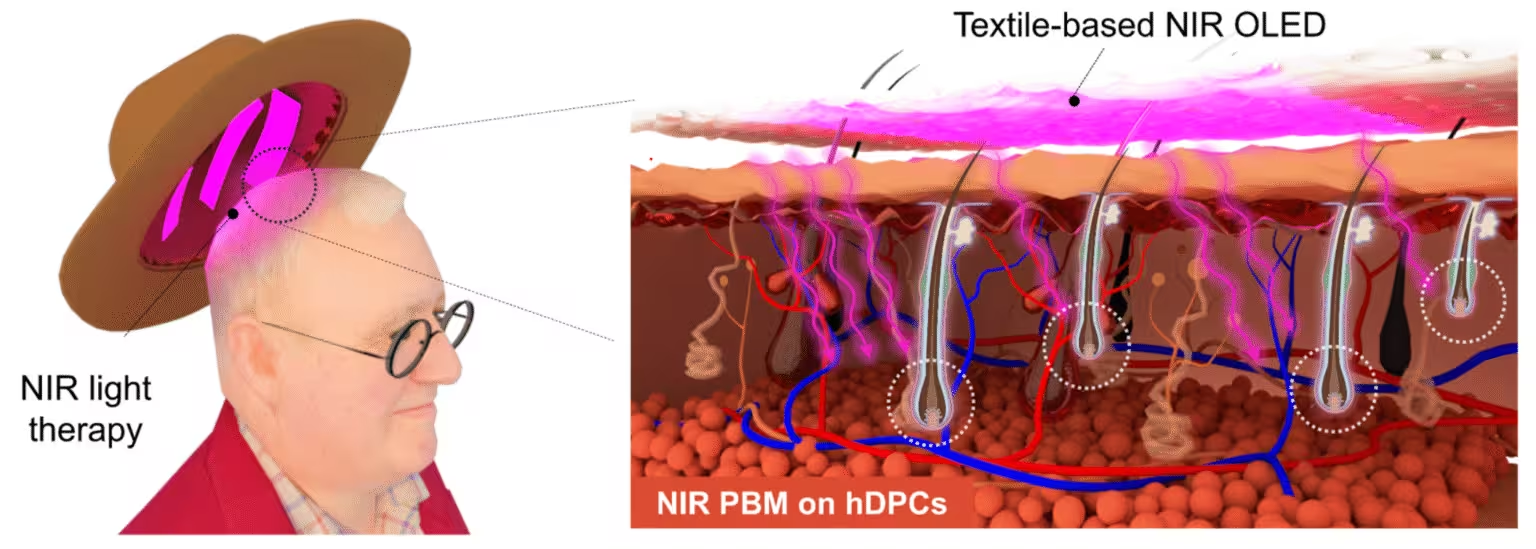
An illustration of the light therapy and its effects on cells at the base of hair follicles.
From rigid helmets to wearable caps
Most consumer phototherapy devices are rigid—bulky helmets or arrays of LEDs and lasers that sit a short distance from the scalp. The new approach swaps hard plastics and point-source diodes for thin, conformable OLED sheets that can be integrated into a washable cap. The result: diffuse, uniform illumination that hugs the skull. "Because OLEDs are thin and flexible, they can closely conform to the curved surface of the scalp, delivering uniform light stimulation across the entire area," explains electrical engineer Kyung Cheol Choi from KAIST.
Diffuse light matters because it reduces the hot spots common with concentrated LEDs and lasers, producing a more even stimulation across a patch of scalp. In their lab work, the KAIST team compared customized near-infrared OLED exposure to red OLED treatment and to untreated controls. The cells treated with the optimized near-infrared signal showed a roughly 92 percent reduction in β-galactosidase expression relative to untreated cells—an effect size well beyond what standard red-light devices typically produce.
That percentage is not a clinical hair-regrowth guarantee. But it does indicate the method can substantially suppress molecular signs of follicle aging in vitro, which is exactly what a medical device would need to influence the hair cycle for people suffering from androgenetic alopecia, the hereditary patterned hair loss that affects up to 40 percent of people in some populations.
Why this could matter to patients
There are only a handful of widely used treatments today. Topical minoxidil helps some users but is not universally effective and requires ongoing use. Oral finasteride can slow or reverse hair loss in men but carries well-documented side effects and is not approved for women in many places. That gap has driven interest in non-drug options. Low-level light therapy has been adopted by many as a less invasive path, but current devices vary in efficacy.
An OLED cap could offer a middle road: a non-pharmacological, wearable treatment designed for daily use and public wearability. KAIST researchers say their next goals include making a fully washable prototype and moving through preclinical safety and efficacy testing ahead of human trials. If the lab effect translates, people might have a treatment that combines convenience with a different biological mechanism—one that directly modulates the aging signature of cells that grow hair.
Related technologies and future prospects
Near-infrared photobiomodulation is not a brand-new idea; clinicians have explored a range of wavelengths for tissue repair, inflammation control, and stimulation of cellular metabolism. What sets the KAIST work apart is the combination of wavelength tuning, OLED form factor, and cell-level readouts tied to a recognized aging biomarker. The team published the work in Nature Communications in 2026, which adds weight to the experimental design and peer review.
Practical challenges remain. Delivering consistent dose through hair, ensuring long-term safety of repeated near-infrared exposure, and proving meaningful hair-count gains in randomized clinical trials are nontrivial hurdles. Still, the platform's modular design could allow iterative improvements: different wavelength stacks, targeted dosing schedules, and integration with wearables for compliance tracking.
Expert Insight
"A precise, conformal light source changes the game because biology responds to both wavelength and dose distribution," says Dr. Hannah Lee, a clinical photomedicine specialist. "If the 730–740 nm window reliably reduces senescence markers in vivo, clinicians will want to see how that translates to follicle cycling and patient outcomes—particularly in early-stage androgenetic alopecia."
For now, the most compelling finding is biochemical: a strong suppression of a marker tied to follicle aging. The road to an over-the-counter, clinically verified cap is still long, but this kind of targeted phototherapy shows a credible path away from bulky helmets and toward wearable, daily treatment that could be polite enough to wear in public and powerful enough to matter.











Leave a Comment
Comments (2)
hmm 730-740 nm specific? sounds too precise. how does the light get through thick hair to follicles tho? curious, skeptical.
wow an OLED cap that hugs your head? kinda wild. 92% drop in an aging marker sounds insane, but real hair regrowth is messy, hope trials show it