

4 Minutes
Tiny particles in the air may be doing more than making you cough. New epidemiological evidence suggests long-term exposure to PM2.5—particles smaller than 2.5 micrometers—correlates with a measurable rise in Alzheimer's diagnoses among older adults. The result reframes air pollution as a direct threat to the aging brain, not merely an indirect driver through other illnesses.
The study, led by researchers at Emory University and published in PLOS Medicine in 2026, analyzed health records spanning 18 years for more than 27.8 million Americans aged 65 and older. Instead of relying on individual air monitors, the team estimated PM2.5 exposure by ZIP code and matched those environmental data against diagnostic records. The sheer scale of the dataset allowed the investigators to tease apart whether particle pollution raises dementia risk on its own, or only because it increases other conditions that then raise dementia risk.
Direct links, not just collateral damage
What stands out is the persistence of the association after adjusting for common comorbidities. In plain terms: yes, air pollution worsens heart disease and depression, and those conditions can contribute to dementia. But in this work PM2.5 exposure remained associated with higher Alzheimer's risk even when accounting for those pathways. That suggests particulate matter may act directly on brain health.
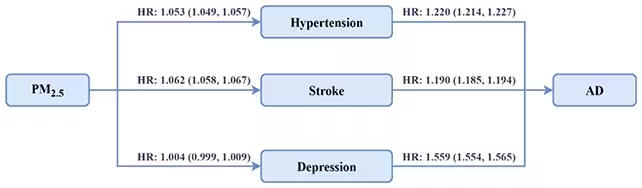
How might that happen? The authors present biologically plausible mechanisms. Fine particles can provoke systemic inflammation, which increases neuroinflammation. They may also penetrate or disrupt the blood–brain barrier when cerebrovascular integrity is compromised, especially after a stroke. There is evidence that these processes accelerate the accumulation of protein aggregates linked to Alzheimer's, such as amyloid beta and tau, or otherwise speed neuronal loss.
The team noted an interaction with stroke history: people who had experienced stroke showed a slightly amplified risk of later Alzheimer's following PM2.5 exposure. The implied mechanism is straightforward and worrying. Stroke-related damage can weaken neurovascular defenses, opening a door for circulating inflammatory mediators or even particle components to influence brain tissue more directly.
Strengths, limits, and why this matters

Large scale. Long follow-up. That gives weight to the findings. Yet the study is observational, and association is not proof of causation. Exposure was inferred from ZIP-code level environmental models, which capture outdoor air but miss individual indoor exposures and work-related pollution. Measurement error in exposure estimates tends to bias results toward the null, however, so the observed relationship could understate the true effect.
Another caveat: diagnosis patterns change over time and across regions. The investigators adjusted for many potential confounders, but no observational study can account for every variable. Still, the clear signal across millions of records is meaningful: multiple analyses now converge on the idea that PM2.5 is a risk factor for neurodegenerative disease.
From a public-health perspective the implications are immediate. Air quality is modifiable. Reducing fine particulate emissions—through cleaner transport, regulated industrial emissions, and better residential heating—could reduce the population burden of dementia decades from now. Design of healthy neighborhoods, with attention to pollution sources, also matters; older adults spend more time locally and are more vulnerable to environmental insults.
Expert Insight
Dr. Elena Ruiz, an epidemiologist who studies environmental drivers of chronic disease, says the study adds an urgent layer to policy debates. "This is not just a respiratory or cardiovascular issue anymore. We need to treat air quality as part of brain health strategy. Policies that drop PM2.5 levels will pay dividends for cognitive health as the population ages." Her point cuts to the policy core: cleaner air yields wide-ranging, long-term benefits.
Laboratory and clinical work will be needed to clarify mechanisms: which particle components are most neurotoxic, how much crosses into the brain, and whether anti-inflammatory or vascular-protective interventions can blunt the effect. Animal models and molecular studies may reveal whether PM2.5 accelerates classic Alzheimer's pathology or promotes parallel injury pathways that converge on similar clinical decline.
Until then, this research strengthens the rationale for integrating air quality into dementia prevention strategies. Individual actions—like using air purifiers and avoiding heavy-traffic routes—help, but systemic solutions are vital. If tiny particles can shift the odds toward dementia across whole communities, then emissions controls, urban planning, and public-health surveillance are part of the cognitive-health toolkit.
We still do not fully understand Alzheimer's causes; it is rarely a single-factor disease. But every study that illuminates modifiable risks refines where to invest prevention efforts. Cleaner air may prove to be one of the most cost-effective investments in preserving cognition at population scale.













Leave a Comment
Comments (2)
Is this even causal? ZIP-code exposure estimates seem crude, indoor pollution differs a lot. Still, if true it's a huge public health problem 🤔
Whoa this is terrifying. Tiny particles upping Alzheimer risk? Ugh, we need cleaner air now... people near highways, retirees suffer