

4 Minutes
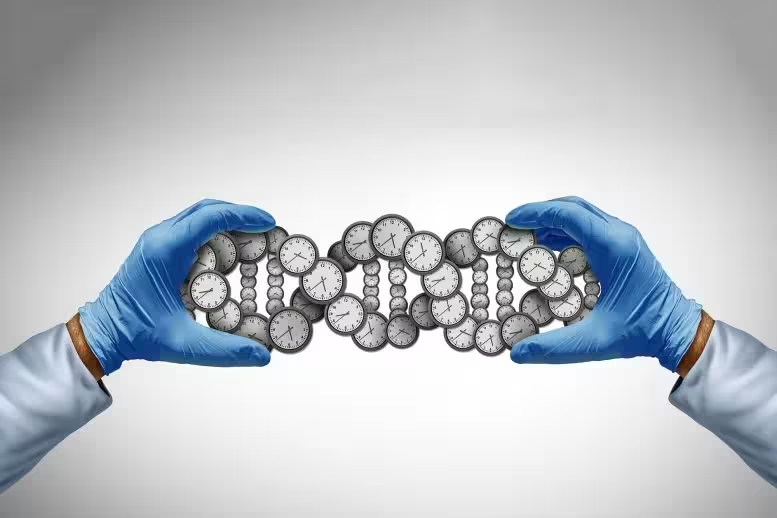
Researchers at the University of Michigan found that a single gene in tiny roundworms acts like a flip switch between lifespan extension and normal aging. Their experiments show that simple sensory experiences—like the feeling of food—can shut down a longevity pathway previously linked to dietary restriction. Credit: Shutterstock
From worms to wider biology: why this matters
When scientists study aging, they often look for conserved mechanisms—biological rules that apply across species. Caenorhabditis elegans, a millimetre-long nematode, has been a workhorse for these discoveries because many metabolic and genetic pathways are shared with humans. Scott Leiser, Ph.D., and his team in the Molecular and Integrative Physiology Department at the University of Michigan used C. elegans to trace how environmental signals are translated into molecular decisions about lifespan.
Dietary restriction (eating less without malnutrition) is one of the most reproducible ways to extend lifespan in animals. But it’s hard to sustain in real life. The new work asks a crucial question: what exactly cancels the survival benefit of eating less? Is it only smell, or do other senses—like touch—play a role?
Touch, taste and the fmo-2 switch
Leiser’s team focused on a gene called fmo-2, first identified in 2015 as necessary and sufficient for dietary restriction–linked longevity in C. elegans. The fmo-2 enzyme remodels cellular metabolism in ways that promote survival under limited food. Without it, worms do not live longer when food is scarce.
To test sensory influence, researchers placed worms on surfaces dressed with tiny beads mimicking the tactile texture of their bacterial food (E. coli). The tactile stimulation alone was enough to reduce intestinal fmo-2 activity and blunt the lifespan benefits normally seen during dietary restriction. In short: feeling like you’re near food can turn off a gene that helps you live longer.
Tracing the circuit deeper, the team discovered that mechanosensory input activates neurons that release dopamine and tyramine. Those neurotransmitters then signal to the intestine, dialing down fmo-2 expression and removing the protective metabolic program linked to dietary restriction.
Behavioral trade-offs: longevity isn’t free
In a follow-up study published in Science Advances, the same group showed that manipulating fmo-2 alters behavior. Worms engineered to overproduce fmo-2 became less responsive to important environmental cues: they didn’t avoid harmful bacteria and they didn’t slow down feeding after a short fast. Conversely, worms lacking fmo-2 explored their surroundings less. The behavioral changes correlated with shifts in tryptophan metabolism, suggesting that turning on longevity pathways reshapes brain chemistry and decision-making.
“There are going to be side effects to any intervention to extend life—and we think one of the side effects will be behavioral,” Leiser said. He and colleagues propose that if researchers can pair lifespan-extending treatments with behavioral supports or supplements, some unwanted consequences could be mitigated.
What this could mean for humans
The immediate findings are in worms, but the principle is provocative: sensory perception influences metabolic programs that control aging. Humans also translate environmental cues into hormonal responses—adrenaline, dopamine and other neuromodulators. If similar circuits exist in mammals, it may be possible to pharmacologically or behaviorally mimic the beneficial effects of dietary restriction without imposing strict diets.
Leiser suggests a future where drugs or targeted interventions could “induce fmo-2 without taking away food,” effectively triggering a stress-response program that enhances healthspan. That said, he cautions, more work is needed to map all roles of fmo-2 (or its mammalian analogs) before safe therapies are possible.
Experiment details and scientific context
The experiments used genetic tools, neuronal mapping, and controlled tactile environments to isolate the role of touch from other cues such as smell. The study builds on earlier findings—like Scott Pletcher’s work in fruit flies showing that merely smelling food can eliminate the survival benefit of dietary restriction—by demonstrating that tactile cues alone can also override longevity mechanisms.
Technically, the pathway links mechanosensory neurons to monoaminergic signaling (dopamine/tyramine) and finally to intestinal gene regulation. That neuro-intestinal axis is an emerging area in aging research: the brain senses the environment and orchestrates whole-body metabolic responses, which in turn influence longevity.
Expert Insight
Dr. Maria Santos, a fictional aging researcher and science communicator, commented: “These studies elegantly show how behaviour and environment feed back into molecular ageing programs. It’s exciting because it adds a layer of control—sensory perception—that could be targeted. But it also reminds us that ageing interventions may change how organisms interact with their world, so balancing benefits and behavioral costs will be critical.”
Going forward, Leiser’s group plans to map additional sensory signals from the gut to the brain and to explore whether supplementing affected metabolic pathways can compensate for behavioral side effects. That research may point to multi-pronged therapies that nudge metabolism toward resilience without narrowing an organism’s ability to respond adaptively to its environment.












Leave a Comment
Comments (2)
Is this even true? feels like smell and touch could overlap, or maybe ppl are overinterpreting worm data, curious but kinda skeptical
Wow, didn't expect a tiny worm's touch to flip longevity genes, weirdly exciting! If that holds in mice… 🤯 hope they test behavior tradeoffs too