
3 Minutes
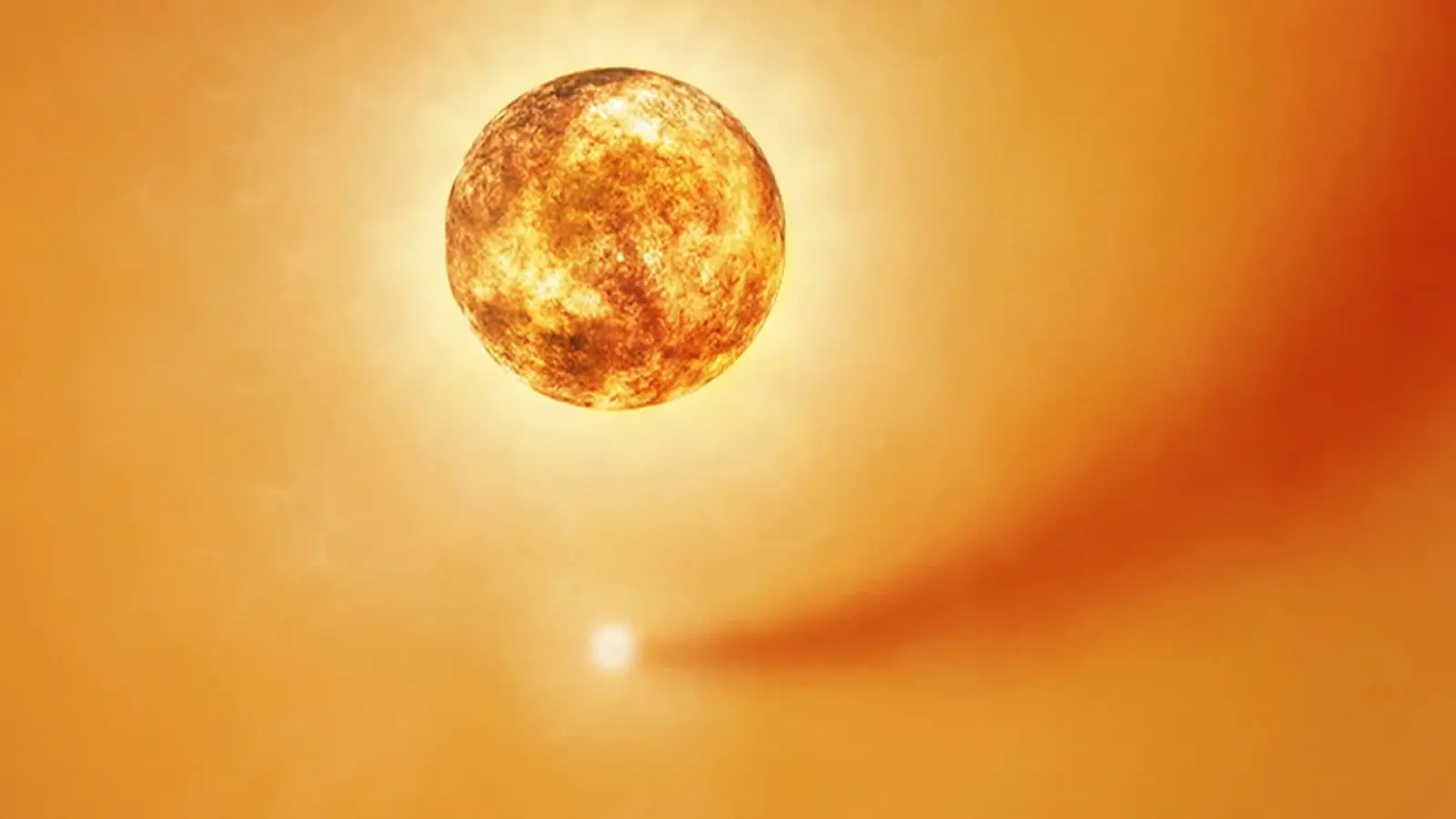
For decades astronomers have tracked Betelgeuse’s changing face: a red supergiant whose brightness and surface features drift with time. Interest peaked in 2020 when the star dimmed dramatically, prompting new scrutiny of the mechanisms—both internal and external—that shape its variability. Now, fresh observations reveal a tangible sign that something else is at work: a compact companion carving a wake inside Betelgeuse’s extended atmosphere.
A two-part heartbeat: pulsations and a long cycle
Betelgeuse’s variability has two well-established rhythms. The first is a roughly 400-day pulsation tied to the star’s internal oscillations—think of it as the star inhaling and exhaling. Sitting atop that is a much slower secondary cycle of about 2,100 days that has puzzled researchers. Proposed explanations have ranged from enormous convective cells and episodic dust clouds to magnetic activity or an unseen companion.
From theory to direct evidence: the discovery of a wake
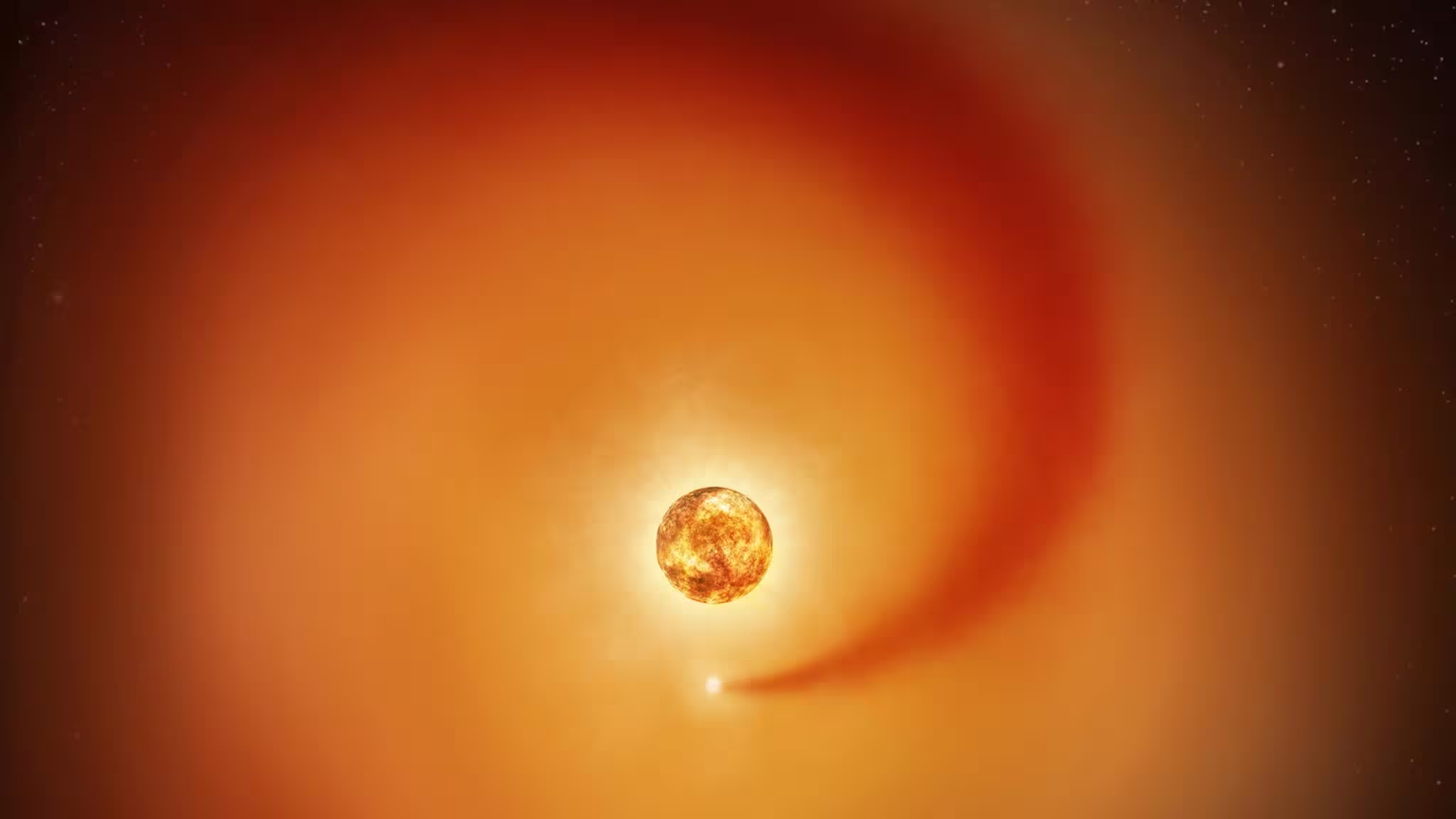
Recent high-resolution imaging and spectral measurements have produced what researchers describe as the first clear sign of interaction: a wake trailing inside Betelgeuse’s extended atmosphere, consistent with a low-mass companion plunging through the star’s outer layers. This wake behaves like the wake behind a boat, shedding material and disturbing the flow of gas. Unlike earlier suggestions based on indirect signals or models, this structure is direct evidence that a companion is actively shaping the supergiant’s envelope.
Why this matters for stellar evolution and supernova science
Finding a companion inside a red supergiant’s atmosphere changes how we think about mass loss, angular momentum transfer, and pre-supernova behavior. As the companion perturbs Betelgeuse’s envelope it can enhance mass shedding and create asymmetries that affect how the star will explode when it reaches the end of its life. "With this new direct evidence, Betelgeuse gives us a front-row seat to watch how a giant star changes over time," said one team scientist. The wake is a living laboratory for studying processes that may be common among other evolved massive stars.
What astronomers will do next
From Earth the companion is currently hidden behind Betelgeuse, but astronomers plan renewed observations when it reemerges—expected around 2027. Follow-up campaigns across multiple wavelengths (optical, infrared, and radio) will track how the wake evolves, test models of binary interaction, and look for similar signatures around other red supergiants. If confirmed across systems, this mechanism could help explain long-term cycles and sudden dimming events elsewhere.
Hubble’s continuing role
The Hubble Space Telescope delivered the observations that helped identify the wake. Hubble, a long-running joint mission of NASA and ESA, continues to provide high-resolution imaging and spectroscopy that ground-based facilities cannot easily match. NASA’s Goddard Space Flight Center and the Space Telescope Science Institute manage key mission operations and scientific programs, keeping Hubble at the forefront of discoveries about stellar life cycles.
As Betelgeuse reveals its hidden companion, astronomers gain a rare chance to witness how binary interactions transform a star as it marches toward its final act: a supernova. The next few years of monitoring could rewrite parts of the story for massive-star evolution.







Leave a Comment
Comments
No comments yet. Be the first.