

4 Minutes
Most of us assume the physical slide into frailty waits until our sixties. The data, however, tell a different, sharper story: many measures of fitness and strength start to drift downward in the mid-30s. The drop isn't catastrophic at first. It is steady. Then it accelerates.
That pattern emerges from one of the rare studies that follows the same people over decades rather than taking a snapshot of different age groups at a single moment. The Swedish Physical Activity and Fitness (SPAF) cohort has tracked several hundred individuals from adolescence into older age, collecting repeated tests of aerobic capacity, muscular endurance and power at five time points spanning nearly 50 years.
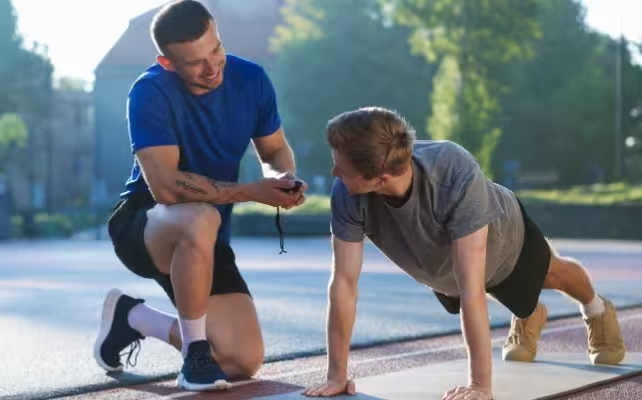
Even with continuous training, physical performance peaks around 30.
Study design and what the numbers mean
The strength of SPAF lies in its longitudinal design. Participants were first measured at 16, then again at ages 27, 34, 52 and 63. Because the same people returned for tests across decades, researchers can observe within-person change — a clearer signal for how aging affects the body than cross-sectional comparisons, which mix generations and lifestyles.
Across both men and women, estimated maximal aerobic capacity and muscular endurance typically reached their highest levels between roughly 26 and 36 years of age. After that, decline set in. Initially, the descent is modest — on the order of 0.3 to 0.6 percent per year. Later in life it steepens, with annual losses rising to as much as 2.5 percent. By the time participants reached their early 60s, overall performance had fallen 30 to 48 percent from each person’s peak.
Muscle power displayed a slightly different curve. Men tended to hit their peak near 27; women, surprisingly, peaked earlier — around 19. After those peaks, both sexes lost power at similar rates: a small yearly drop early on (0.2–0.5 percent) that accelerates to declines of 2 percent or more per year.
Those percentages may look technical, but they translate into everyday consequences: slower walking speed, reduced capacity to climb stairs, and a greater chance that routine tasks become more demanding. Underlying the numbers is the progressive decline in skeletal muscle mass and function — the hallmark of sarcopenia — which often only becomes clinically visible decades after it has begun.

Why activity still matters
The headline — that peak performance centers around the mid-30s — could be misread as fatalistic. It shouldn't be. The SPAF data show clearly that physical activity shapes the slope of decline. People who were active in their leisure time at age 16 maintained higher aerobic capacity, greater muscular endurance and better power across the decades. Those who increased their activity in adulthood improved their capacity by roughly 10 percent compared with peers who remained sedentary.
Put simply: you probably cannot stop the biological clock from nudging peak performance past its summit, but you can slow the slide. Regular exercise — especially activities that challenge both aerobic fitness and muscle power — preserves function and delays the point where mobility and independence become threatened.
The authors of the paper, published in the Journal of Cachexia, Sarcopenia and Muscle, emphasize public-health implications. Encouraging movement in adolescence and young adulthood helps build a higher peak, and promoting activity later in life still returns benefits. It’s a two-part strategy: lift the summit, and then reduce the gradient down.
Expert Insight
“Our findings show that physical activity cannot completely freeze the aging process,” says Maria Westerståhl, lead author and lecturer at the Karolinska Institute, reflecting on the results. “But being active early and maintaining activity into adulthood can meaningfully slow performance loss.”
Dr. Elena Mora, a fictional physiologist with two decades of clinical experience in geriatric rehabilitation, adds perspective: “Muscle is both tissue and habit. Building reserve in youth gives people options later. Even a 10 percent improvement in capacity can mean the difference between independent living and needing assistance years earlier.”
Researchers now want to understand mechanisms. Why does peak capacity cluster near 35? Why does activity blunt but not eliminate decline? Answers will require molecular studies of muscle aging, investigations into hormonal and metabolic shifts, and trials testing which training types best preserve function across decades.
Policy and practice can follow the evidence. Schools and communities that prioritize regular, varied physical activity — aerobic work, resistance training and explosive power exercises — help people accrue reserve. For adults who never established those early habits, starting later still pays dividends.

The human body has its timelines. But within those timelines, choices about movement make a measurable difference; how much difference matters is the next question scientists are racing to answer.












Leave a Comment
Comments (2)
Is this even true though? Longitudinal study cool, but few ppl, lots changed across decades, confounders maybe. Still useful, but cautious.
Wow, didn't expect the peak so early. Mid 30s? Yikes. Makes me wanna lift more, not just jog. Also, physiology nerd in me curious...