
4 Minutes
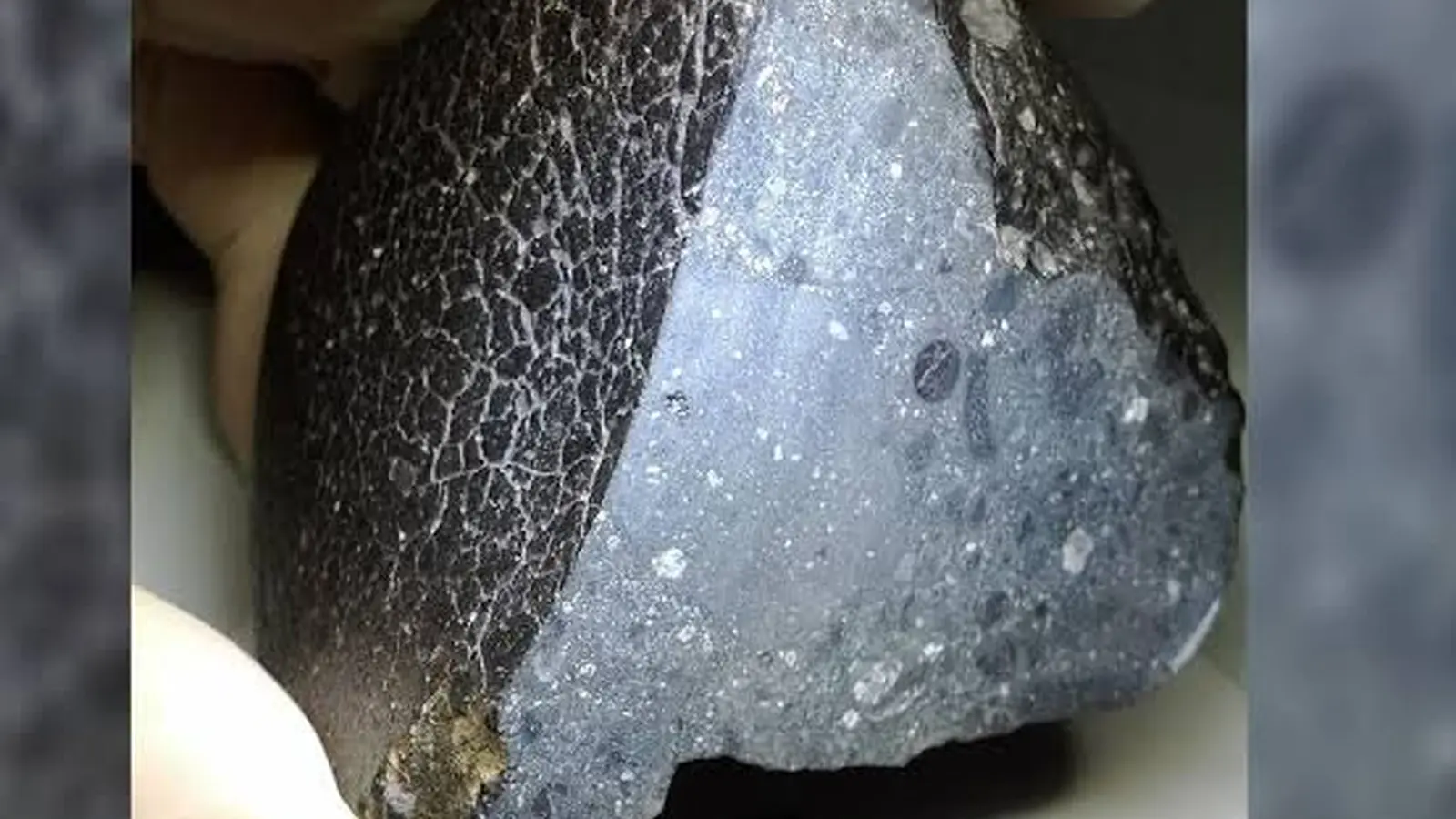
They call it Black Beauty. The name fits: a dark, fractured meteorite that has quietly carried a piece of Mars across the void to our planet. But when researchers trained modern computed tomography tools on a fingernail-sized slice of that same rock, the results were not merely pretty—they reframed part of Mars’ watery past.
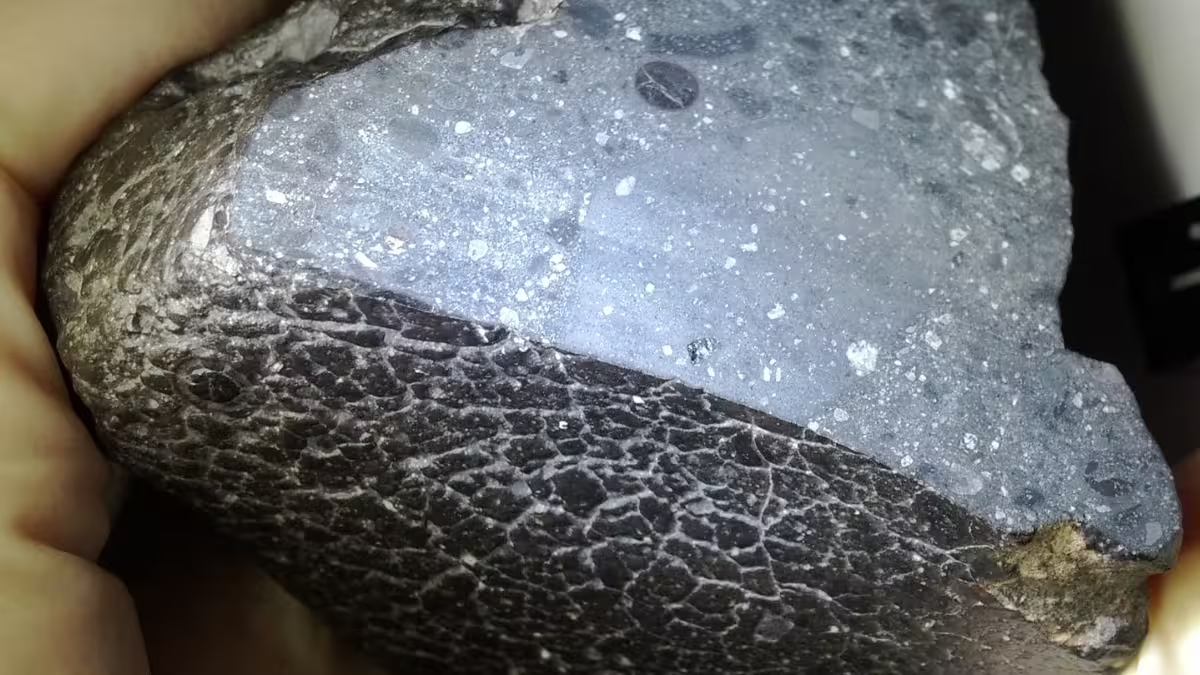
The meteorite NWA 7034, nicknamed Black Beauty.
Black Beauty — formally NWA 7034 — is one of the most prized Martian samples in terrestrial collections. Formed roughly 4.48 billion years ago and likely launched from Mars by a massive impact, it preserves a jumble of ancient fragments welded together. Scientists have long chipped away at it to learn its story, but destructive techniques consume irreplaceable material. So when non-destructive options improved, curiosity met opportunity.
How the scans were done and what they found
Researchers led by Estrid Naver at the Technical University of Denmark applied two complementary computed tomography methods to a polished fragment of Black Beauty. One was conventional X-ray CT, the kind of scanner familiar from medical clinics: fast, excellent at revealing dense metals like iron and titanium. The other was neutron CT, a less common but highly informative technique that uses neutrons to penetrate materials and is particularly sensitive to hydrogen.
Why neutrons? Because hydrogen hides in surprising places and, where hydrogen congregates, water—or minerals that formed in watery environments—often follow. The team’s scans revealed not just the expected rock fragments, known as clasts, but a previously underappreciated population of tiny hydrogen-rich iron oxyhydroxide clasts. The authors label these H-Fe-ox clasts. They occupied roughly 0.4% of the scanned volume, a sliver by space-rock standards, yet chemical calculations show these bits could contain as much as 11% of the sample’s total water content.
To put numbers on it: Black Beauty’s bulk water content is around 6,000 parts per million—remarkably high for material from a planet now known for its dryness. Detecting a concentrated reservoir of hydrogen-bearing minerals in a meteorite like this implies localized, perhaps repeated, hydration events on early Mars.
Why these tiny clasts matter

Small things, big implications. Finding hydrogen-rich oxyhydroxide in Black Beauty connects dots between disparate Martian records. Perseverance collected hydrated minerals at Jezero crater in a campaign on the planet’s surface; Black Beauty came from a different region entirely. Yet both point toward widespread liquid water operating on Mars billions of years ago.
There’s another practical angle. The techniques used are non-destructive and can peer through enclosing materials—meaning they could scan samples still sealed inside collection containers. That capability is attractive for future sample-return work: scientists can triage and prioritize samples remotely without opening them, preserving the most sensitive material for later study.
That promise is bittersweet. Plans for a coordinated Mars Sample Return campaign have run into funding and scheduling setbacks, and delays mean it could be many years before fresh Martian samples arrive on Earth in quantities suitable for this kind of analysis. A Chinese robotic sample-return mission remains on the horizon, and meanwhile terrestrial collections of Martian meteorites like Black Beauty provide the best laboratory for exercising these non-destructive tools.
Expert Insight
"Non-destructive imaging has matured faster than many expected," says Dr. Leila Moretti, a planetary geochemist not involved with the study. "The ability to map hydrogen distributions inside a meteorite without grinding it down changes how we prioritize samples. It’s like having X-ray vision for water—only more nuanced."
Dr. Moretti adds that the study demonstrates a practical workflow. "You scan. You identify interesting pockets. You plan targeted, minimal sampling. That approach preserves the greatest scientific value for future generations and for techniques we can’t yet imagine."
Beyond methodology, the finding itself nudges the narrative of early Mars. If small, hydrogen-rich clasts stored a disproportionate share of a meteorite’s water, then the planet’s aqueous history may have been patchier and more mineralogically complex than a simple ‘wet then dry’ storyline allows. Localized alteration, transient water films, or subsurface reservoirs could all leave the mineral fingerprints seen in H-Fe-ox clasts.
There are practical next steps. Scientists can run similar neutron and X-ray CT surveys across other Martian meteorites in collections worldwide. Cross-comparing mineral textures, hydrogen concentrations, and spatial distributions will test whether Black Beauty is exceptional or representative. If common, the implication is clear: early Mars hosted diverse, water-driven environments across wide regions.
For now, Black Beauty remains both a window and a warning: it preserves evidence of abundant ancient water, but we must treat these relics carefully. Non-destructive imaging is a gentle scalpel—powerful, precise, and indispensable in the era before another round of samples returns from Mars itself.








Leave a Comment
Comments (2)
Is that hydrogen really Martian or could it be Earth contamination? curious how they ruled that out, scans sound cool but I'm skeptical until cross-checks
wow, Black Beauty carrying tiny water pockets from Mars? mind blown. Neutron CT sounds like X-ray vision for H, neat but also kinda eerie… hope they scan more samples