
Sunlight, a scaffold of polymer chains and a sponge-like lattice of nanospheres — together they turned seawater into drinkable water without a grid connection. The trick is not a miracle; it's materials engineering dressed as a tiny forest.
Traditional desalination rigs gulp electricity. Reverse osmosis, the workhorse technology, squeezes seawater through membranes with powerful pumps. Clean, yes. Cheap? Not always. Solar evaporation has long promised a low-energy alternative, but powders that soak up light tend to clump in water, clogging the escape route for vapor and killing efficiency.
Researchers from the Chinese Academy of Sciences and Shenzhen University sidestepped that pitfall by building a three-dimensional photothermal architecture they call a "nano-forest." Hollow multishell nanospheres (HoMS) serve as the leaves that trap light. Instead of letting those light-absorbing particles drift and cake, the team threaded them with durable polyethylene terephthalate (PET) polymer chains, locking each nanoshell in place like vines wrapping tree trunks.

They used Hansen solubility parameter theory to guide how the polymers attach, producing a molecularly strong bond between polymer and particle. During fabrication the polymer strands are carefully drawn through microscopic pores in the shells and then cooled, so the whole network snaps together into a stable, porous matrix. The result is a coherent, three-dimensional mesh that both captures incoming radiation and lets water move freely to the evaporation surface.
The payoff is dramatic. This material reaches an evaporation rate of 38.14 kg per square meter per hour — roughly 8.5 times higher than standard two-dimensional membrane systems. It traps 90.2% of incoming sunlight, and because energy barriers at the nanoscale are altered by confinement effects, the physical work needed to turn liquid into vapor drops. Net energy required for evaporation falls by about 45.7%.
In practical testing the team built a 0.75 m2 prototype. There was almost no machinery involved: a small solar panel powered a fan that gently guided vapor into a condenser box. Under natural sun, the unit consistently produced over 20 liters of clean drinking water each day — enough for roughly ten people — and the water met World Health Organization quality standards without additional treatment.
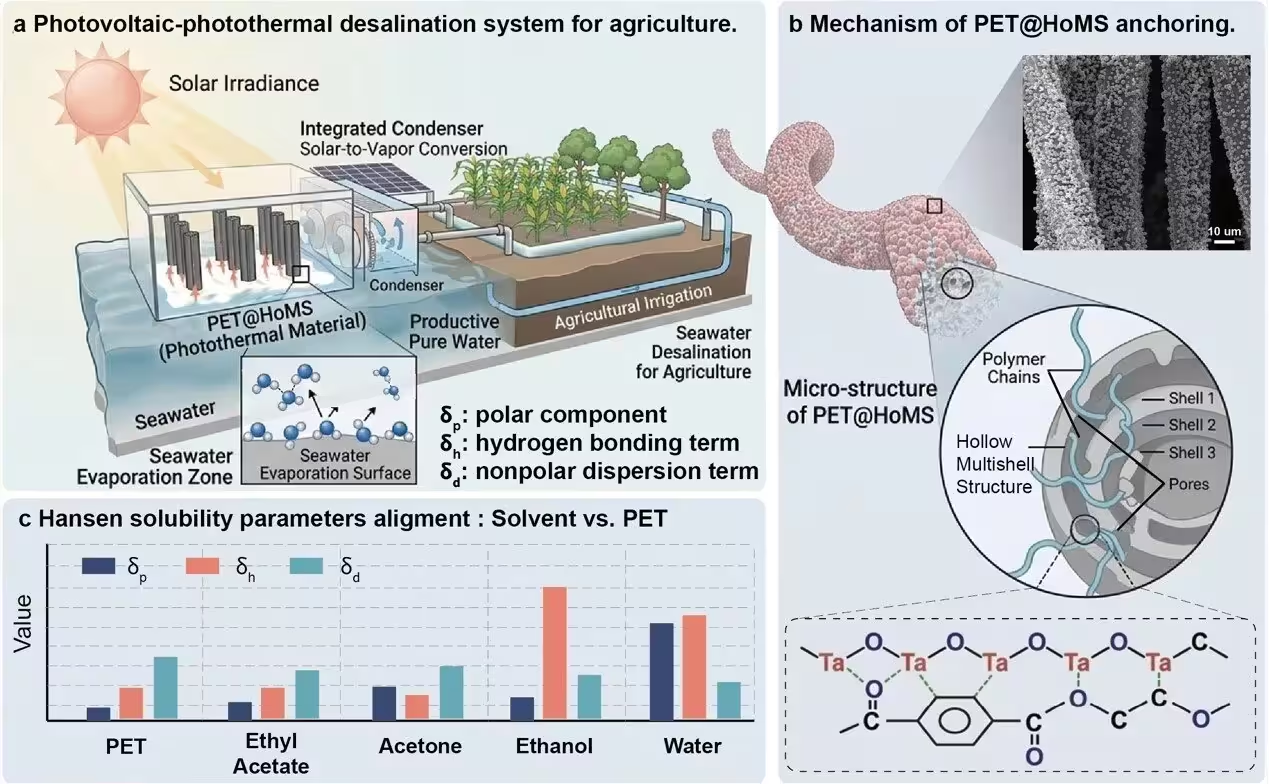
They didn’t stop at lab bottles. The desalinated water irrigated a small field where spinach, corn and bok choy completed a full growth cycle without issues, demonstrating agricultural viability, not just potable supply.
Researchers estimate that after two years of operation the cost of water from this off-grid solar device could be lower than commercially bottled water.
Publishers and peers will find the full experimental details in Advanced Materials, but the broader implication is immediate: with clever micro-architectures and inexpensive polymers, solar desalination can leap past long-standing bottlenecks. The approach scales by tiling modules, and for coastal or island communities lacking reliable electricity, it offers a pathway to clean water that is both low-tech in operation and high-tech in design.
Questions remain — longevity under harsh marine conditions, fouling over many seasons, and mass-manufacturing costs — but the nano-forest shows how a structural rethink at the nanoscale can reshape a global problem. Who will plant the first rows?


Leave a Comment
Comments
No comments yet. Be the first.