
4 Minutes
There is a miniature world crawling on your cheeks and chin, a secret population that spends nearly its entire life tucked inside the pores and hair follicles of your face. You probably knew about microbes. You probably did not picture a parade of microscopic arthropods burrowing, mating and dying on your skin.
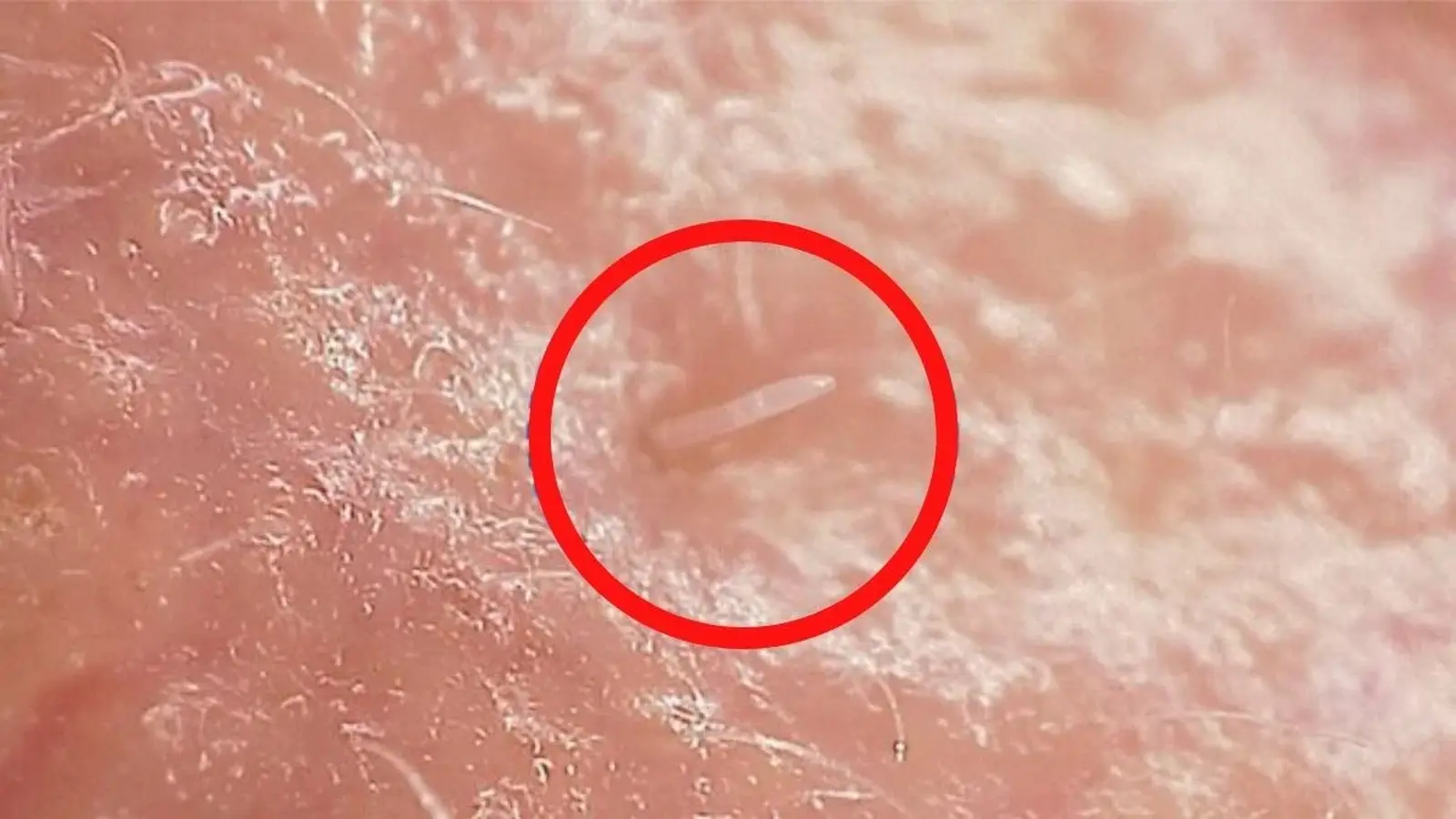
Meet Demodex folliculorum, the tiny mite that calls only humans home. At roughly a third of a millimeter long, its sausage-shaped body, stubby legs and slow shuffle are perfectly engineered for slipping down a hair shaft and dining on the detritus of human skin. They live fast and brief lives, roughly three weeks, emerging at night in the slim chance of finding a mate before retreating into the safety of a follicle.
Scientists who sequenced the genomes of these mites call the results startling. Over generations of living sheltered lives inside human pores, D. folliculorum has shed genes it no longer needs. The genome is pared down to essentials. Limbs are driven by three single-cell muscles each. Protein-coding content sits at the bare minimum for survival—smaller than in related mite groups.

D. folliculorum seen in a potassium hydroxide preparation of human skin.
Why would losing genes be noteworthy? Because it marks a shift from freeloading ectoparasite to what appears to be an obligate partner. No sunlight. No rivals. Little exposure to other species. Those constraints change evolutionary pressures. Genes for UV protection, and even mechanisms that respond to daylight, are gone. The mite lacks the biochemical toolkit to make melatonin, the molecule many animals use to time activity. Yet they still come out only after dusk. How? The researchers suggest they may be cueing off the melatonin secreted by our own skin at nightfall.
These mites are becoming so specialized to the human face that they may no longer survive apart from us.
Genome shrinkage also explains some of their odd anatomy. Reproductive parts have migrated forward along the body so that a male must wedge himself beneath a female on a hair to mate. It is a clumsy choreography, but one that works under the cover of darkness. With such intimate, enclosed breeding grounds, opportunities to mix genes are limited. The tiny population structure risks inbreeding and the narrowing of genetic diversity, a possible evolutionary dead end.


The position of D. folliculorum's penis. This is not convenient.
Another curious discovery overturns a long-standing myth. For years it was thought that these mites lacked an anus, that they held waste until their bodies ruptured at death and spewed material into pores, contributing to skin inflammation. The new anatomical evidence shows they do, in fact, defecate. That finding revises a messy story about disease and suggests their presence may not be as harmful as once feared.
There are hints of a more constructive relationship. Zoologists speculate that by grazing on skin debris and shifting pore contents, Demodex could help keep follicles unclogged. The notion of a tiny janitor community is appealing. It flips the script from parasite to potential partner, a micro-tenant performing an unglamorous but useful service.
Researchers behind the 2022 study in Molecular Biology and Evolution include Alejandra Perotti, Gilbert Smith and Alejandro Manzano-Marin, who pieced together the genetic story, and commentators such as Henk Braig who emphasize the long, unique association between these mites and humans. One especially revealing observation is developmental: nymphal stages actually contain more cells than the adults. Adults lose cells as they mature, a pattern some evolutionary biologists interpret as an early step toward symbiosis in arthropods.

The arrow points to the mite's anus, and now you're probably on some kind of watch list.
That trajectory raises provocative questions. If a tiny species can shrink its genome, shed functions and rewire behavior to match our biology, what does symbiosis mean on the smallest scales? And what responsibilities should we accept toward organisms that cannot live without us?

The idea that your face hosts a species slowly merging its existence with ours sounds like science fiction. But the evidence is genomic, anatomical and behavioral. Whether Demodex folliculorum ends up remembered as a harmless cohabitant, a helpful cleaner, or a species trapped on an evolutionary cul-de-sac is a story still unfurling. Next time you glance in a mirror, consider the centuries of quiet cohabitation happening just beneath the surface.













Leave a Comment
Comments (2)
is this even true?? genome shrinkage sounds wild but could it be lab contamination or just isolated populations? if that's real then...
wow didnt expect my face to be a tiny metropolis, kinda creeped out but also fascinated... are they roommates or prisoners now?