
4 Minutes
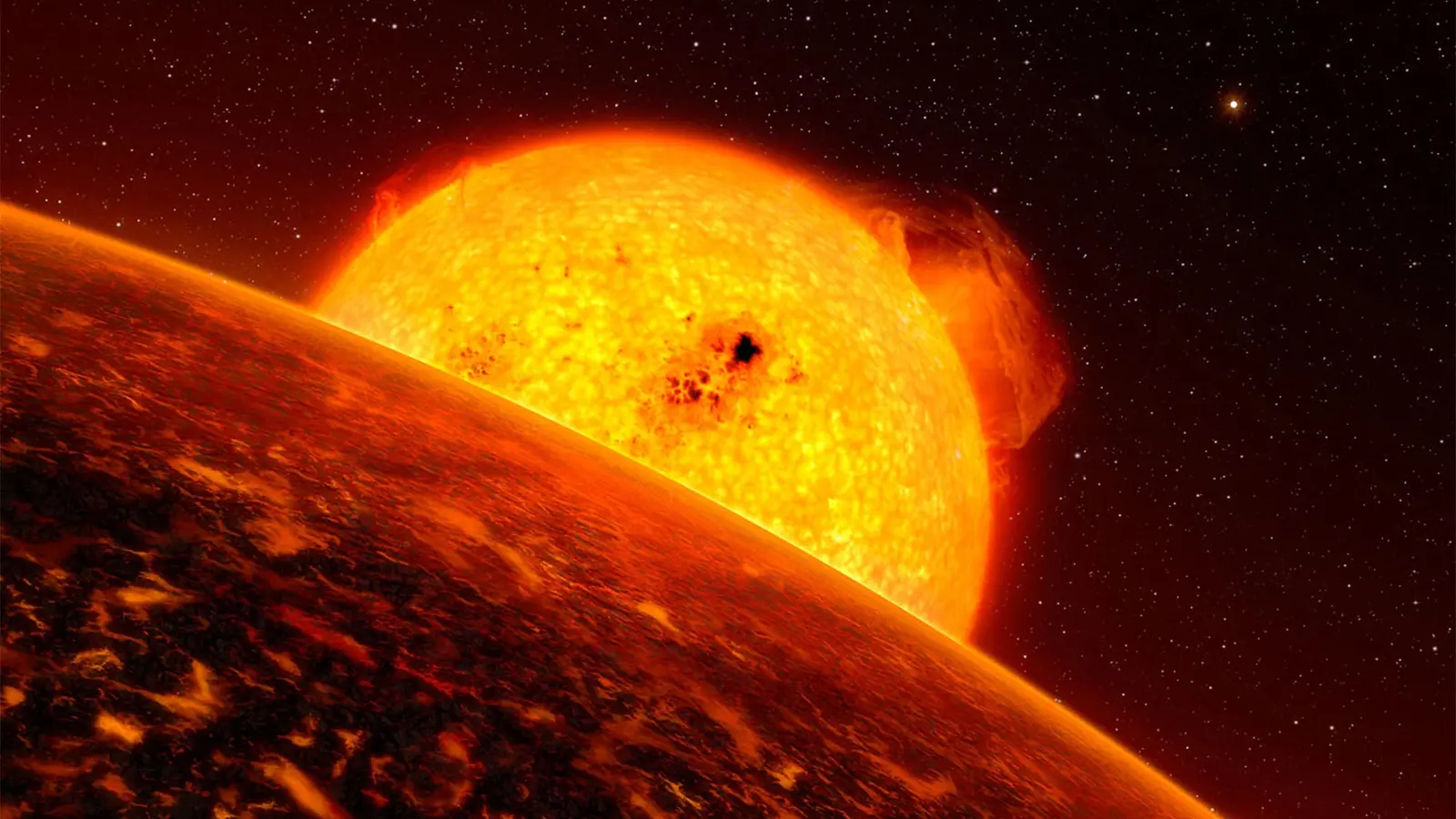
Imagine a planet where the daylight side is literally molten — rivers of rock, a sky tainted by steam and exotic gases, and a night so close you can feel the star’s heat lingering. That is 55 Cancri e: a blisteringly close super-Earth about 41 light-years from Earth, completing an orbit in roughly 0.7 days and locked so one face always stares at its star.
Using the James Webb Space Telescope, astronomers watched this world disappear behind its star five times. Each secondary eclipse served as a brief experiment: when the planet slips out of view, the star’s light alone reveals what the planet was contributing — the thermal glow and spectral fingerprints of its atmosphere. The team’s analysis favors an atmosphere rich in hydrogen, with significant carbon monoxide and smaller amounts of carbon dioxide — a chemistry that points inward, into the planet’s molten heart.
Why does that matter? Because a rocky planet’s secondary atmosphere is not a random coat of gases. It is a storybook of the interior, written in volatile chemistry. The dominance of hydrogen and the steep spectral inversions the models produce suggest a reduced interior — in short, an environment low in oxygen where a magma ocean can outgas hydrogen-rich mixtures. That interior redox state shapes everything from what comes off the surface to the short-lived clouds that may sweep across the dayside.
The five eclipses were not carbon copies. Small but measurable differences between them hint at a planet in flux: episodic outgassing could seed transient clouds or hazes that briefly blanket and cool patches of the molten surface, only to be cleared by renewed volcanic venting. Picture curtains of vapor that form and vanish on timescales of hours to days, changing the planet’s spectral signature between observations.

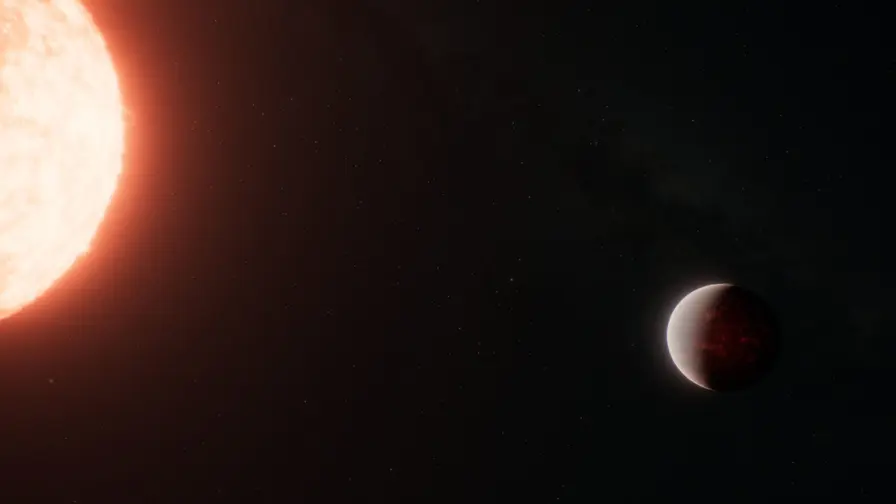
Artist’s illustration of 55 Cnc e.
This is a different brand of volcanism than the one we see on Io. Jupiter’s moon boils with tidal heat — stretched by gravity, it spews magma almost everywhere. On 55 Cancri e and its kin, heat comes from the star. These exoplanets hug their suns so tightly that surface rock melts from irradiation rather than internal tidal flexing. The result can be a dayside ocean of magma on a tidally locked world or, depending on orbital period and composition, molten patches facing the star.
55 Cancri e is not alone in turning up the planetary heat. Over the past decade astronomers have cataloged several lava exoplanets — CoRoT-7 b, K2-141 b, L 98-59 d, TOI-561 b and others — each with its own mix of orbital speed and temperature. Some complete orbits in mere hours and are scorched across the whole surface; others show magma confined to the star-facing hemisphere. Comparing them helps researchers tease apart which features stem from formation history, which from stellar irradiation, and which from interior chemistry.
Beyond the sheer drama of molten landscapes, these spectral detections carry a deeper payoff: they give us a way to connect atmosphere to mantle. If hydrogen-rich models hold up, they argue for a reduced magma ocean and outgassing chemistry very different from Earth’s oxygen-rich volcanic emissions. That changes how we think about atmosphere retention, surface chemistry, and even the potential for longer-term evolution on close-in rocky worlds.
The Webb observations are an opening chapter, not the last word. More eclipses, broader wavelength studies and time-resolved monitoring will test whether those transient clouds are regular weather or one-off tantrums. Each dataset peels back another layer of these infernos, teaching us how rocky planets behave under astronomical pressure.

We have learned to read distant light with exquisite precision. Now we must learn to listen for the small, changing notes of worlds whose geology writes itself in steam and flame.










Leave a Comment
Comments (2)
Is this even real? Hydrogen-rich magma planet sounds wild but maybe JWST data could be fooled by transient clouds, or noise, idk
Wow, a whole planet with molten rivers? mind blown. Curtains of vapor forming and vanishing in hours, kinda poetic and terrifying...