
6 Minutes
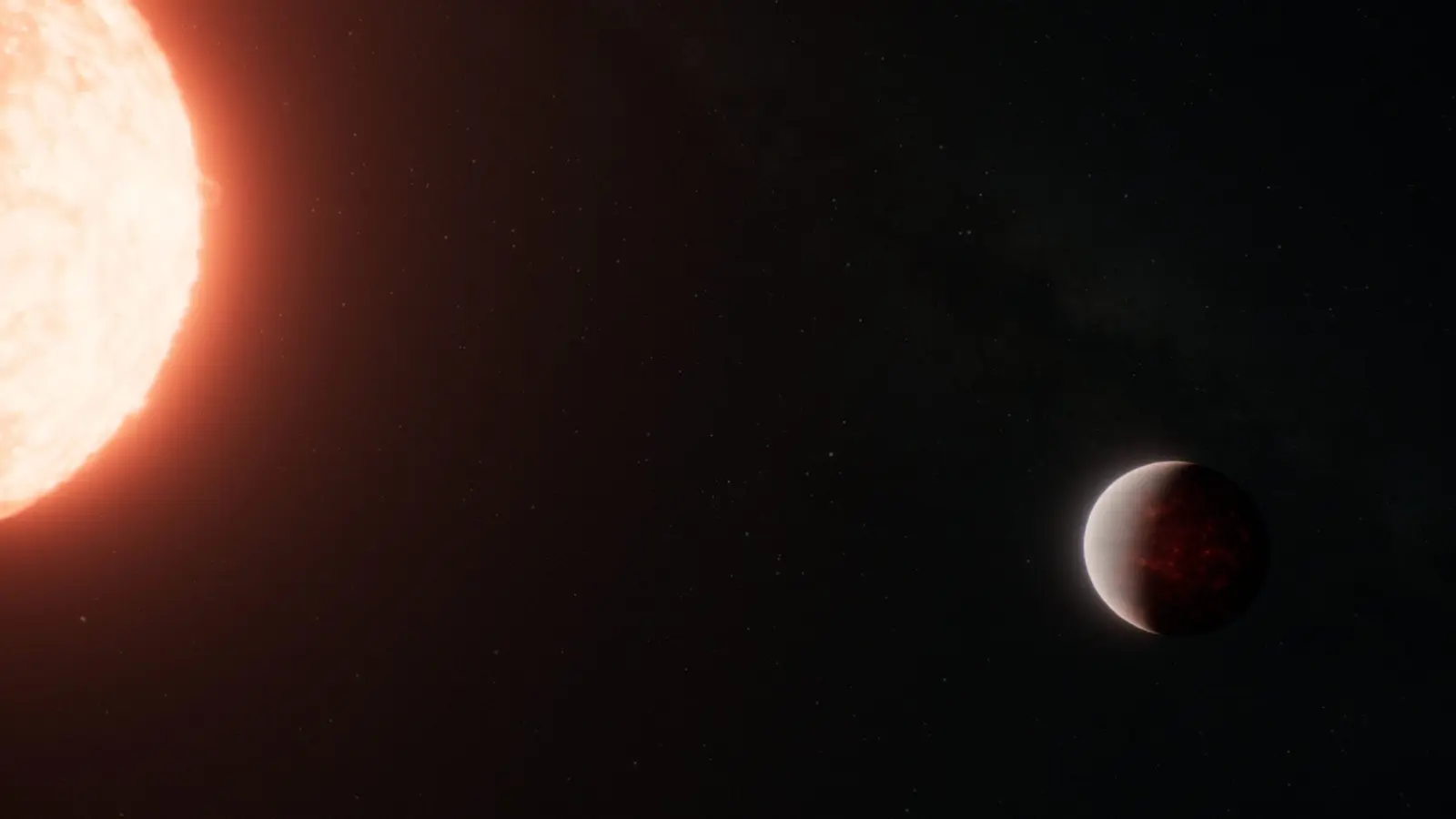
NASA’s James Webb Space Telescope has delivered the strongest evidence yet that a small, ultra-hot rocky exoplanet — TOI-561 b — is wrapped in a substantial atmosphere above a global magma ocean. The discovery challenges assumptions about how small worlds survive extreme stellar radiation and offers a glimpse into planets that formed early in our galaxy.
How an unusually cool dayside revealed a hidden atmosphere
TOI-561 b is an ultra-short period super-Earth: roughly 1.4 times the radius of Earth and completing an orbit in under 11 hours. Its orbit brings it to less than one million miles from a Sun-like star — about 1/40th the distance between Mercury and our Sun — which heats the planet’s dayside to thousands of degrees. Given that intense irradiation, conventional wisdom predicted the planet would be a bare rock or molten surface with no capacity to hold on to an atmosphere.
But observations from Webb’s Near-Infrared Spectrograph (NIRSpec) paint a different picture. By measuring the system’s near-infrared brightness as TOI-561 b passed behind its star (a secondary eclipse), scientists could estimate the dayside temperature. If the planet were a bare lava world with no atmosphere, its dayside would reach about 4,900 °F (2,700 °C). Instead, Webb measured a surprisingly cooler dayside near 3,200 °F (1,800 °C).
This mismatch between expected and observed temperature suggests an additional layer is at work. The simplest explanation consistent with the data is a dense, volatile-rich atmosphere that redistributes heat and partially absorbs near-infrared emission from the hot surface.
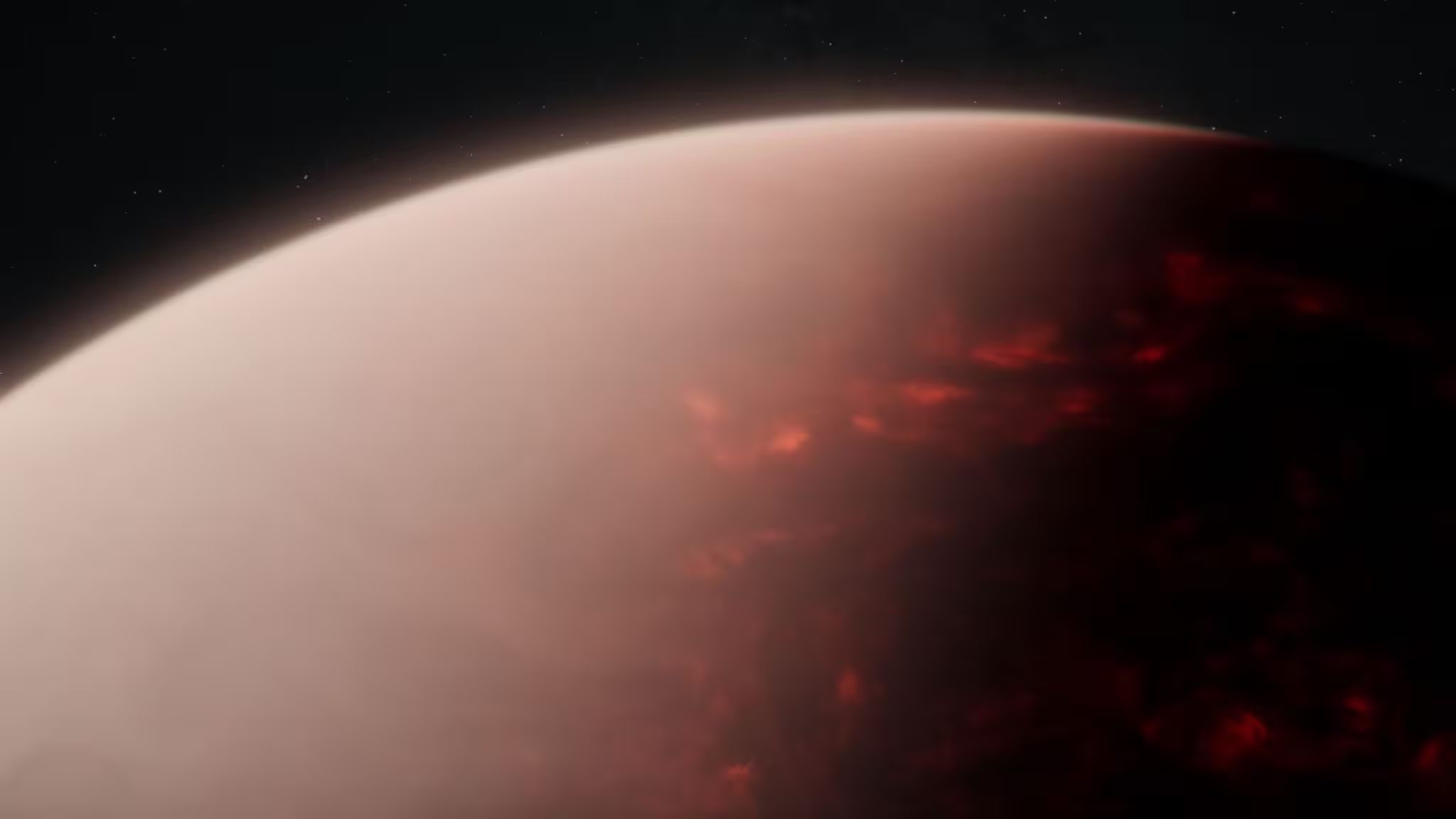
This artist’s concept shows what a thick atmosphere above a vast magma ocean on exoplanet TOI-561 b could look like. Measurements of light captured from the planet’s dayside by NASA’s James Webb Space Telescope suggest that in spite of the intense radiation it receives from its star, TOI-561 b is not a bare rock. Credit: NASA/STScI
Observations, techniques and what the data reveal

The Webb team observed TOI-561 b in continuous monitoring over more than 37 hours, covering nearly four full orbits. They used NIRSpec’s ability to dissect near-infrared light to determine the planet’s brightness and infer its thermal emission. The technique — observing the dip in combined light when the planet goes behind the star — isolates the planet’s contribution and reveals its dayside temperature.
Why brightness tells a story
- Without atmosphere: Surface emission dominates and the dayside should appear extremely bright in the near-infrared — consistent with a rock or molten surface approaching thermal equilibrium with stellar input.
- With atmosphere: Gases such as water vapor and other volatiles absorb specific near-infrared wavelengths, reducing observed brightness and giving the impression of a cooler surface. Strong winds could also transport heat to the nightside, further lowering measured dayside temperatures.
Researchers considered alternative explanations such as an unusually small iron core or a mantle composed of lower-density rock, both of which could reduce the planet’s bulk density. But those structural explanations alone struggle to account for the thermal signature captured by Webb. A thin rock-vapor veneer above a magma ocean was also considered; it would cool the surface only modestly, not enough to match the observed temperature drop.
Why this planet is different — and why it matters
Lead author Johanna Teske (Carnegie Science Earth and Planets Laboratory) highlighted the planet’s low density as a key puzzle piece: "What really sets this planet apart is its anomalously low density. It is less dense than you would expect if it had an Earth-like composition." That odd density led the team to explore whether an extended atmosphere could inflate the planet’s apparent size and lower average density estimates.
TOI-561 b orbits an unusually old, iron-poor star located in the Milky Way’s thick disk. The star is about twice the age of the Sun, suggesting the planet formed in a chemical environment different from the one that produced our solar system. As co-author Tim Lichtenberg (University of Groningen) put it: "We think there is an equilibrium between the magma ocean and the atmosphere. While gases are coming out of the planet to feed the atmosphere, the magma ocean is sucking them back into the interior. ... It’s really like a wet lava ball."
That equilibrium — continuous exchange between molten surface and gaseous envelope — offers a plausible mechanism for how a small planet in a harsh radiation environment could sustain an atmosphere over geological timescales, provided its interior started rich in volatiles (water, carbon-bearing species, and other gases).
Scientific context and implications

This result challenges a long-held boundary in exoplanet science: that only larger planets or those far from their stars can keep atmospheres. If ultrashort-period rocky worlds can retain vapor-rich atmospheres via magma-atmosphere coupling, our census of potentially active or chemically complex rocky exoplanets must be revised. The discovery points to a class of worlds that are neither simple barren rocks nor gas-rich mini-Neptunes, but hybrid lava planets with dynamic surface-atmosphere interactions.
Practically, the finding informs models of planetary formation and evolution. Planets forming around metal-poor, old stars in the thick disk could inherit very different volatile inventories, and those inventories determine whether a molten planet later becomes a dry rock or a persistently “wet” lava world.
What comes next: mapping and composition
The Webb observations reported are the first results from General Observers Program 3860. The team is now analyzing the full dataset to produce a temperature map across the planet’s surface and to better constrain atmospheric composition. Future spectroscopy and phase-curve analysis could detect molecular signatures (water vapor, silicate species, or other volatiles) and measure wind patterns that move heat between the dayside and nightside.
Confirming specific molecules would be a breakthrough: it would reveal not only the presence of an atmosphere but also its chemistry, origin, and the balance of evaporation and reabsorption with the magma ocean.
Expert Insight
Dr. Evelyn Mora, a planetary scientist at the Institute for Exoplanetary Studies (fictional), comments: "Webb’s sensitivity in the near-infrared gives us a new window on how extreme planets behave. TOI-561 b may look hostile, but it could be a laboratory for volatile exchange under conditions we can’t replicate on Earth. If the atmosphere is confirmed and its composition pinned down, it will reshape models of atmospheric loss and interior-outgassing for small planets."
As Webb continues observing ultra-short period exoplanets, astronomers will refine population-level trends: which small planets can hold atmospheres, how those atmospheres evolve, and what that means for habitability’s broader context — even if worlds like TOI-561 b are far too hot for life as we know it.












Leave a Comment
Comments (2)
Is this even true? Cooler dayside = atmosphere, or some weird rock chemistry? Webb looks solid but I'm skeptical until they show specific molecules.
wow didn't expect that... a tiny lava world keeping a thick atm? Mind blown. If Webb maps water or silicates next, that'd settle it, but still curious about longevity