
3 Minutes
Six light-years away, a quiet red dwarf is keeping a secret: four small, strange planets packed tighter than beads on a string. They were found in 2025, and they don’t look like anything in our Solar System—smaller than Earth and Venus, larger than Mars, and arranged in an orbital dance that has kept them together for billions of years.
Stare at the numbers and you get the outline: all four are sub-Earth, all four likely lack thick atmospheres, and all four sit unimaginably close to their star. The outermost world orbits at roughly a tenth of Mercury’s distance from the Sun. Close-in, low gravity, a fierce stellar wind—conditions that strip air and boil off water. Short of a miracle, these planets are dry and exposed.
What makes them stranger still is chemistry. Cambridge astronomers analyzed the star’s spectrum to infer what its planets might be built from. Barnard’s Star is unusually rich in magnesium. On Earth, magnesium commonly forms olivine, a mantle mineral that traps water inside rocks. Around this star, the chemistry instead favors periclase—magnesium oxide—a mineral that does not sequester water the way olivine does. The upshot: the planets may have formed with far less internal water than comparable rocky worlds.

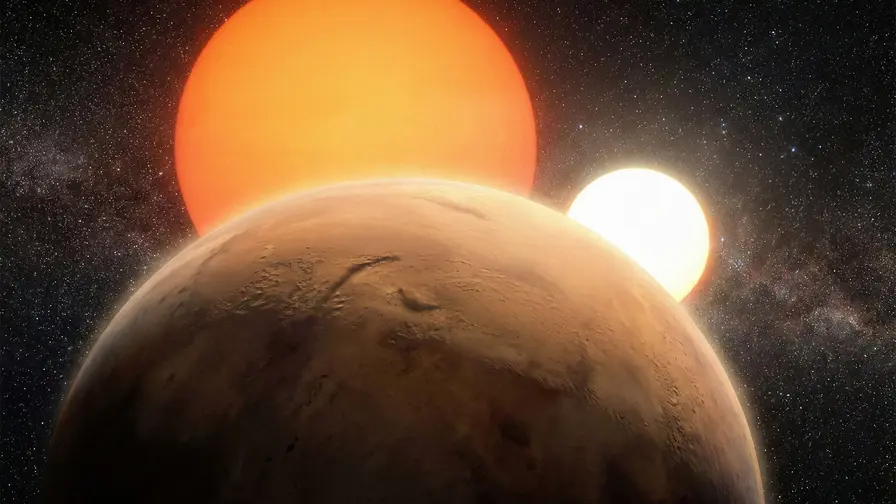
Imagine standing on the bright side of one of these worlds: a permanent noon, an unrelenting glare. The opposite hemisphere basks in perpetual night. Tidal locking has likely frozen each planet into that two-faced existence. Air, if it ever clung to them, has mostly been lost; models suggest any primordial atmospheres could have survived no more than about two billion years, while the system itself is roughly five times older than that.
Still, the planetary neighborhood is not a scrap heap. Gravity usually fights dirty in compact systems—pulls, nudges, eventual collisions. But here the orbits fall into tidy ratios: the inner three planets follow a 9:12:16 period pattern, a resonance reminiscent of musical intervals. Those resonances act like an invisible scaffolding, stabilizing paths that might otherwise cross and tear the system apart.
These are not new Earths; they are dry, airless rocks shaped by a magnesium-rich star and extreme proximity.
The discovery matters for more than curiosity. Current telescopes bias us toward big planets. Missions on the horizon—ESA’s Plato among them—will push sensitivity into the sub-Earth regime and reveal whether such compact, magnesium-rich systems are common or exceptional. If chemistry at the star’s birth sets a template for planet composition, then reading starlight gives us a way to prioritize targets in the search for habitable worlds.
So what do we take from these four hostile neighbors? That planets come in flavors our Solar System doesn’t show; that orbital resonances can preserve delicate configurations over cosmic time; and that the elemental cookbook of a star can nudge planetary recipes toward dryness rather than ocean. Finding more of them will teach us whether Barnard’s Star is an oddball or a preview of a population we’ve been missing all along.

Leave a Comment
Comments
No comments yet. Be the first.