
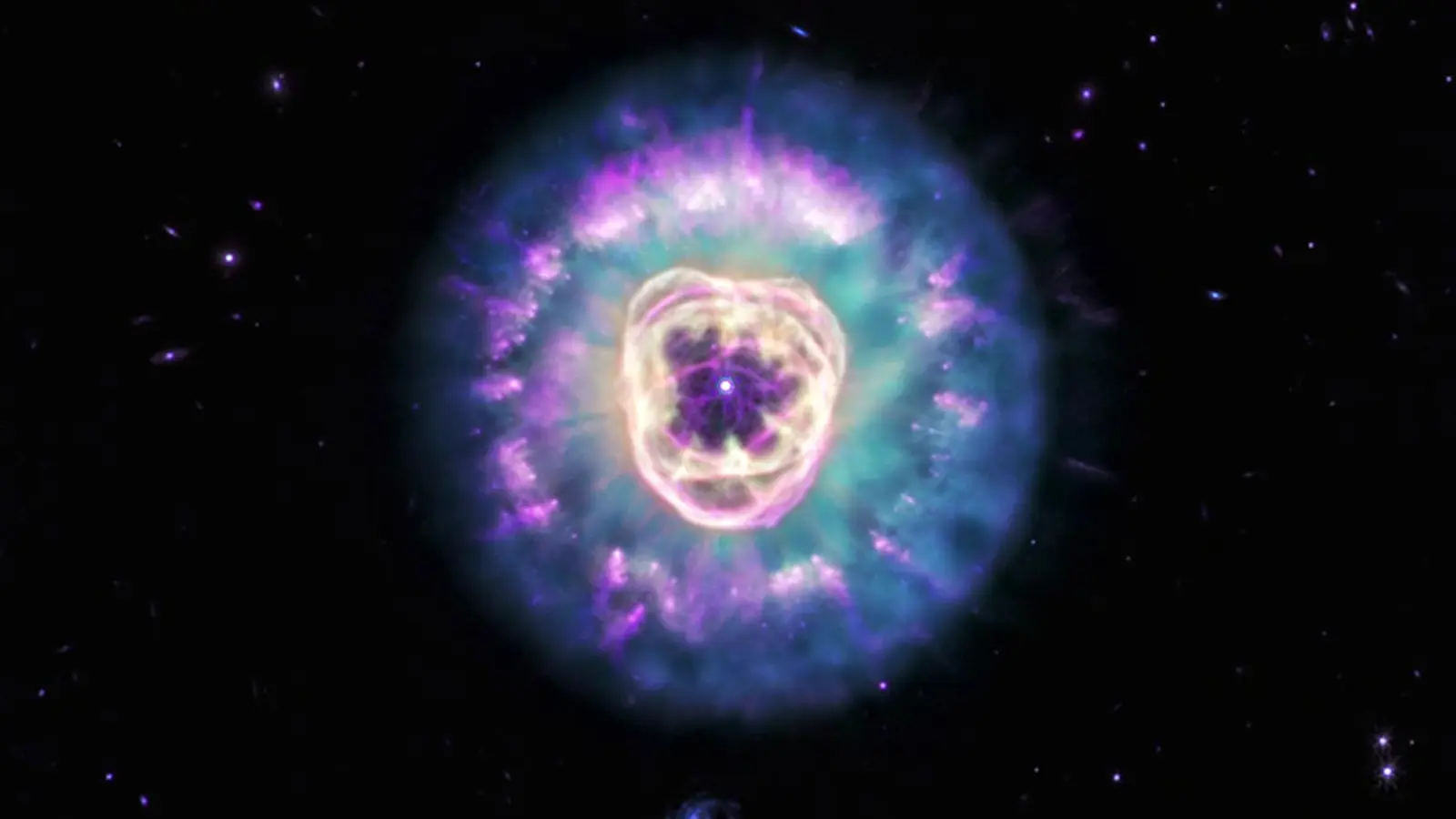
Look up at NGC 2392 and what at first glance looks like a lion's face is actually the fossil record of a star saying goodbye. Webb's infrared eyes strip away the glare and show the architecture beneath: shells, clumps, and a bright central remnant that sculpts this cosmic portrait.
The James Webb Space Telescope combined near- and mid-infrared observations from NIRCam and MIRI to make this image. Hubble first popularized the Lion Nebula back in 2000 with visible-light photographs, but Webb cuts deeper, teasing out concentrated dust lanes and hazes of ionized gas that are nearly invisible in optical light. The result is a sharper, richer view of the same structure — familiar but transformed.
At the heart of the lion sits a white dwarf, tiny but ferociously hot. It looks like the nebula's button nose, but its influence is anything but small. High-energy photons from the exposed stellar core carve a bubble of ionized gas that lights the face of the nebula. As that bubble expands it both shapes and erases the material it encounters.
How does such a sculpted scene form? Most stars in our galaxy are not massive enough to explode as supernovae. Instead, when lower-mass stars exhaust the fuel in their cores they begin to shed their outer layers in fits and pulses. Those expelled shells become a planetary nebula — a glowing shroud of gas and dust pushed outward by radiation from the newly revealed white dwarf.

But the geometry is rarely neat. Observers see rings, nested shells, and intricate arcs. Some of those patterns arise from changing winds and pulses in the dying star; others likely reflect interactions with companion stars or magnetic fields. The dense knots that make up the lion's mane are especially telling. These compact dust clumps survive longer against the onslaught of radiation, casting shadows and forming comet-like tails downstream.
Webb’s infrared view almost freezes the nebula in mid-change. Gas is still streaming away. Dust grains continue to break down where the radiation is strongest. Astronomers estimate that the Lion Nebula will disperse into the interstellar medium in roughly 10,000 years — a blink on cosmic timescales, but long enough for complex structures to evolve.
The image also underscores a larger truth: dying stars are factories. They manufacture and return much of the dust that later becomes planets, moons, and the raw ingredients for new generations of stars. This is not just a pretty picture — it’s a working laboratory for how stars seed their galaxies with dust and chemistry.
Behind the image is an international effort. Webb, the most powerful space telescope to date, flew thanks to contributions from NASA, ESA, and the Canadian Space Agency. ESA supplied the Ariane 5 launch and key instrument elements, including NIRSpec and half of MIRI, built in concert with partners across Europe and the U.S. The result: a tool that lets us witness, in remarkable detail, the last acts of stellar lives and the quiet recycling that shapes the cosmos.
Peer at the mane long enough and you begin to see more than a lion. You see cycles: a star sheds material, light sculpts it, and the skeleton of a new chemical legacy drifts outward, waiting to be incorporated into something else. The universe keeps making and remaking itself, one dying star at a time.

Leave a Comment
Comments
No comments yet. Be the first.