
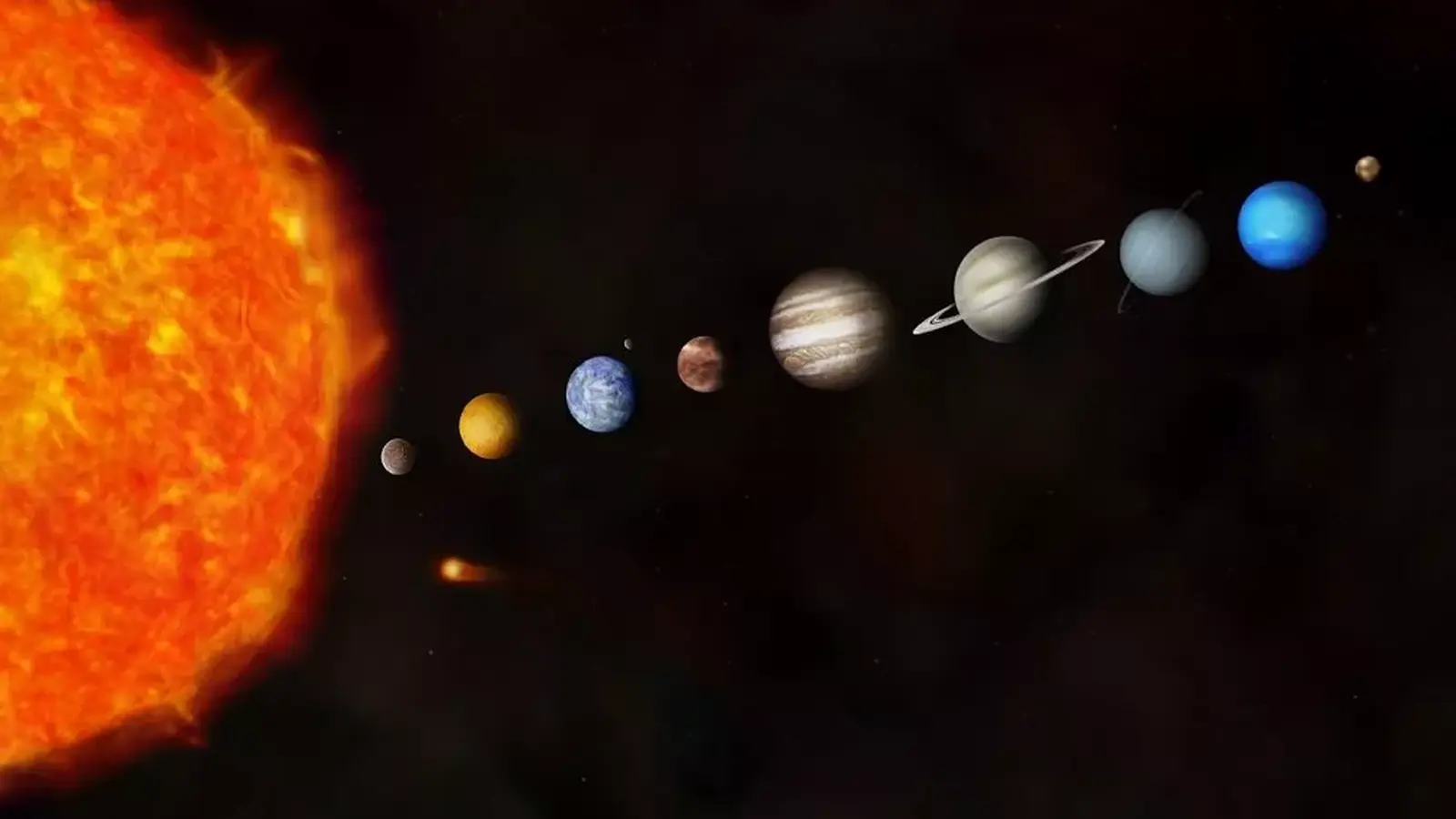
Picture Jupiter and Saturn — monarchs of our cosmic neighborhood — suddenly nudged out of their slow, stately waltz. The choreography breaks. Orbits stray. Chaos seeps in, but not because of a rogue star passing by; because of the Sun itself.
A team at Caltech says this is exactly what could happen. Using new models of stellar mass loss and orbital dynamics, the researchers find that the outer giants — Jupiter, Saturn, Uranus and Neptune — are likely to become destabilized roughly one billion years after the Sun exhausts its fuel and collapses into a white dwarf. That timing slashes earlier estimates of their survival by about a billion-fold compared with some previous predictions that stretched stability to unimaginably long spans, even on the order of a quintillion years.
We still have time. The Sun will puff up into a red giant in roughly five billion years, swallowing Mercury, Venus and probably Earth. Mars should survive that phase, nudged outward as the Sun loses mass. Farther out, the gas and ice giants were long assumed to survive the star’s death almost unscathed: as the Sun sheds mass, their orbits would simply expand and settle into wider, stable tracks.
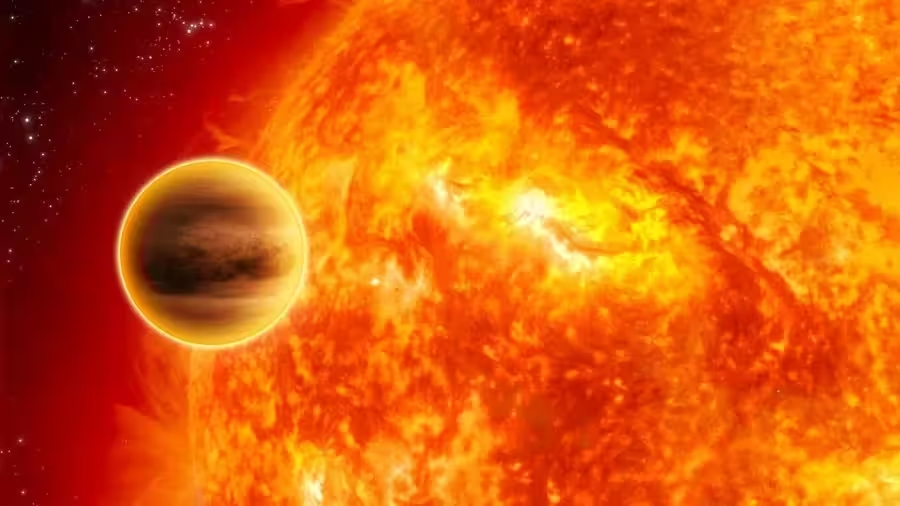
But the new work challenges that calm picture. Instead of a smooth, gentle peeling away of mass, the dying Sun may shed material in violent, irregular bursts — sudden jolts the paper calls "random kicks." These impulsive losses change the gravitational pull in spurts, not whispers, and those spurts can nudge planetary orbits into resonances and crossings. Over time, what began as tiny orbital tweaks can cascade into large rearrangements.
The upshot: the outer planets’ orderly architecture may unravel roughly a billion years after the Sun becomes a white dwarf.
This isn't an immediate apocalypse. The instability arrives long after the red-giant fireworks fade and the Sun has collapsed to about half its current radius and cooled. But it does rewrite the timeline for when solar-system dynamics go off script. Previously, many astronomers argued that only external agents — passing stars or galactic tides over tens to hundreds of billions of years — would disrupt those distant orbits. Internal, stochastic mass loss turns out to be a more efficient trigger for later chaos.
There are consequences beyond our backyard. If the Sun’s final breaths can toss giant planets into new orbits, similar processes might destabilize exoplanet systems as their host stars die, reshaping debris belts and sending comets and asteroids inward. That could leave observable signatures around white dwarfs: metal-polluted atmospheres, dusty disks, or engulfed minor planets.
Who would have guessed the Sun’s last act could be so dramatic? The finding is a reminder that even the slowest dramas in astronomy — stellar evolution, planetary motion — can contain sudden turns. Astronomers will now be watching their simulations more closely, hunting for the small kicks that have very big consequences.


Leave a Comment
Comments
No comments yet. Be the first.