
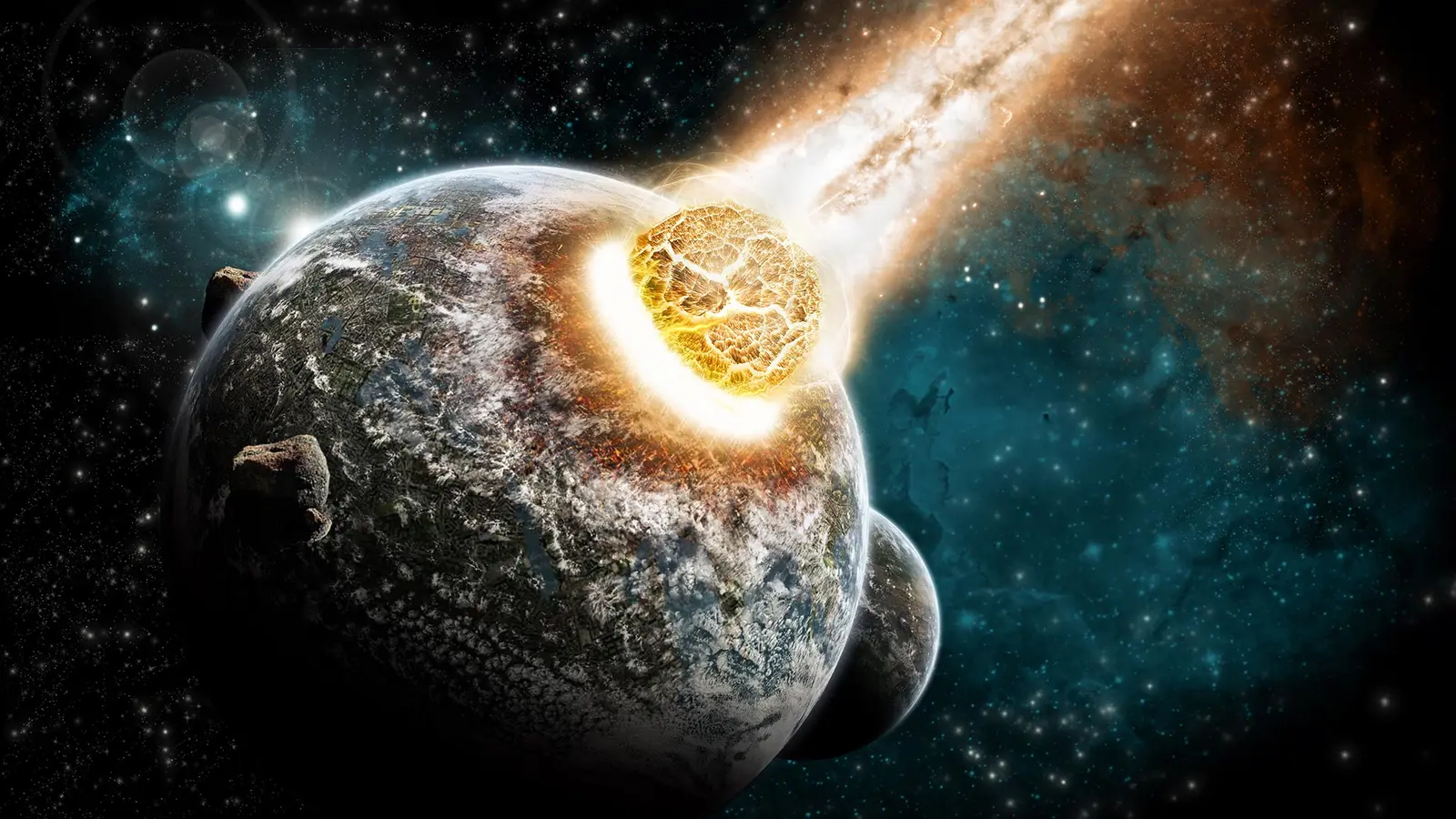
Picture a moon ripped into a spray of icy shards and rock, then slowly reassembled like the pieces of a smashed clock. It sounds terminal. But a new set of simulations suggests that destruction doesn’t always mean the end of an ocean.
Researchers led by the University of Maryland, reporting in Nature Astronomy, stitched two very different kinds of models together: dramatic impact simulations and long-term interior evolution. The aim was straightforward and stubbornly human—could a moon that was blown apart still hide liquid water beneath its shell afterward?
“The big question we asked was whether these destructions help moons have oceans afterward or whether they delete the ocean and reset the moon into a cold, dead world,” said Marc Neveu, the study’s lead author and an astronomy associate research scientist at the University of Maryland. Their answer was surprising in how uncompromising it sounded: if a moon had an ocean before, it probably has one after. If it was frozen beforehand, a smash-up usually won’t bring it back to life.
The team modeled moons roughly 500 and 1,000 kilometers across—about 310 and 620 miles—and sent smaller impactors at speeds and energies large enough to completely disrupt them. The crash simulations followed millions of fragments as they heated, collided, and eventually reclumped into a single body. That outcome then fed into a separate model that tracked heat flow, differentiation, and potential melting for 4.5 billion years.
The devil, as often, lives in the details. For the larger moons, the energy from a catastrophic impact can actually thicken an existing ocean, sustaining liquid water for a couple billion years longer than if the impact had never occurred. For smaller moons the story flips: their outer layers are typically a mixed jumble of rock and ice that acts as an insulating blanket. A violent collision tears that blanket apart; when the pieces settle, rock sinks and ice floats, leaving a cleaner stratified shell that leaks heat more readily and makes it harder to keep an interior ocean alive.
But even that dichotomy comes with an important rider. Tidal heating—the flexing and kneading of a world by gravitational forces from its planet and sibling moons—can dominate a moon’s thermal budget. Changes in orbit or resonant interactions might throttle heating up or down, and those orbital shifts both cause and result from collisions. The full picture, Neveu says, requires watching moons move, smash, and age in one continuous simulation.
There are observational hints that past impacts left fingerprints. Saturn’s Rhea, for example, wears oddly softened craters—features that look as if ice near the surface partially relaxed or flowed after being warmed from below. Neveu compares it to a snowman sagging after a warm spell, only the warmth here would have come from the moon’s interior, possibly boosted by a long-ago collision.
These results matter beyond academic curiosity. They reshape where planetary scientists might point telescopes and spacecraft. The study’s implications stretch across many targets of interest: Saturn’s mid-sized satellites such as Mimas, Enceladus, Tethys, Dione, and Rhea; Uranus’s Miranda, Ariel, Umbriel, Titania, and Oberon; and Neptune’s Triton. If collisions seldom sterilize oceans, then more of these worlds remain plausible habitats for microbial life.
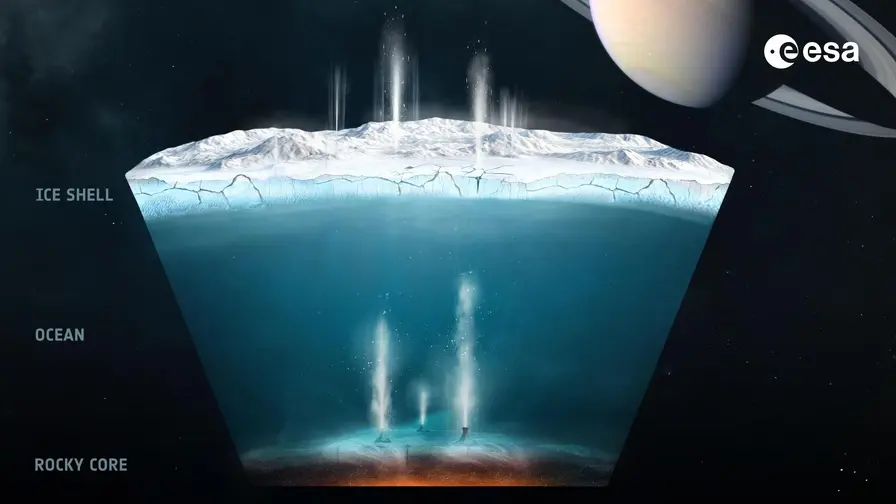
How would we tell? Subsurface oceans can betray themselves in several ways: subtle gravitational signatures, salty deposits on the surface, or cryovolcanic plumes that loft interior material into space. Each diagnostic calls for different instruments and mission designs—and different expectations about what we might hope to find. A smear of microbes requires one kind of sensitivity; an ocean teeming with complex chemistry would demand another.
What this work ultimately does is widen the sandbox. It says smashed moons are not necessarily dead moons, and that the scars of cosmic violence may hide a continuing, slow-burning potential for habitability. The next step is to simulate entire moon systems—watching orbits, impacts, and interior evolution together—so that when a probe arrives at a frozen world it carries not just instruments, but a sharper sense of what that world has endured and what it might still be hiding under the ice.

Leave a Comment
Comments (1)
wow this is wild, smashed moons might still hide oceans? mind blown. Rhea sagging like a snowman... if true, more targets for life, but also so messy, need way better sims