
Imagine a tiny boat slipping across water, not pushed by a motor or propeller, but nudged along by a tone. Strange? That was the scene on a lab bench at EPFL, where researchers coaxed movement out of sound itself.
They built miniature boats and drones that translate acoustic energy into thrust. No gears. No magnets. No spinning shafts. Instead, the trick relies on resonant cavities: hollow chambers tuned to sing back at specific frequencies. When a speaker plays the right pitch, the air inside these cavities vibrates and is forced through a small aperture. The escaping jet produces a unidirectional push, and the whole device moves.
Think of the sound you make when you blow across a bottle neck. Same physics, different scale. EPFL's team fabricated resonators from 3D-printed plastics, rubber-like polymers and glass, materials chosen for precision and lightweight form. Because there are no moving mechanical parts, the researchers could shrink the devices to sizes that classical motors would struggle to reach.
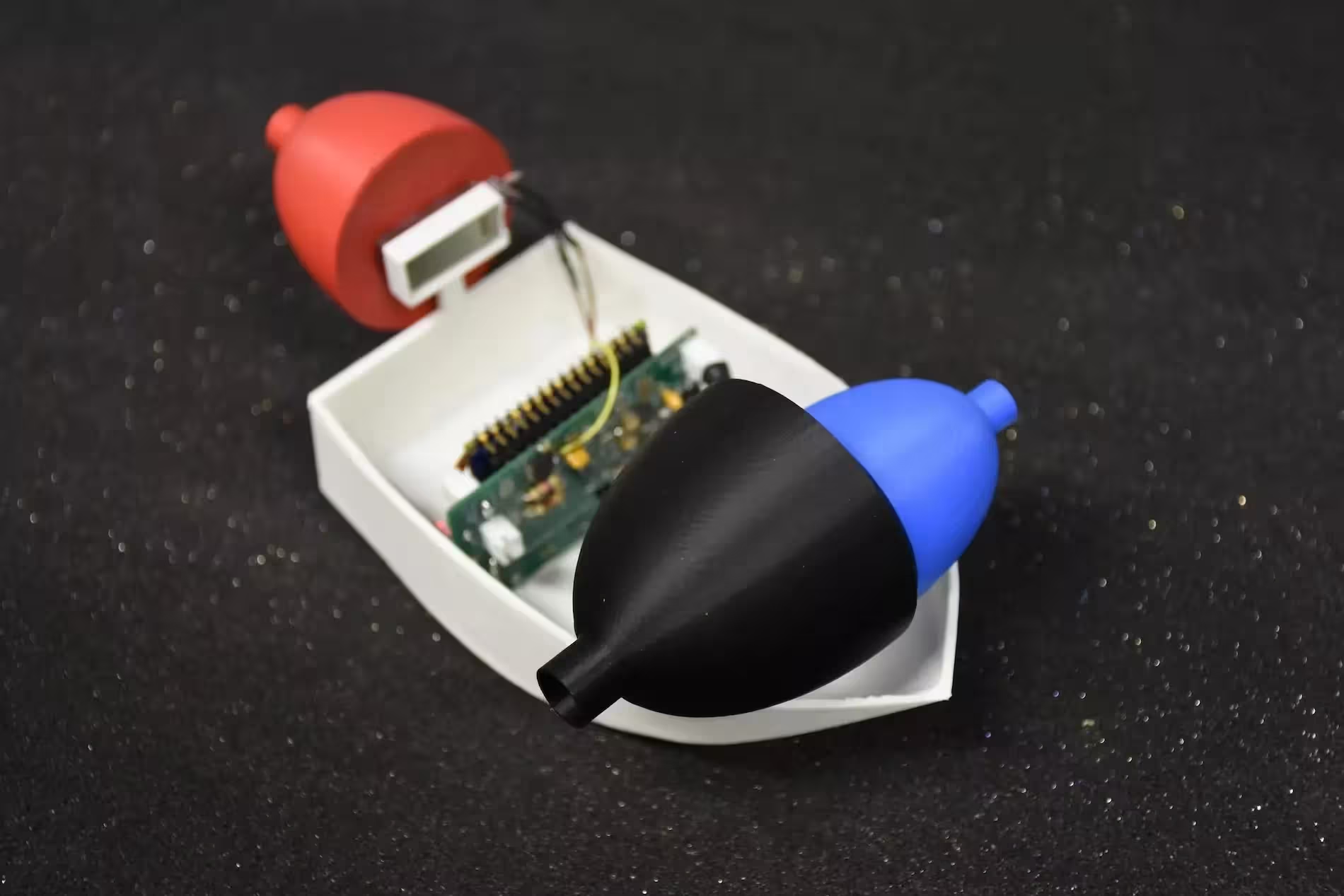
In early trials, the scientists mounted up to three resonators on small boats. Each cavity responded to a distinct audible frequency and nudged the craft in a particular direction. By switching tones from an external speaker, they steered the boats through obstacle courses and even programmed them for simple autonomous navigation. Control came from sound, not onboard actuators.

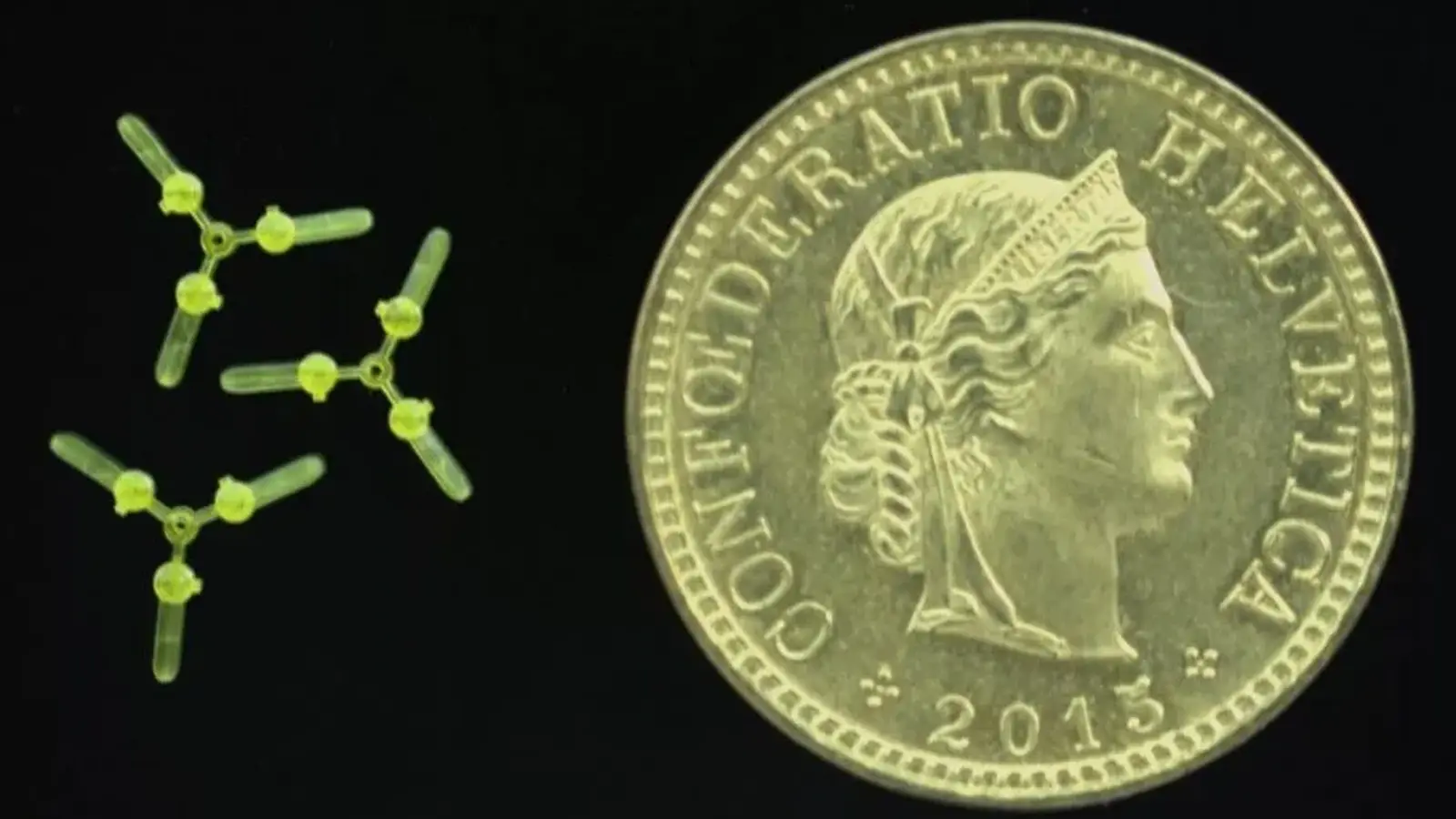
They pushed the concept further with ultralight flying prototypes. Using nano-3D printing, the team made microdrones that operate in the ultrasonic range, so humans cannot hear them. One design, weighing about 150 micrograms and fitted with three cavities, generated downward thrust and popped off the surface like a miniature rocket. Another layout placed three resonator-equipped blades around a central axis; when driven at the right ultrasonic frequency the blades spun at roughly 13,000 rpm, producing lift enough to hover briefly—the physics of a tiny helicopter recreated with sound.

Scale remains the sticking point. These flyers rose less than 5 millimeters, and the boats were extremely light. Yet the experiments demonstrate a powerful idea: resonant cavities can serve as propulsion systems for microrobots. Acoustic jets, once an odd curiosity, now look like a viable method to move, steer and even lift centimeter- and subcentimeter-scale machines.

Acoustic propulsion opens a path toward simpler, lighter microrobots that forgo conventional moving parts in favor of sound-tuned mechanics. Challenges remain—efficiency, integration of onboard control, and operation outside controlled lab fields—but the principle is clear and the potential compelling.
The full technical account appears in Science Advances, and the next steps will test how far this sonic momentum can carry miniature explorers beyond the bench and into practical tasks.


Leave a Comment
Comments
No comments yet. Be the first.