
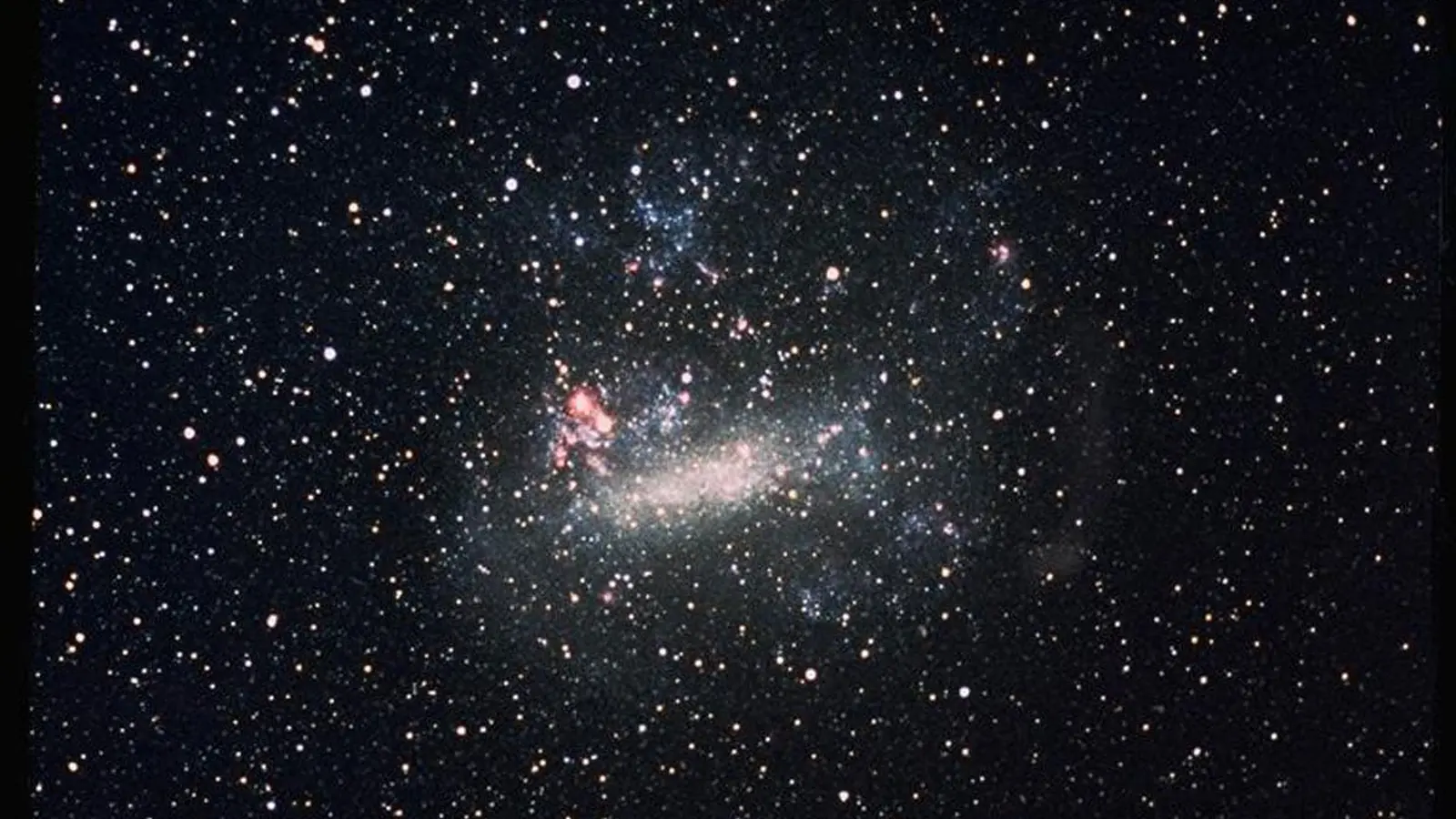
What can make a distant star wink for an hour and then go quiet forever? On the night of 18 December 2019 a star in the Large Magellanic Cloud brightened smoothly for about sixty minutes, a rise and fall so symmetric it looked less like a flare and more like a precise cosmic nudge.
Observers at Swinburne University, combing high-cadence survey data, gave that nudge a name: Phoebe. The shape of the light curve pointed to gravitational microlensing — the familiar trick from Einstein’s toolbox where a compact mass passing between us and a background star acts as a transient magnifying glass, bending and amplifying starlight in a characteristic way.
Microlensing events tell you about mass by their timing. Fast events mean low mass. Phoebe’s hour-long cameo lands it right at the detection limit of current surveys. Reverse the math and you get a startling number: roughly three times the mass of the Moon. That’s far smaller than any planet we know and vanishingly small compared with stellar black holes, which start at a few times the Sun’s mass.
So what are the contenders? One possibility is a free-floating planet, ejected long ago and wandering alone in our galaxy. Another is the same kind of rogue object, but orbiting inside the Large Magellanic Cloud itself — which would be the first extragalactic microlensing planet ever recorded. The third option is the most provocative: a primordial black hole, a compact object born not from a dying star but from density ripples in the universe’s first fractions of a second.

The Large and Small Magellanic Clouds.
If Phoebe is what the statistics suggest, it could be a primordial black hole — a relic formed before the first atoms, drifting through space for 13 billion years.
That statement comes from probability. The team modeled where the lens might sit — in Milky Way stellar populations, in the Large Magellanic Cloud, or in the dark matter halo enveloping and between the galaxies. The dark halo scenario outscored ordinary stellar explanations by roughly 100,000 to one: five orders of magnitude in likelihood. Those odds do not prove primordial origin, but they tilt the balance dramatically.
Why does this matter? Because a confirmed primordial black hole at lunar-mass scale would be a clue — perhaps a direct imprint — of physics in the infant universe. It would also reopen conversations about what dark matter could be made of, and about how many tiny compact objects might be drifting unseen through interstellar space.
And yet caution is necessary. One isolated event is a whisper, not a chorus. Microlensing surveys are only now pushing into the short-timescale regime where moon-mass lenses can be found. Confirming Phoebe’s nature will require more detections, sharper statistics, and independent lines of evidence.
For now we have a single, elegant mystery: a fleeting magnification in a neighboring galaxy that might be a wandering planet or a fossil from the Big Bang. Astronomers will be listening for the next whisper.


Leave a Comment
Comments
No comments yet. Be the first.