
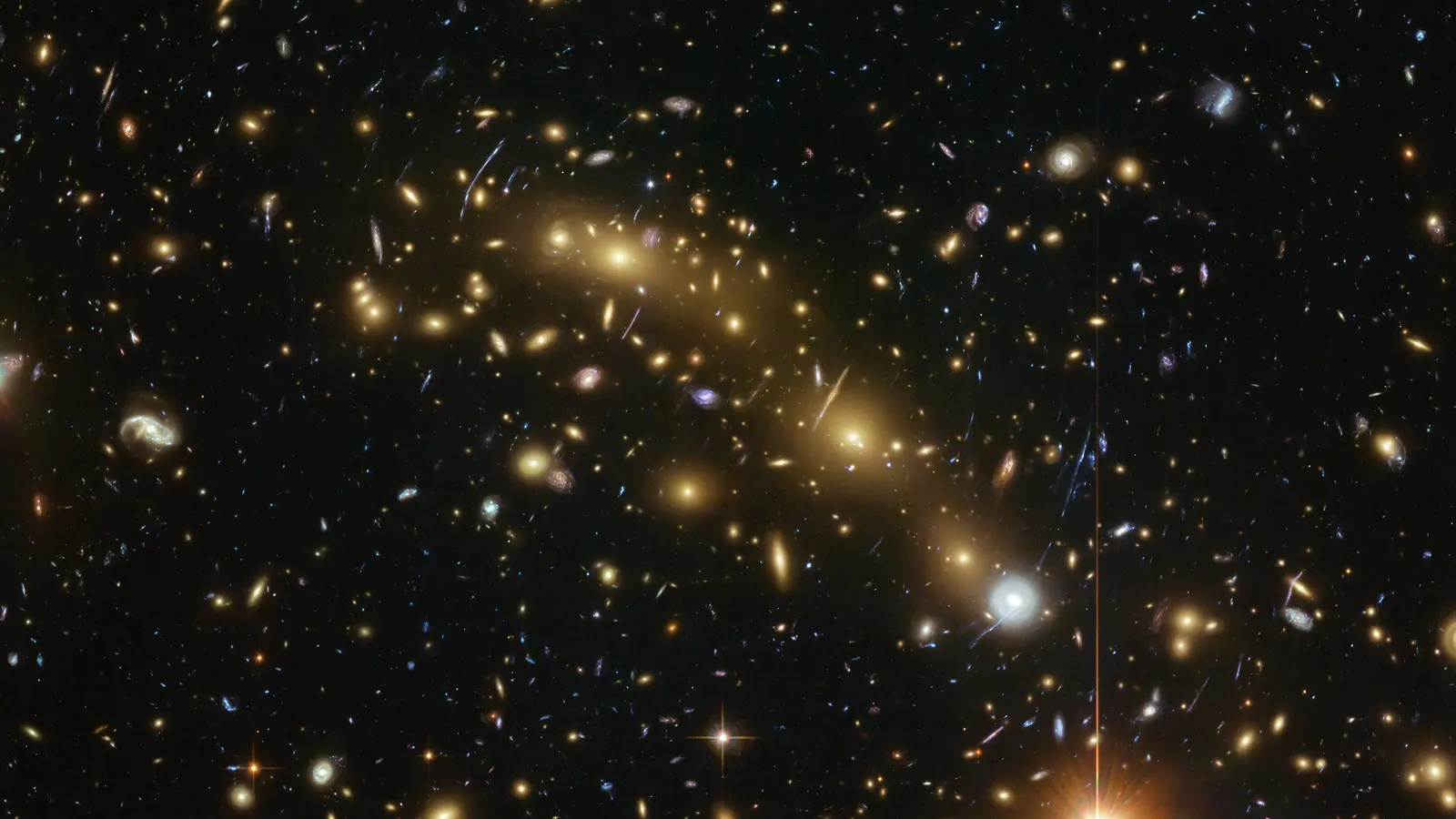
Imagine a silver ribbon unwinding around a faint galaxy 115 million light‑years away — thin, curved, and barely visible, yet holding the fingerprints of invisible mass. This is not a photograph of a fantasy; it's the newly identified stellar stream around UGC 9050‑Dw1, and it behaves like a cosmic seismometer for dark matter.
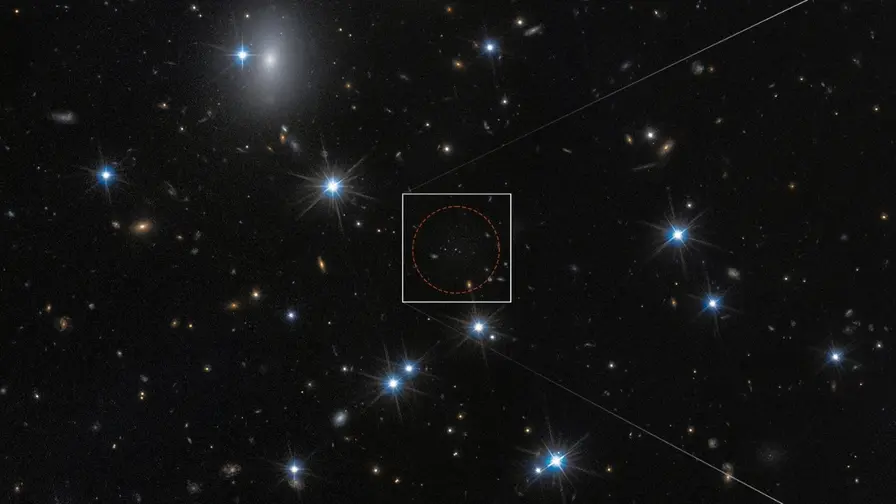
The find, published in Nature by an international team led by Julie Kiel Holm and Sarah Pearson, was coauthored by Northwestern astrophysicist Tjitske Starkenburg and several other researchers. What caught their eye in archival Hubble images was a narrow, comma‑shaped trace that matched the appearance of a globular cluster stellar stream — the first clear example of such a structure discovered outside the Milky Way.
Globular clusters are dense knots of stars bound together by gravity. Over time, the tidal pull from their host galaxy can peel stars away. Those escapees don't scatter randomly. They stretch into graceful leading and trailing streams that track the original orbit. Long after the cluster fades, its stream can persist. Think of it as a wake behind a boat: the water remembers the path even if you no longer see the vessel.
That remembered path is the key. A stellar stream's curve encodes the gravitational landscape it has traversed. By modeling those trajectories, astronomers can estimate a galaxy’s total mass and, crucially, infer how much of that mass must be dark matter. “The stars in a stellar stream all travel along nearly the same orbit, and that orbit is shaped by the galaxy’s gravity,” explains Tjitske Starkenburg. By subtracting the visible mass, the rest points to a hidden halo.

Hubble Space Telescope image showing the globular cluster stellar stream outlined with a box.
UGC 9050‑Dw1 is an ultra‑diffuse galaxy — faint, spread thinly across space. That dim backdrop paradoxically makes faint features easier to spot. Previous Hubble and radio work had already flagged the galaxy as odd: a distorted shape, a stellar plume, and an unusually rich population of globular clusters. The team estimates roughly 52 clusters, contributing about 20% of the galaxy’s light. Such abundance likely helped produce the newly seen stream.
Discovery came partly by serendipity. While combing through archival Hubble frames, coauthor David Hendel noticed the subtle arc. Ground‑based imaging then reinforced the impression that this was not an imaging artifact but a genuine astronomical structure. To go from suspicion to proof, the investigators ran thousands of computer simulations, varying the progenitor cluster’s properties and the galaxy’s mass distribution until the models reproduced the arc's shape and color.
The results favor a galaxy embedded in a substantial dark matter halo. This is the first time a globular cluster stream has been used to constrain the dark matter halo of an ultra‑diffuse galaxy. That single sentence matters: ultra‑diffuse galaxies are testing grounds for competing dark matter ideas, and a new, independent tool to probe them is a welcome addition.
There is more than one way a stream can teach us about unseen matter. Thin streams are delicate. A compact concentration of dark matter passing nearby can nudge stream stars, carving gaps or producing clumps — scars that reveal the size and frequency of small dark structures. Observers have debated whether similar features in Milky Way streams are signatures of dark subhalos. If confirmed, the technique scales beyond our galaxy and could map dark matter on finer scales than whole‑galaxy measurements allow.
The timing is fortunate. Future wide surveys from ESA’s Euclid and NASA’s Nancy Grace Roman Space Telescope will sweep far larger swaths of sky than Hubble ever could. Roman, in particular, can image areas roughly 100 times larger than Hubble’s deep fields, dramatically increasing the chance of finding more extragalactic streams and the tiny perturbations within them.
One delicate arc around one faint galaxy is not an answer; it is an invitation. Find many more streams, and we can compare dark matter environments across different types of galaxies, testing theories that today remain speculative. The river of stars around UGC 9050‑Dw1 has started to sketch the outline of what cannot be seen — and the next telescopes will give us the rest of the map.

Leave a Comment
Comments
No comments yet. Be the first.