

Picture this: a routine prescription for depression turns out to nudge the immune system at the very place cancer immunotherapy is trying to act. Strange, yes. Plausible, increasingly so.
Researchers scanning electronic health records have noticed a striking pattern. Among more than 3,000 cancer patients who began treatment with immune checkpoint inhibitors, those taking selective serotonin reuptake inhibitors—SSRIs—had fewer deaths recorded over the first two years than a matched group taking benzodiazepines. The numbers are hard to ignore: 23.5 percent of SSRI users died within two years versus 34.4 percent in the benzodiazepine group, and an adjusted analysis linked SSRI use to roughly a 37 percent lower hazard of death during follow-up.
Names you know—fluoxetine, sertraline, escitalopram—belong to the SSRI family. They change how serotonin is handled in the brain. But serotonin lives outside the skull, too, and immune cells seem to listen to it. A 2025 study in Cell found that the serotonin transporter (the protein SSRIs block) acts like an internal brake on T cells in mice. Remove that brake, the study showed, and T cells attack tumors more aggressively; pair that effect with anti–PD-1 drugs and tumors shrank more than with immunotherapy alone.
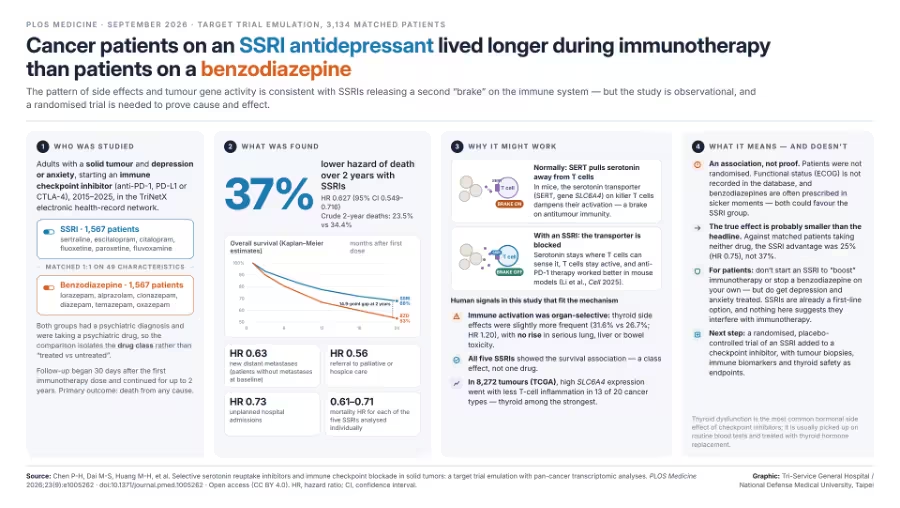
Study overview comparing SSRI antidepressant users with benzodiazepine users receiving cancer immunotherapy. SSRI use was associated with a 37 percent lower hazard of death over two years; the observational study cannot establish cause and effect.
The new clinical analysis, led by Po-Huang Chen and colleagues in Taiwan and published in PLOS Medicine, was careful but observational. Investigators used the TriNetX health-record network to identify adults with solid tumors who were prescribed either SSRIs or benzodiazepines while starting checkpoint inhibitors between 2015 and 2025. They matched 1,567 SSRI users to 1,567 benzodiazepine users across 49 baseline variables—age, tumor type, lab results, other meds—trying to compare like with like rather than contrast medicated patients to those taking nothing at all.
Still, association is not causation. Electronic records cannot capture everything that matters. The study lacked reliable measures of patients’ functional status—their ability to walk, eat, get out of bed—which is a powerful predictor of cancer outcomes. Benzodiazepines are often given for short-term anxiety or insomnia, sometimes when disease is flaring. That could mean the benzodiazepine group included more acutely ill patients despite matching. And SSRI prescriptions might signal better access to coordinated care: a proxy for more attentive doctors, more follow-up, or other unmeasured advantages.

Laboratory and genomic clues, however, add plausibility to the clinical signal. The team analyzed thousands of tumor samples from The Cancer Genome Atlas and found that higher expression of the gene encoding the serotonin transporter correlated with lower markers of T-cell inflammation in 13 of 20 cancer types. That doesn’t prove SSRIs reshape the tumor microenvironment in people, but it lines up with the mouse experiments and offers a conceivable biological pathway.
There were other findings worth noting. Thyroid disorders appeared more often in SSRI users (31.6 percent) than in benzodiazepine users (26.7 percent). Rates of hepatitis, pneumonitis and colitis were similar between the groups. But diagnosis codes can’t reliably determine whether thyroid events were immune-related side effects or unrelated problems, so that signal demands deeper study.
Survival curves and estimated cumulative mortality among 3,134 matched patients receiving cancer immunotherapy. SSRI antidepressant users (blue) had a 37 percent lower hazard of death than benzodiazepine users (orange). The study is observational.
What would settle the question? Randomized trials. Only a trial that assigns patients to an SSRI or placebo alongside checkpoint inhibitors can separate a drug’s direct immunologic impact from the many ways medical care and patient characteristics can skew observational results. Those trials would need to measure survival and progression, of course, but also collect tumor biopsies before and after treatment to see whether T-cell activity changes when serotonin signaling is blocked. Dose, drug choice, timing, and which cancers might benefit would all have to be worked out.
Until then, clinicians urge caution. Cho-Hao Lee, an oncologist involved in the analysis, sums it up plainly: this is not a reason to start an SSRI to boost immunotherapy, nor to stop benzodiazepines without your doctor’s guidance. The study opens a door. It does not prove that stepping through it will help patients live longer.
The idea that a medication prescribed for mood could also tweak antitumor immunity is an unsettlingly attractive hypothesis. It nudges us toward an uncomfortable and promising conclusion: drugs we thought we understood may still harbor unexpected effects on the immune system. Researchers must now build the experiments that separate hopeful correlation from reproducible clinical benefit, because the stakes could not be higher.


Leave a Comment
Comments (1)
This sounds promising but is it really causal? EHRs miss a ton, benzos often given when disease flares. SSRIs could just signal better care… we need RCTs.