
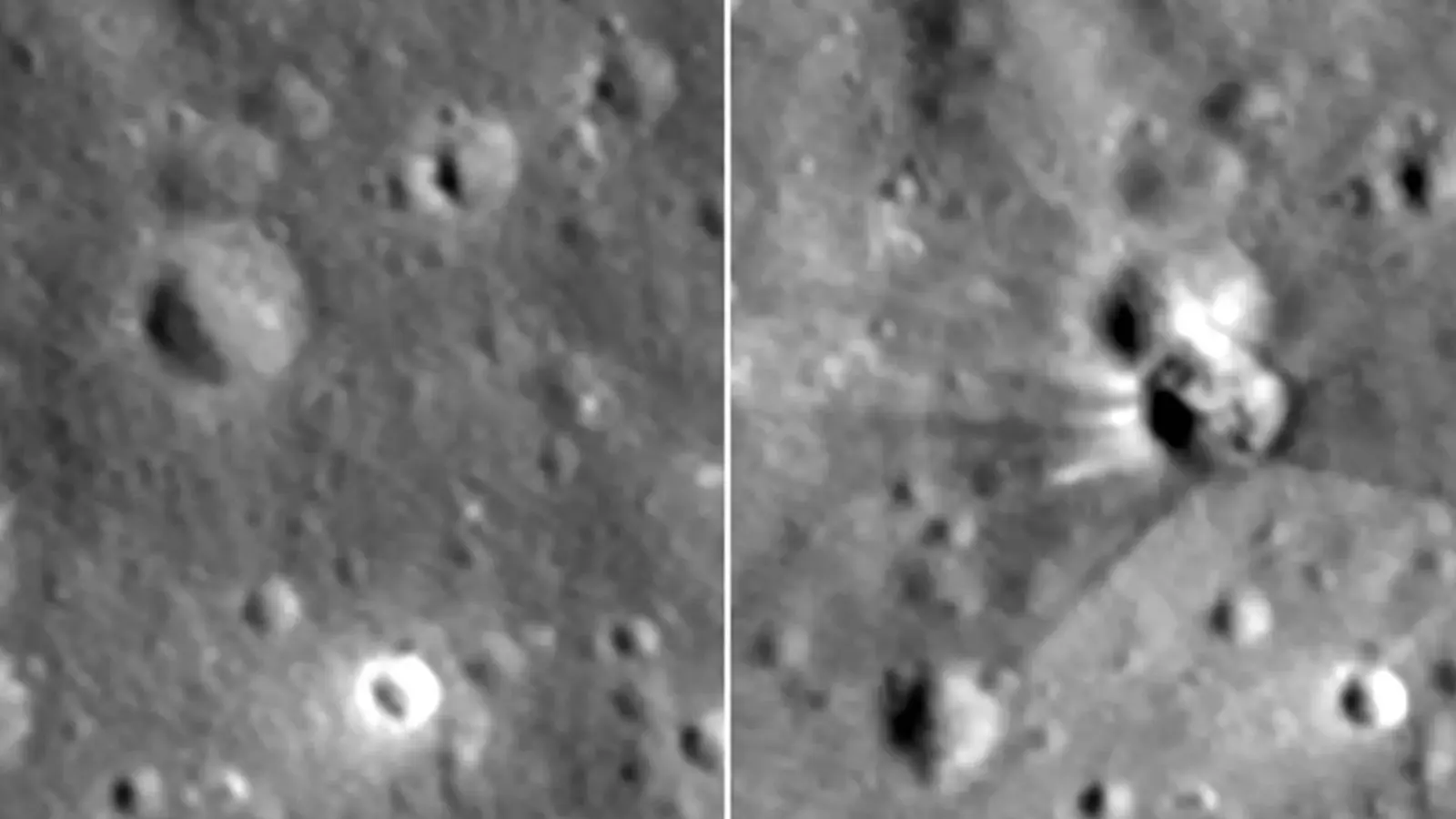
How does a discarded rocket stage carve a brand-new scar on the Moon? On August 5, 2025, a 4.4-ton upper stage from a Falcon 9 that had launched two lunar landers on January 15 slammed into the lunar surface and left a shallow, roughly 18-meter-wide crater surrounded by streaks of ejected rock.
Images captured by NASA's Lunar Reconnaissance Orbiter between August 11 and 12 reveal the fresh impact site: a dark, bowl-shaped depression ringed with linear rays of pulverized regolith. The scene looks recent. Sharp edges. Scattered blocks. Small, bright rays that betray material flung outward at the moment of contact.
South Korea's Danuri orbiter was first to reach the coordinates, photographing the feature and publishing the initial views on August 6. LRO followed six days later to collect higher-resolution imagery and confirm the measurements. Locating the site was not trivial; NASA credits a global network of amateur astronomers and experts for narrowing down where the strike occurred.
The projectile had not been an intact spacecraft but the Falcon 9's upper stage, a component routinely discarded once payloads are injected into transit. After circling Earth for nearly a year, the 4.4-ton stage drifted away under the tug of solar radiation pressure and lunar gravity. It ultimately collided near the Einstein crater in the Moon's northwestern near side — a region that happened to be sunlit at impact. That geometry, NASA says, meant any brief flash produced by the strike was not visible from Earth.

Speed helps explain the size. The stage hit at about 8,700 kilometers per hour (roughly 2.4 kilometers per second). Fast, yes. But modest compared with the typical speeds of meteoroids striking the Moon, which NASA cites as in the range of about 72,420 to 257,495 km/h. The lower relative speed and the stage's composition produced a comparatively small disturbance, which made the crater hard to pick out from Earth-based telescopes.
Beyond the immediate novelty — a human-made scar now cataloged on our closest neighbor — the event offers practical lessons. It underscores how spent rocket hardware can change trajectories over months and years, how lunar impacts of human origin can be traced and imaged, and how international collaboration speeds detection and verification. It also raises quieter questions about how future lunar activities will be monitored and managed as more missions arrive.
NASA’s imagery confirms a distinct 18-meter impact and highlights the value of orbital reconnaissance and global observation networks in tracking man‑made events on the Moon.
Expect more analysis as teams model the collision, study ejecta patterns, and sift through the images for clues about impact dynamics — and keep watching; the Moon still has surprises to reveal.

Leave a Comment
Comments
No comments yet. Be the first.