
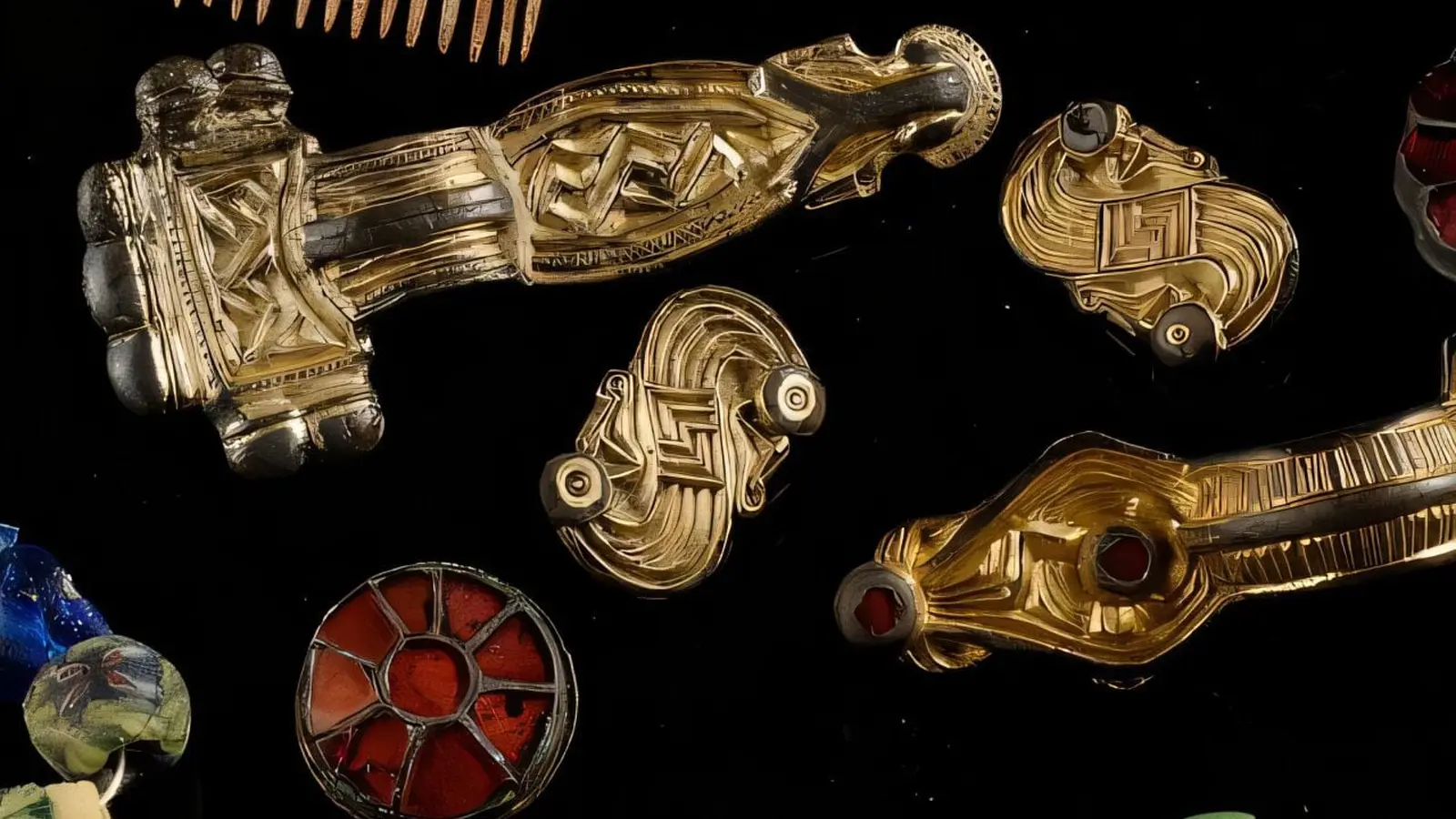
Imagine opening a grave and finding not just bones, but a biography written in DNA. That is essentially what an international team did in northwestern Hungary, where strands of ancient genomes have begun to redraw the map of early medieval Europe.
The HistoGenes project—led by Yijie Tian and István Koncz, with Patrick Geary as co-PI—published new results in Science after sequencing genomes from more than 300 individuals excavated across the Little Hungarian Plain. These are not dry statistics. They are voices from families, neighborhoods and shifting power centers as Rome’s shadow receded.
During the Roman era, communities in this lowland sat at a crossroads of trade and migration. Genetic signatures show a predominantly southern European ancestry there, laced with threads from Africa and Asia—mirroring the empire’s cosmopolitan networks. Then, in the wake of imperial decline, something changed. The genetic picture brightened with markers common in northern Europe. The switch was neither instant nor uniform. Instead of a single, sweeping replacement, the data trace repeated waves and long-distance ties linking the Little Hungarian Plain to northern populations.
So what does this tell us about the so-called ‘Barbarian’ period? For centuries historians have leaned on sparse texts—mostly written by Romans who had lost power—to describe an age of brute conquest. Genetics complicates that story. The newcomers associated with the Lombards did become politically dominant in the region, but dominance did not equate to wholesale erasure. Incoming groups with northern ancestry mixed and traded with local people carrying mostly southern roots. From that mixing emerged a mosaic of communities: rural settlements, fortified centers, and hierarchical social structures with new elites at the top.


This schematic illustrates the formation of differing forms of sixth-century communities through the convergence of migrating Northern European (blue) and local Southern European (red) ancestry. By combining ancient DNA, isotopic data, and archaeological data, we are able to reconstruct the emergence of complex regional hierarchies in the post-Roman world.
Archaeology and ancient DNA together reveal patterns that each method alone would miss. Material culture—pottery styles, burial goods, house plans—doesn't always map neatly onto ancestry. A grave richly furnished with objects tied to a migrating group might contain an individual whose genome matches the local population. Isotopic analyses add another layer, indicating who moved as a child versus who stayed put. The combination of lines of evidence shows movement that was complex: some people moved long distances, others relocated short hops, and still others integrated through marriage and adoption into existing networks.
Perhaps the most striking upshot is how social orders were reshaped. The arrival of northern-ancestry groups coincided with the rise of new political hierarchies, but those hierarchies drew on both local and incoming talent. In short, post-Roman society in this corner of Europe was not a simple story of conquerors versus conquered. It was a negotiated, negotiated again, and layered process—an unpredictable blending that produced fresh identities and new institutions.
Patrick Geary, reflecting on the broader HistoGenes effort, emphasizes the nuance: movements were sometimes slow and localized, sometimes rapid and far-reaching. Material culture and genetic ancestry did not always march in step. The archive in the ground, he argues, preserves a messy, human reality: people arriving, staying, marrying, ruling and adapting.
For readers used to tidy narratives of large-scale invasions, these findings are a reminder that population histories are rarely binary. The archaeology of the Little Hungarian Plain now reads like a patchwork quilt—stitched from threads of southern and northern ancestry, overlain by episodes of long-distance contact and punctuated by moments of swift change. Each genome adds a stitch. Each artifact adds color. Together they reveal a post-Roman Europe that was inventive, hybrid and socially complicated.

If ancient DNA can do this in a single region, imagine what a continent-wide reading might show. The past, it turns out, keeps surprising us when we learn to listen in new languages—like the language written inside our cells.

Leave a Comment
Comments
No comments yet. Be the first.