
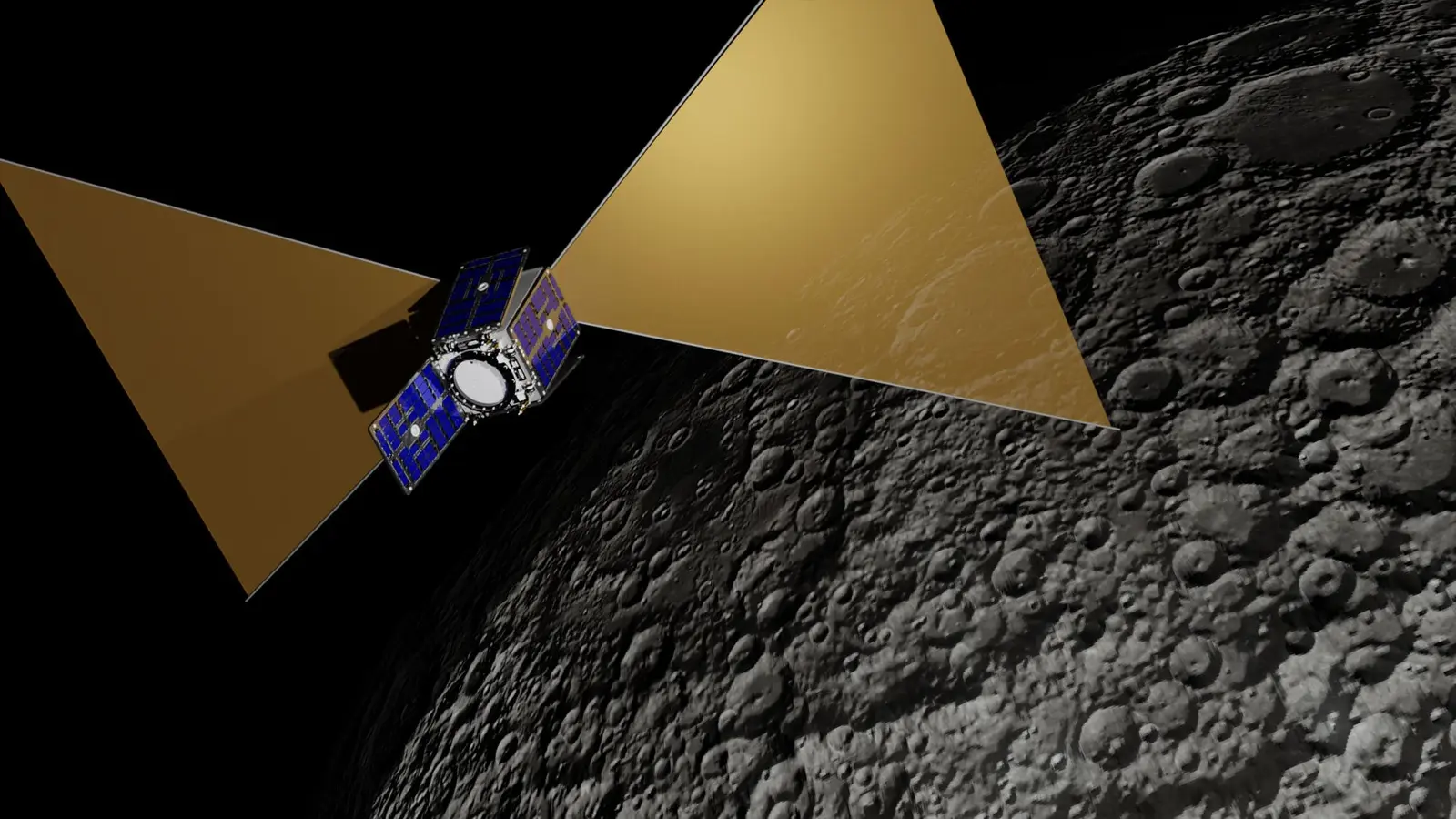
Imagine a tiny spacecraft, no larger than carry-on luggage, drifting out of Earth orbit and slipping into the Moon's shadow like a ship entering harbor at night. For a brief window each orbit it will sit behind the Moon, shielded from our planet's relentless radio chatter, and listen for a whisper that has been traveling since before the first stars ever ignited.
That listening post is CosmoCube, a UK-led mission built to eavesdrop on the universe's so-called dark ages. This is the period—roughly 150 million years long—after the Big Bang's afterglow faded and before the Cosmic Dawn when the first stars switched on. Astronomers suspect that neutral hydrogen left a faint fingerprint across very low radio frequencies during that time. Detecting that 21-centimeter line redshifted to between about 10 and 50 MHz would be like finding a fossil record of the cosmos before light as we know it existed.
Why hide behind the Moon? Could anything on Earth hope to hear such an ancient, feeble signal? The short answer is no. The ionosphere scrambles and blocks those low frequencies, and human-made sources—FM radio, satellites, mobile networks—overwhelm the sky. The Moon's far side acts as a natural radio shield, a quiet bowl facing deep space. CosmoCube will take advantage of that calm: in a two-hour lunar orbit the craft will spend roughly 40 minutes each pass in radio silence, accumulating an expected thousand hours of observations over a planned two-year mission.
Small does not mean simple. CosmoCube unfolds a long, lightweight radio antenna once it reaches lunar orbit. It listens across a band largely off limits to ground telescopes. The challenge is not only cosmic faintness but self-noise. Electronics hum. Temperatures swing. Tiny instrumental drifts can masquerade as meaningful features.
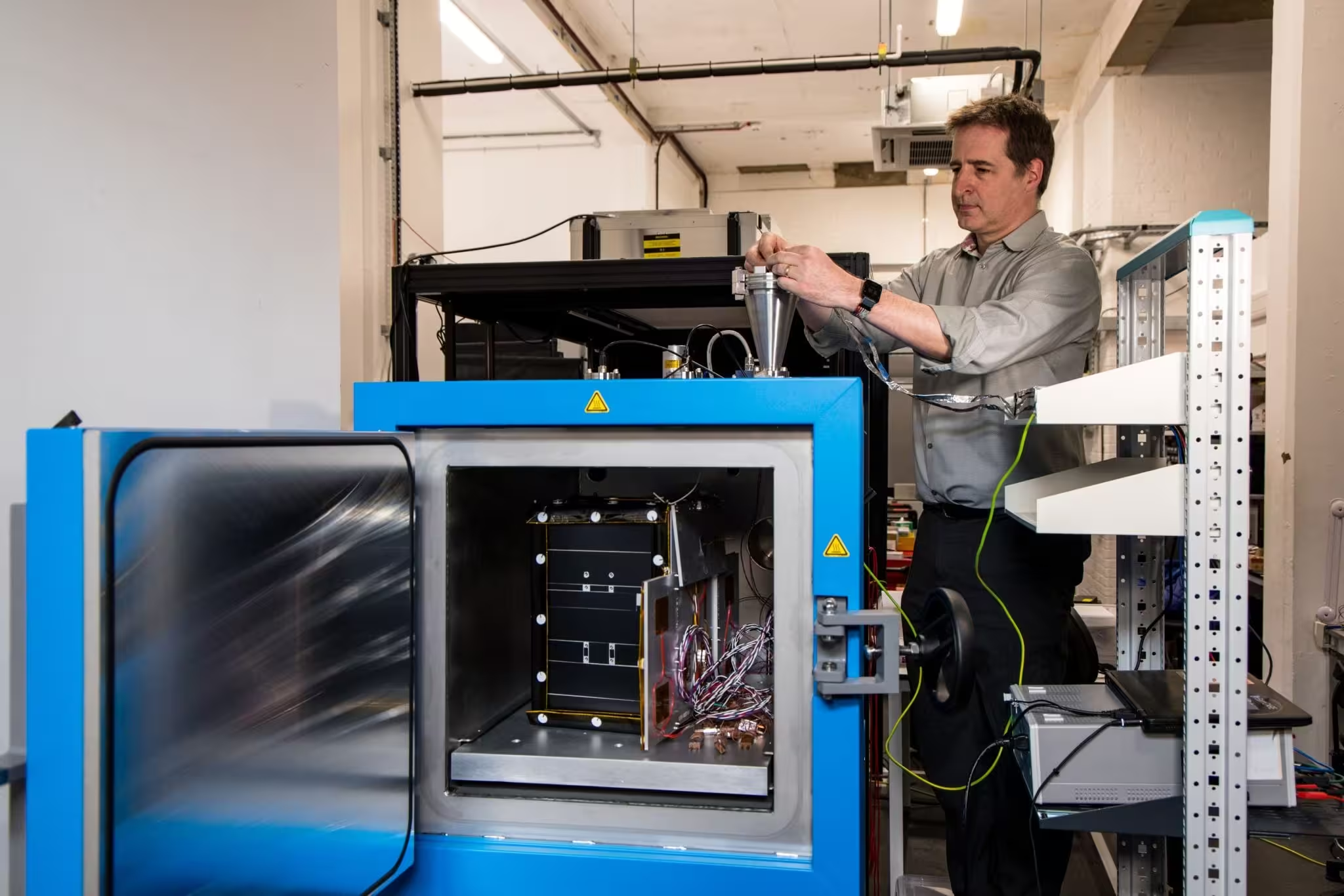
A representative model of CosmoCube undergoing thermal tests at RAL Space.
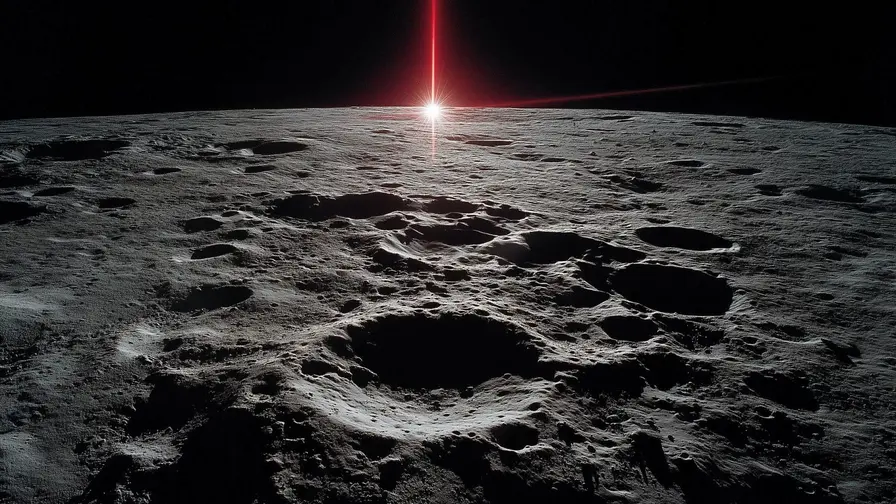
To fight that, the team equipped the satellite with a Dicke-switched calibration system that alternates sky measurements with built-in reference loads. Repeated switching lets scientists track and subtract instrumental quirks before they corrupt the data. After the telemetry returns to Earth, sophisticated Bayesian analyses will separate the sought-after hydrogen signature from much brighter foregrounds—chief among them the Milky Way's own radio glow. The team will also simulate and measure how the antenna responds to different parts of the sky so they can unpick residual distortions.
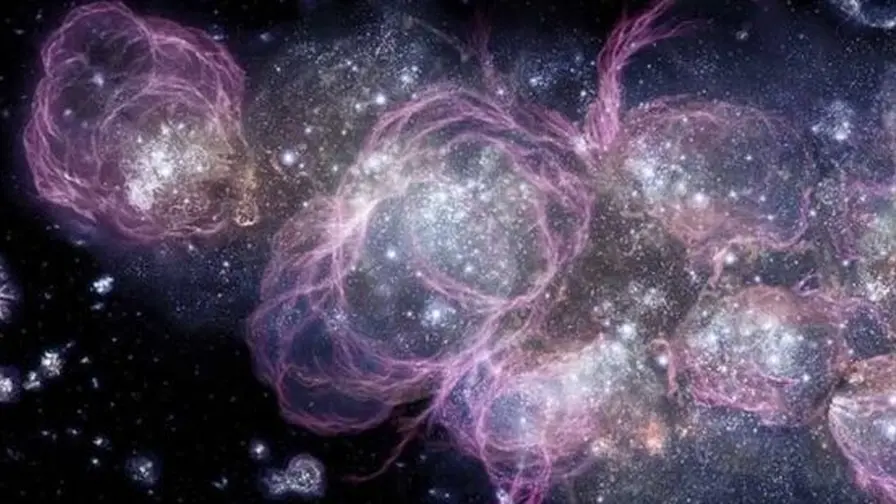
CosmoCube's science stretches beyond a single spectral line. Observing the Universe before stars formed is a direct probe of how dark matter behaved at early times—how it shepherded hydrogen into the seeds of the first galaxies. Did dark matter speed up cooling? Did it leave an imprint on the distribution and temperature of primordial hydrogen? Answers to questions like these would fundamentally change our picture of structure formation.
This compact mission could open a clear radio window into the universe's dark ages, revealing physics no telescope has yet touched.
Engineers have packed modern analog and digital technologies into a miniature radiometer built on RF-Systems-on-Chip (RFSoC). The spacecraft bus, dubbed SSTL-21, comes from Surrey Space Technology Ltd (SSTL), a British small-satellite specialist. Prototypes already exist; environmental and thermal testing is underway at facilities including STFC RAL Space. Academic partners across the UK and Europe—Cambridge's Cavendish Laboratory, Portsmouth University, Malta collaborators and others—have contributed to design, simulations and payload development. The project has attracted UK Space Agency funding and has been described in Nature Astronomy; the team hopes for a launch within about five years.
There is a race element here, too. The Moon's far side is unusually pristine today, but it won't stay empty forever. Nations planning lunar exploration—crew missions, landers, communication relays—will gradually add radio sources to that landscape. The quieter the far side remains now, the better for experiments like CosmoCube. This satellite is part science experiment and part argument: keep a corner of the Moon free enough that future generations can still listen for the faintest echoes of the cosmos.
CosmoCube sits at an intriguing intersection: ambitious cosmology from a low-cost, compact platform. It asks a big question with a small package. Can we use a suitcase-sized probe to read a chapter of the universe that has never been opened? If the mission succeeds, the answer will be louder than the craft itself.

Leave a Comment
Comments
No comments yet. Be the first.