
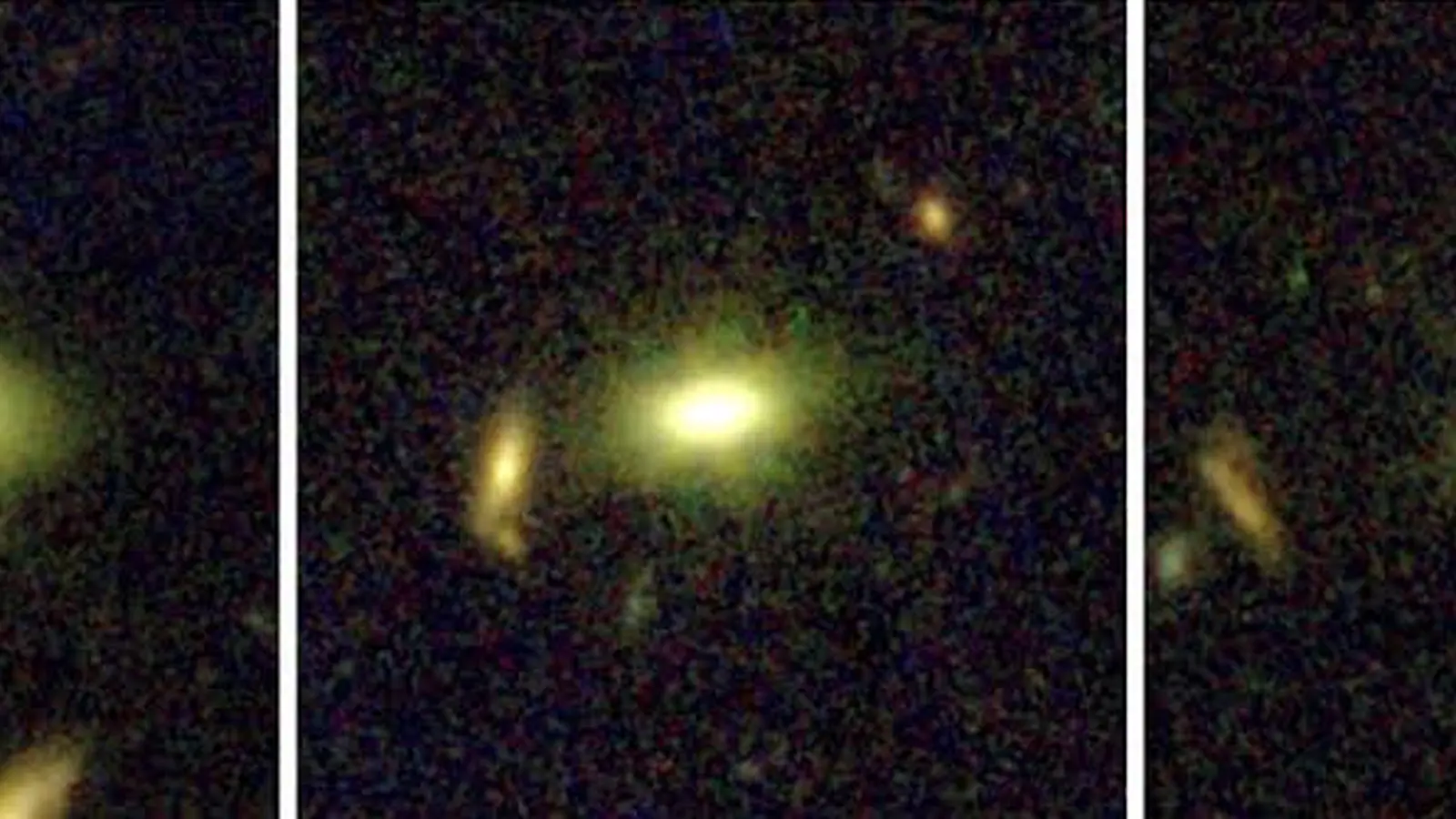
Light from the universe's youth can lie to you. From across billions of years, the brightest stars shout the loudest, hiding quieter neighbors that, together, can outweigh the flashy few.
An international team led by astronomers using NASA's James Webb Space Telescope, together with archival data from the Very Large Telescope, has found that some enormous galaxies formed early in cosmic history harbor far larger populations of low-mass stars than researchers assumed. By dissecting the galaxies' spectra with new models and unusually sharp observations, the group uncovered spectral fingerprints that betray a hidden, faint stellar majority — the kind of stars that barely glimmer on their own but collectively carry substantial mass.
The sample was small but telling: nine massive, mature galaxies that had already stopped forming stars long ago. When the team untangled the mixed colors in each galaxy's light they saw something unexpected. The light from a handful of luminous giants had been drowning out the chorus of dimmer, low-mass stars. Once those subtler signals were teased out, the inferred stellar mass of some galaxies ballooned — sometimes by factors of three or four.

Think of it like a skyline at night. A few skyscrapers dominate the view, but between them sit thousands of small homes. From far away you notice the towers. From a closer look, you realize the suburbs are vast and heavy. The same idea applies to these ancient systems: bright stars reveal the presence of a galaxy, but the true weight of that galaxy may be carried by countless faint stars you almost missed.
These measurements challenge a long-standing assumption in galaxy studies: that the initial mix of stellar masses is roughly universal. Astronomers often use a standard distribution to translate a galaxy's light into total mass, an approach that works well in many nearby systems. The new JWST-based analysis suggests that for the most massive galaxies in the early universe, the stellar mix was skewed toward low-mass stars, meaning prior mass estimates could be systematically low.
One object in the set stood out. Formed within about 1.5 billion years after the Big Bang, it appears to host up to four times the stellar mass previously estimated under conventional assumptions. If that result holds across a larger population, then our picture of when and how the first heavy galaxies assembled will need revision. The extra weight deepens a growing puzzle: JWST has already revealed surprisingly mature and massive galaxies at epochs when, according to standard models, such systems should be rare.
The implications ripple outward. Galaxy formation simulations will have to account for processes that produce many low-mass stars early on. Stellar mass governs gravitational potential, merger histories, and the efficiency of feedback that regulates star formation. Even exoplanet studies may feel the effect, because low-mass stars are fertile hosts for planets; more low-mass stars in the early universe could mean a richer inventory of ancient planetary systems than previously imagined.
Penn State astronomers contributed advanced modeling techniques that helped pull weak spectral features from noisy data. That effort depended on JWST's sensitivity and the high-resolution spectra that ground-based observatories supplied. Together, the instruments and analysis opened a window that was simply closed before.
What's next? The team plans to push the same approach to even earlier cosmic times, hunting for faint-star signatures closer to the era when the first generations of stars and galaxies flickered into existence. Each new spectrum could either confirm a trend or force theorists back to the drawing board.
Either way, the lesson is clear: when you weigh the cosmos, don't trust the brightest lights to tell the whole story.

Leave a Comment
Comments
No comments yet. Be the first.