

4 Minutes
Imagine your blood telling a different story about your age — not in wrinkles or gray hairs, but in the chemical signals that slide through every artery and vein. That's what a tightly controlled month-long diet experiment appears to have done for a group of older adults: their biomarker 'age' moved noticeably younger, fast.
Researchers at the University of Sydney enlisted 104 people aged 65 to 75 in the Nutrition for Healthy Living trial. For four weeks every meal was prepared and delivered. No calorie counting. Eat until satisfied. Participants were assigned at random to one of four menus so no one picked their own plan.
Two menus mixed plant and animal sources, with roughly half the protein coming from animals. Two were semi-vegetarian, where about 70 percent of protein came from plants. Each of those styles was split again: one variant higher in fat and lower in carbohydrates, the other lower in fat and higher in carbohydrates. Across all menus, protein accounted for about 14 percent of total energy.
Before and after the intervention the team estimated each person's biological age using the Klemera-Doubal Method (KDM), a way to compress multiple clinical markers into a single age-like metric. Different KDM versions used seven or 15 markers — measures such as cholesterol, fasting glucose and insulin, blood pressure, inflammation-related signals, waist circumference and BMI.
What happened? The diet most like participants' usual intake — a higher-fat menu containing animal foods — produced no meaningful change in the biological-age estimate. The other three menus nudged the clock downward. The biggest shift showed up in the group eating both plant and animal foods but with less fat and more carbohydrates: their KDM estimate was roughly 3.5 to 4.1 years lower than the high-fat comparison after accounting for baseline differences.
Does that mean these people literally got younger in a month? Not quite. Study co-author Alistair Senior cautions against that headline. He says calling participants 'biologically younger' risks overstating the result; more precise language is that the diets produced 'the biomarker profile of a younger person'.

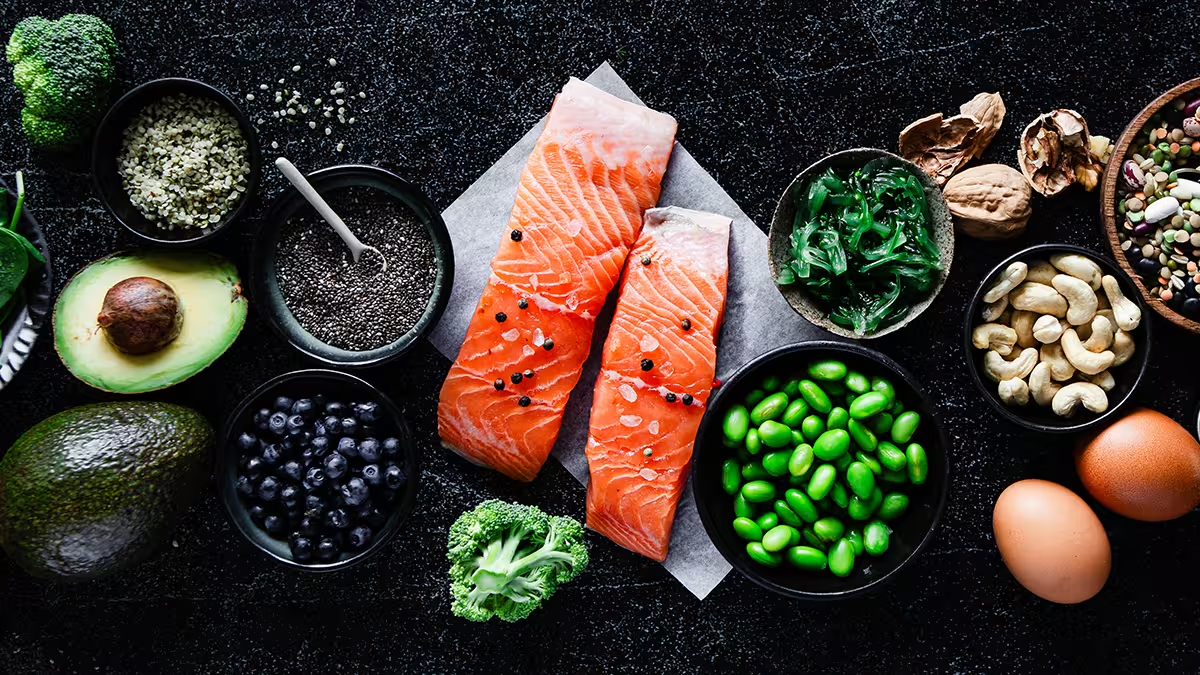
Key context: the higher carbohydrate menus were not an invitation to sugar and pastries. Carbohydrates mainly came from whole, minimally processed sources. The groups that shifted to younger biomarker profiles also ate more fiber, less total and saturated fat, and somewhat less animal protein than they were used to. The researchers point to saturated fat as a plausible driver separating the high-fat omnivorous menu from the others.
There is another wrinkle. Biological-age calculators like KDM draw on metrics that can change rapidly. Stress, sleep loss or an acute illness can tug these markers upward or downward over days to weeks. Diet in particular can quickly affect blood sugar, lipids, insulin and inflammatory signals — the very inputs that drive a KDM score. So the clock may have moved because the body responded favorably to four weeks of cleaner, controlled meals, rather than because the underlying pace of aging slowed.
The trial cannot decide between those possibilities. It was short, involved a modest number of fairly healthy older Australians who already had younger-than-expected physiological profiles at baseline, and stopped once researchers stopped delivering meals. The study did not measure whether the biomarker changes persisted, lowered risk of age-related disease, or translated into longer or healthier lives.
Four weeks of controlled meals changed biological-age signals — a striking hint, but not proof of slowed aging.
So what should we take away? The study suggests the body's apparent age is not an immovable tally. Metabolism, inflammation and cardiovascular markers respond to what we eat, and that response can show up quickly on composite biomarker clocks. For scientists, the result is an invitation: longer, larger trials that follow people after the intervention ends and that track actual disease outcomes will be needed to know whether shifting biomarkers today means fewer heart attacks or healthier years tomorrow.
For anyone tempted to leap to a diet trend: the lesson is nuanced. Whole-food carbohydrates, more fiber and lower saturated fat — not refined sugars — were associated with the most favorable shifts in this controlled trial. Whether that translates into real-world, lasting anti-aging benefits is a question begging for a longer answer.
Would you change what’s on your plate for four weeks to see what your blood says about your age?


Leave a Comment
Comments (1)
hmm is a 4-week biomarker shift really an 'age reversal' or just short-term diet effects? need longer followup, not convinced...