
3 Minutes
Photon-like electrons and a new class of quantum materials
Quantum materials host exotic charge carriers that can behave more like photons than conventional electrons. On September 13, 2025, researchers at Ehime University reported the synthesis and combined theoretical–experimental study of a family of organic charge-transfer compounds whose electrons exhibit relativistic, photon-like behavior. These so-called Dirac electrons can be effectively massless and travel with velocities approaching those of light within the crystal lattice, producing distinctive electronic and magnetic responses that set quantum materials apart from ordinary solids.
Scientific background: Dirac electrons and linear band dispersion
What are Dirac electrons?
Dirac electrons are quasiparticles in solids that obey a relativistic-like dispersion relation described by the Dirac equation. Unlike conventional electrons with a parabolic energy–momentum relation, Dirac electrons have a linear relationship between energy and momentum, causing unusual transport, optical, and magnetic properties.
Linear band dispersion (LBD) explained
Linear band dispersion (LBD) is the characteristic band-structure feature where electronic energy bands cross with a linear slope near the crossing point (Dirac point). LBD leads to high carrier mobility, suppressed backscattering, and distinctive magnetic susceptibility. The Ehime University team demonstrated that LBD is the microscopic origin of a universal magnetic signature found across the synthesized organic compounds.
Experiment, modeling and the key discovery
The research combined chemical synthesis of organic charge-transfer complexes with spectroscopic characterization, magnetometry, and first-principles band-structure calculations. Experimentally, some compounds displayed temperature-dependent crossovers between conventional electron behavior and Dirac-like behavior; in others the carriers showed intermediate or mixed characteristics. Using an original theoretical model built by the team, the researchers linked the observed magnetic response directly to linear band dispersion.
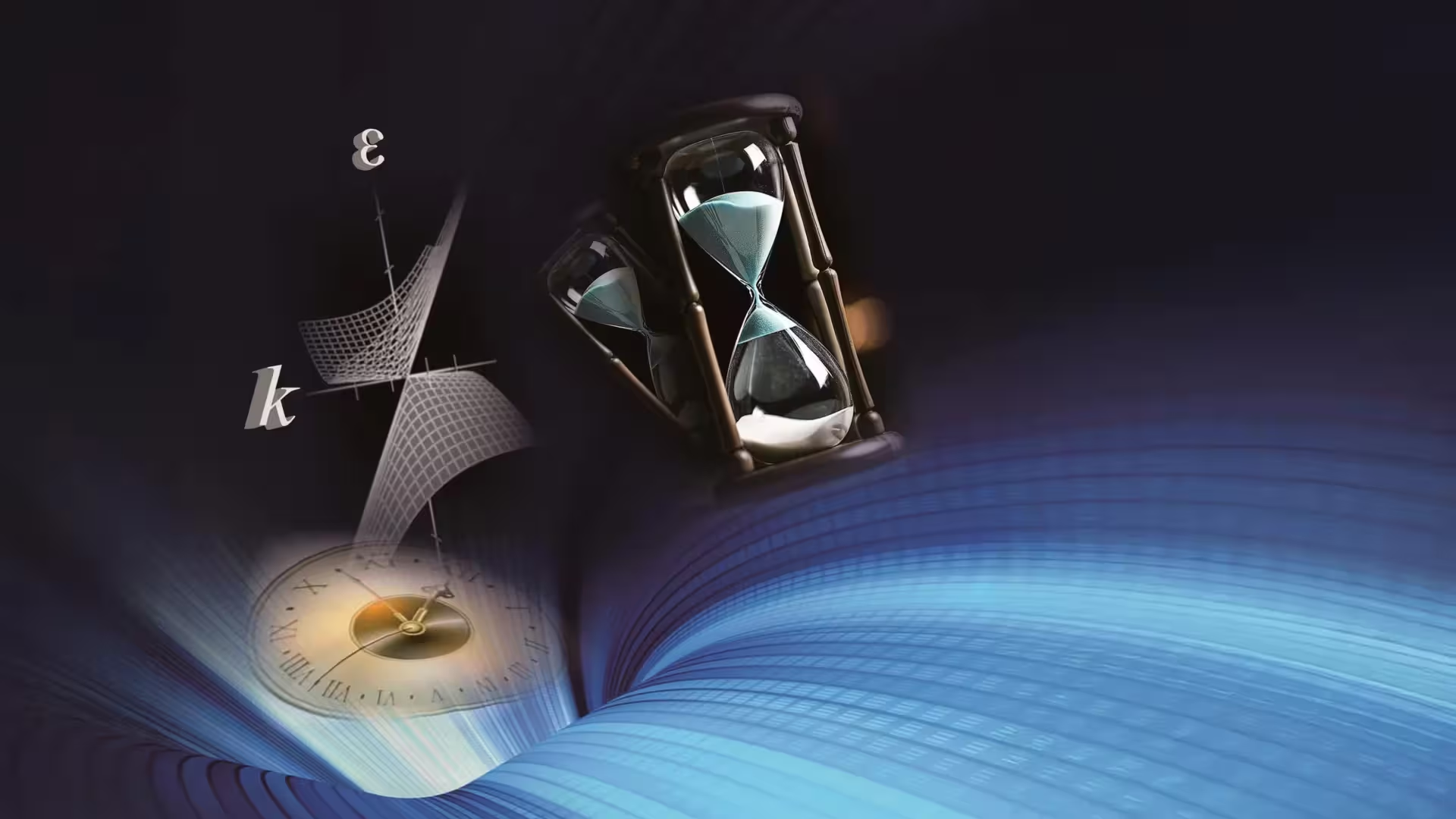
The central finding is that the magnetic behavior — measured as a characteristic temperature and field dependence in magnetic susceptibility — is intrinsic and universal to quantum materials whose band structures include LBD. In other words, the magnetic fingerprints are not accidental features of a single compound but arise from a common electronic topology shared by this class of materials.
Implications for technology and future research
This discovery deepens fundamental understanding of quantum systems and narrows the search for materials with predictable, tunable quantum properties. Materials with LBD and Dirac electrons are promising for next-generation information and communication technologies, including ultrafast electronics, low-dissipation interconnects, and components for spintronics and quantum information platforms. Organic compounds bring advantages in chemical tunability and potential for flexible or low-cost device integration that inorganic crystals may lack.
"Our results show a clear theoretical–experimental link between band topology and magnetic response," said Dr. Keiko Sato, lead investigator at Ehime University. "This makes it easier to screen and design molecular materials with desired quantum properties."
Expert Insight
Dr. Maya Patel, condensed-matter physicist at a national laboratory, commented: "Finding a universal magnetic signature tied to linear band dispersion is a significant step. It gives materials scientists a measurable, robust criterion for identifying Dirac-like behavior in organic systems. That will accelerate the path from discovery to device demonstration, especially where molecular design can tune the band structure."
Conclusion
The Ehime University study identifies a universal magnetic behavior rooted in linear band dispersion across a new family of chemically synthesized organic quantum materials. By connecting band topology to measurable magnetic properties, the work advances both theoretical understanding and practical pathways to exploit Dirac electrons in future information and communication technologies. Continued synthesis, detailed spectroscopic studies, and device-level testing will be needed to translate these quantum signatures into technological applications.


Leave a Comment
Comments
No comments yet. Be the first.