
4 Minutes
a spotted rock and a possible clue to ancient life
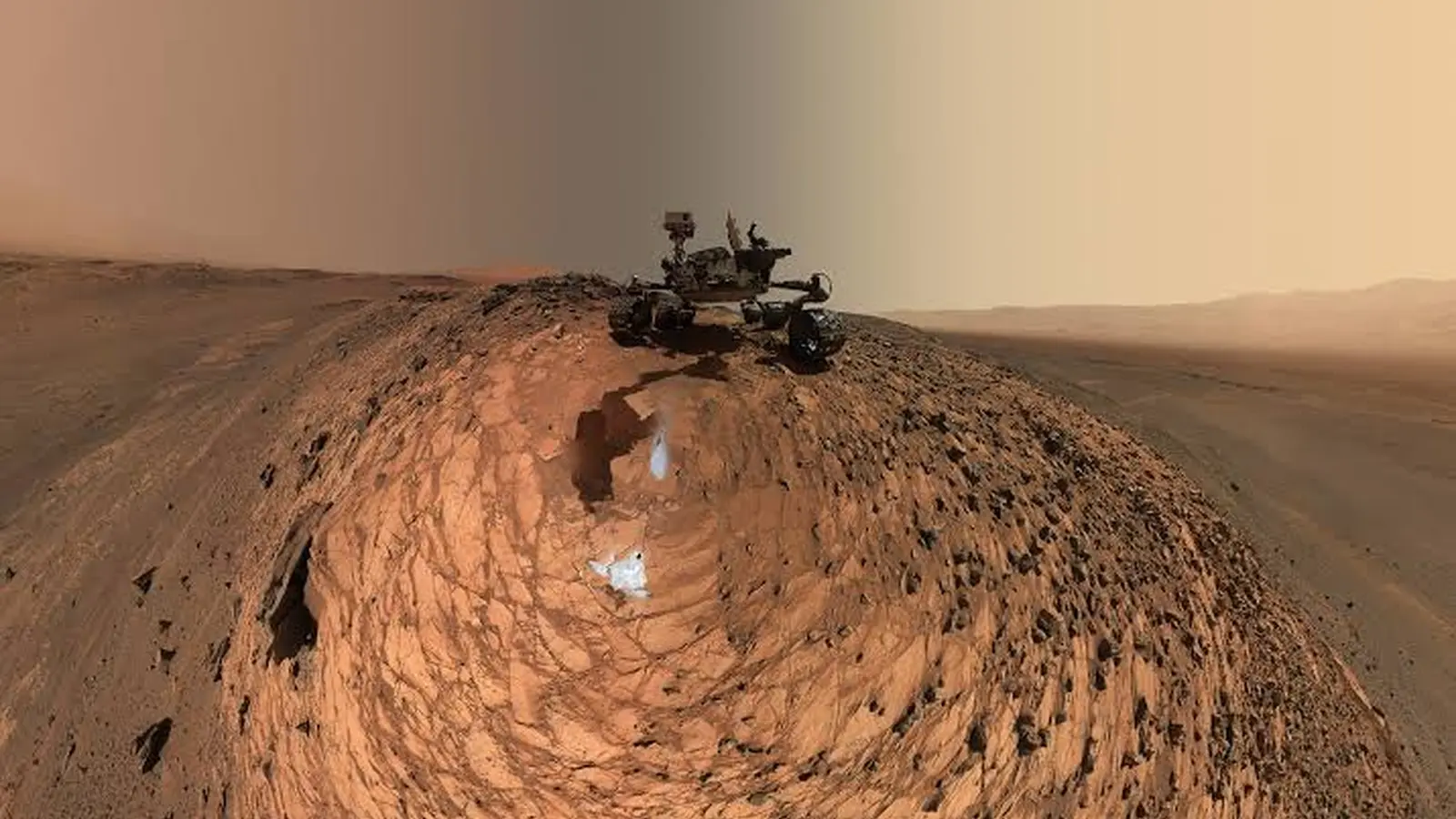
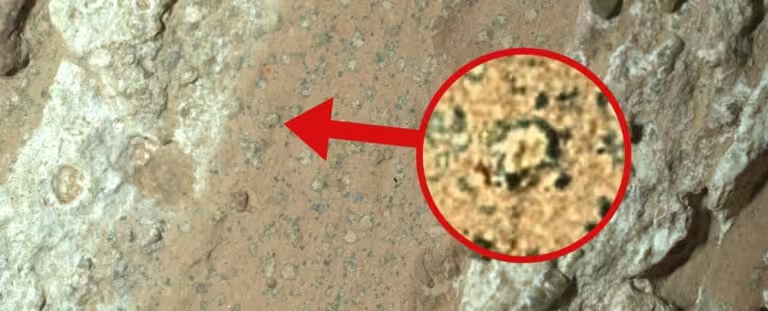
In July 2024 the Perseverance rover drilled into a distinctive, banded rock in Jezero Crater called Chevaya Falls and collected a sample the science team has named Sapphire Canyon. Early instrument analyses revealed an unusual, spotted texture across the rock surface: concentric patches enriched in iron-bearing minerals. A study published 10 September 2025 describes those mineral associations as a potential biosignature, raising the possibility that chemical reactions driven by ancient microbes produced the observed pattern.
What is a biosignature and why it matters
A biosignature is any measurable feature—molecular, mineralogical, structural or isotopic—that provides evidence of past or present life. On Earth, biosignatures range from fossilized remains and organic molecules to mineral textures created by microbes. For Mars, scientists classify candidate features as "potential" biosignatures when their biological origin is plausible but not yet proven; such findings require additional data, contextual analysis, and ideally laboratory confirmation on Earth.
Types of biosignatures
Biosignatures can be chemical (specific organic molecules or isotopic ratios), physical (microfossils or microbial fabrics), or mineralogical (minerals that form preferentially in biological settings). Identifying a robust biosignature on Mars depends on both the intrinsic properties of the feature and the geological context that could preserve or alter it over billions of years.
Why the Sapphire Canyon sample is scientifically compelling
Sapphire Canyon earned attention because Perseverance’s PIXL (Planetary Instrument for X-ray Lithochemistry) and SHERLOC (Scanning Habitable Environments with Raman & Luminescence for Organics & Chemicals) instruments mapped a pattern scientists call "leopard spots": concentric reaction fronts enriched in vivianite (an iron phosphate) and greigite (an iron sulfide).
On Earth, vivianite frequently forms in environments with abundant decaying organic material, and greigite can be produced by sulfate-reducing microbes. Both minerals are involved in redox (reduction–oxidation) chemistry: spatial gradients where electron donors and acceptors change across a small distance, creating conditions that microbes exploit for energy. Where such gradients persist, microbes can catalyze reactions that leave distinct mineralogical fingerprints.
Abiotic alternatives and the geological context
Minerals like vivianite and greigite can also form through nonbiological processes, for example under high-temperature alteration, in strongly acidic settings, or through purely inorganic aqueous chemistry. The Sapphire Canyon sample, however, shows no clear signs of the intense heat or extreme acidity usually required to explain greigite and vivianite abiogenically. That geologic context—combined with the patterned, concentric textures—makes the biological hypothesis plausible but not yet conclusive.
Jezero Crater, mission aims, and why this location matters
Perseverance was sent to Jezero because the crater contains an ancient river delta and lake sediments—environments on Earth that readily preserve biological material. Rocks deposited in lakes and deltas often record chemical and textural evidence of past habitability and, in favorable cases, biosignatures. Finding the spotted mineralogy in Sapphire Canyon, which comes from relatively young sedimentary layers for the mission, expands the temporal window during which Mars may have been habitable and suggests later episodes of favorable chemistry than previously assumed.
Mission tools and limits
Perseverance’s suite of instruments can identify mineralogy, texture, and some organic chemistry in situ, but they cannot provide the full suite of ultra-sensitive isotopic and molecular analyses available in terrestrial laboratories. That is why the Mars Sample Return campaign is essential: definitive discrimination between biologically mediated and abiotic origins typically requires high-resolution isotopic work, compound-specific organic analyses, and advanced microscopy performed on Earth.
Next steps: tests, sample return and hypotheses to evaluate
Scientists will continue to examine alternative, nonbiological formation pathways for the Leopard Spot minerals: sustained heating, pervasive acidic alteration, or adsorption by abiotic organics. The Chevaya Falls rock currently lacks obvious markers of those conditions, but ruling them out fully requires further remote observations, comparative studies across other sampled rocks, and—ultimately—returned samples.
Once returned to Earth, the Sapphire Canyon sample would be subjected to isotopic fractionation studies (carbon, sulfur, iron), high-resolution imaging to search for microfabrics and potential cell-like structures, and advanced organic chemistry assays to detect molecular distributions consistent with life. Those analyses are the only path to a confident interpretation.
Expert Insight
"The patterning we see in Sapphire Canyon is exactly the kind of contextual clue we hoped Perseverance would find," says Dr. Elena Ramirez, an astrobiologist who works on analogue lake sediments. "But we must be cautious: Mars preserves chemistry differently than Earth. The most reliable approach is a stepwise one—test alternative abiotic scenarios, gather more in situ context, and then bring the best samples home for laboratory confirmation."
Conclusion
The mineral "leopard spots" in the Sapphire Canyon sample are an intriguing potential biosignature because they pair minerals commonly associated with biological redox processes and occur in a geological context conducive to preservation. However, abiotic mechanisms remain plausible, and definitive proof will depend on more data and, critically, analyses conducted on returned samples. Until then, the finding highlights Jezero Crater’s value as a window into Mars’ past habitability and reinforces the scientific priority of sample return and rigorous, multi-disciplinary scrutiny.


Leave a Comment
Comments
No comments yet. Be the first.