

5 Minutes
Quantum Signals Travel on Live Commercial Fiber
A University of Pennsylvania engineering team has demonstrated that quantum information can travel alongside conventional internet traffic on existing commercial fiber-optic infrastructure. A compact integrated device, dubbed the Q-chip, coordinated quantum and classical signals and transmitted them over Verizon’s campus network using standard Internet Protocol (IP) methods.
A Penn team has shown that quantum signals can ride alongside everyday internet traffic on commercial fiber. Their “Q-chip” experiment marks a step toward a scalable quantum internet with world-changing potential. Credit: Shutterstock
This experiment, published in Science, marks a milestone in moving quantum networking out of controlled laboratory settings and into real-world telecommunications systems. The tests prove that fragile quantum states can be packaged, routed and error-corrected while sharing fiber with typical data traffic, an essential capability for future wide-area quantum communications and distributed quantum computing.
How the Q-chip Coordinates Classical and Quantum Data
The Q-chip (Quantum-Classical Hybrid Internet by Photonics) pairs a measurable classical “header” signal with a protected quantum payload. The classical header travels just ahead of the quantum particles and can be read using ordinary network equipment. That readable packet provides routing and status information without ever interacting with the quantum state itself.
“By letting a classical header lead the way, we can determine routing and correct for channel disturbances while leaving the quantum information unmeasured,” explained Liang Feng, professor of Materials Science and Engineering and Electrical and Systems Engineering, who led the study. This arrangement allows the system to use IP-style packet addressing, dynamic switching and familiar network-management frameworks to move quantum data across existing fiber networks.
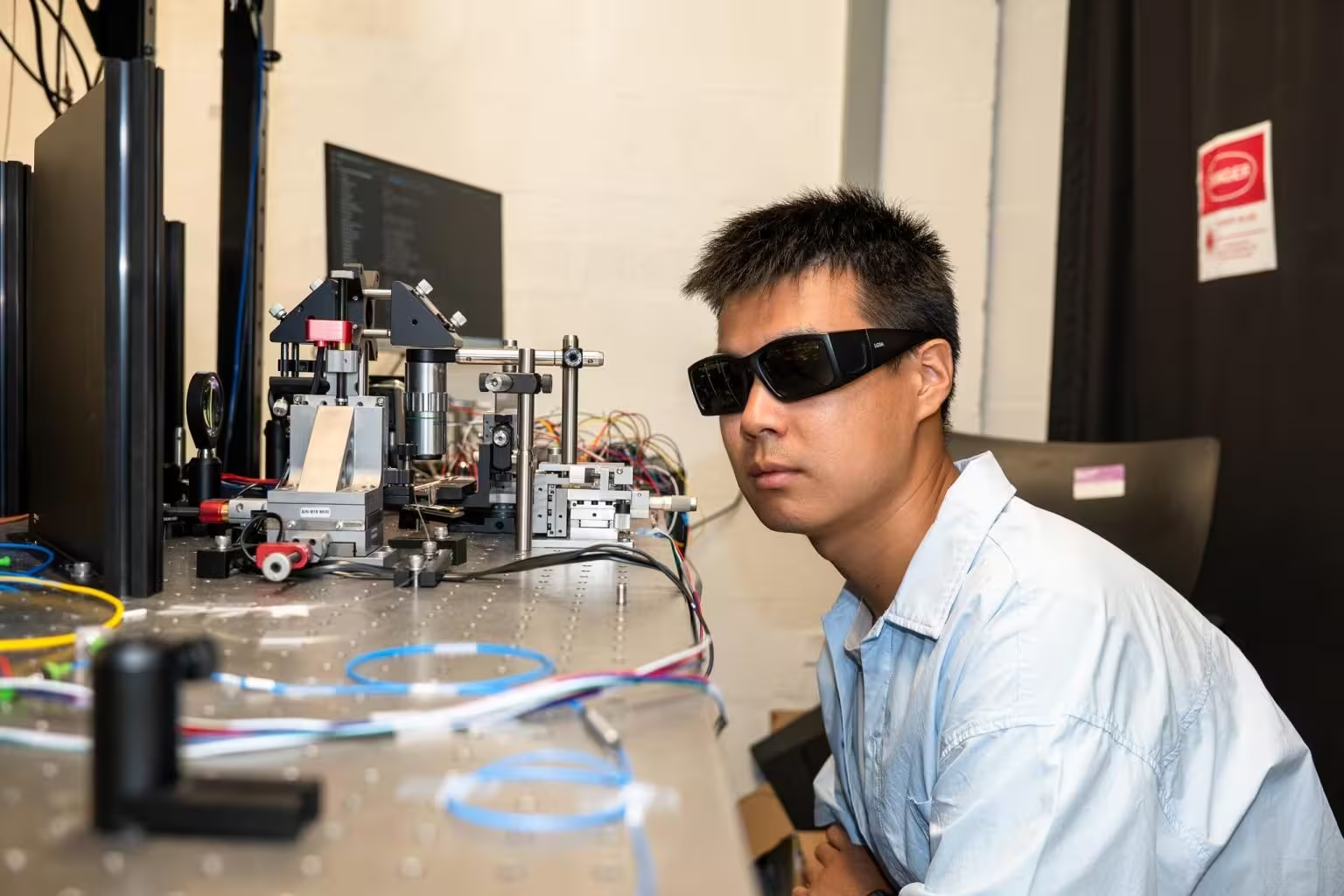
Yichi Zhang, a doctoral student in Materials Science and Engineering, inspects the source of the quantum signal. Credit: Sylvia Zhang
Analogy: train engine and sealed cargo
Think of the classical signal as a locomotive and the quantum information as cargo in sealed containers. The engine can be inspected, redirected and corrected without opening the containers — a useful model for preserving entanglement and other quantum properties that are destroyed by measurement.
Adapting Quantum Transmission to Real-World Networks
Real-world fiber faces temperature fluctuations, vibrations and other environmental variations that are absent in lab conditions. Measuring the classical header enables on-the-fly inference of how those disturbances affect the quantum payload; corrective operations can then be applied on-chip without directly measuring the quantum particles.
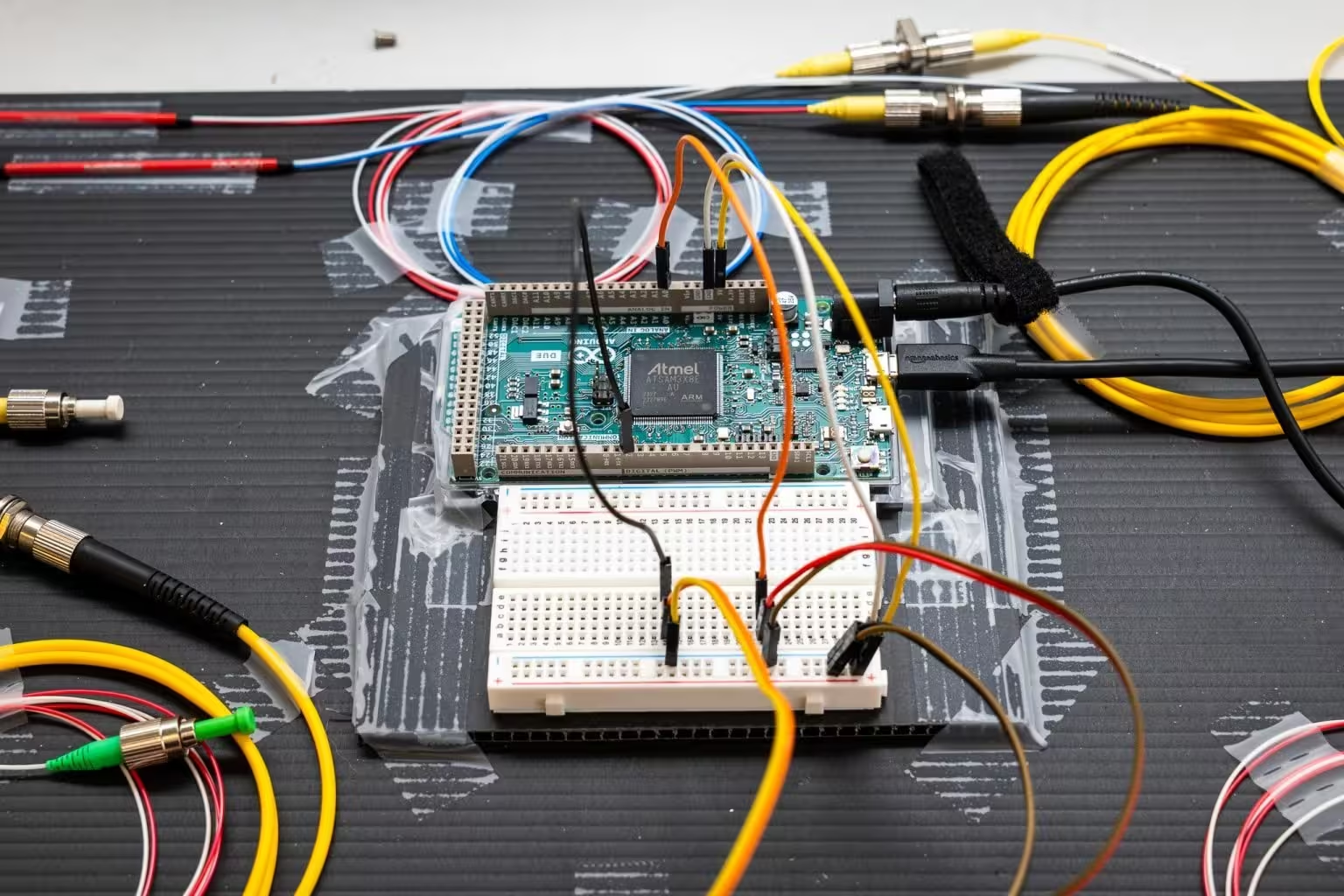
Part of the equipment used to create a node of the quantum network, roughly one kilometer’s worth of Verizon commercial fiber optic cable away from its source. Credit: Sylvia Zhang
In field trials across roughly one kilometer of Verizon campus fiber, the system achieved transmission fidelities above 97%, indicating robust preservation of quantum states despite the noisy environment. The Q-chip is fabricated in silicon using established processes, meaning it can be mass-produced and integrated with current telecom hardware to scale metro-area quantum networks.

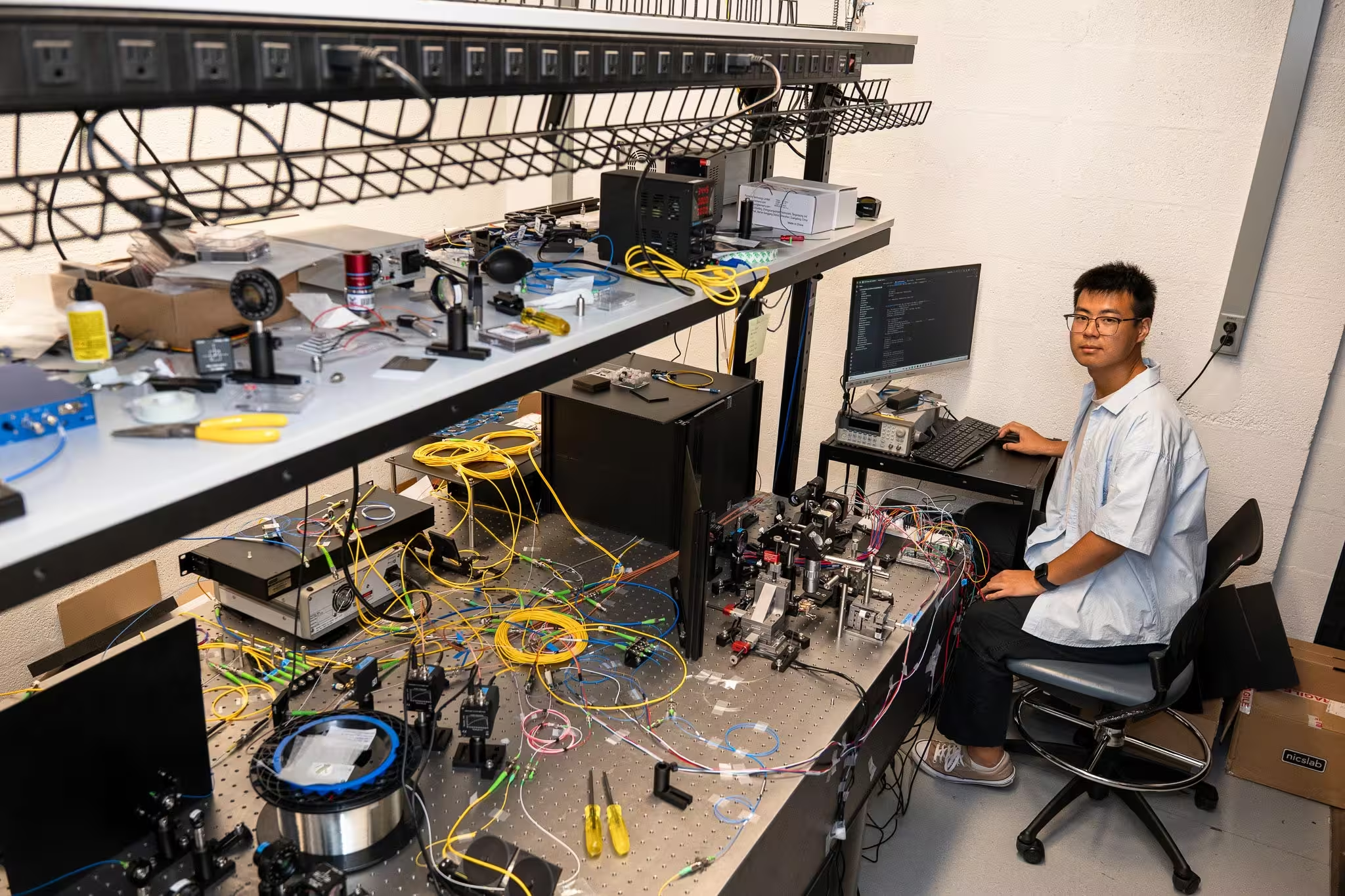
Yichi Zhang, a doctoral student in Materials Science and Engineering, with the equipment used to generate and send the quantum signal over Verizon fiber optic cables. Credit: Sylvia Zhang
Scientific Context and Technical Challenges
Quantum communications rely on entanglement, a nonclassical correlation where measurement of one particle instantaneously affects its partner. While entanglement enables secure communications and distributed quantum computation, it is fragile: direct measurement collapses the quantum state, so traditional signal inspection cannot be used to route or amplify quantum information.
Robert Broberg, a doctoral student in Electrical and Systems Engineering and coauthor, noted that this measurement constraint is the core problem for scaling quantum networks: "Conventional networks use measurement to guide data; quantum networks must avoid measuring the quantum payload while still supporting routing and error mitigation." The Q-chip solves this by separating the readable classical header from the unreadable quantum payload.
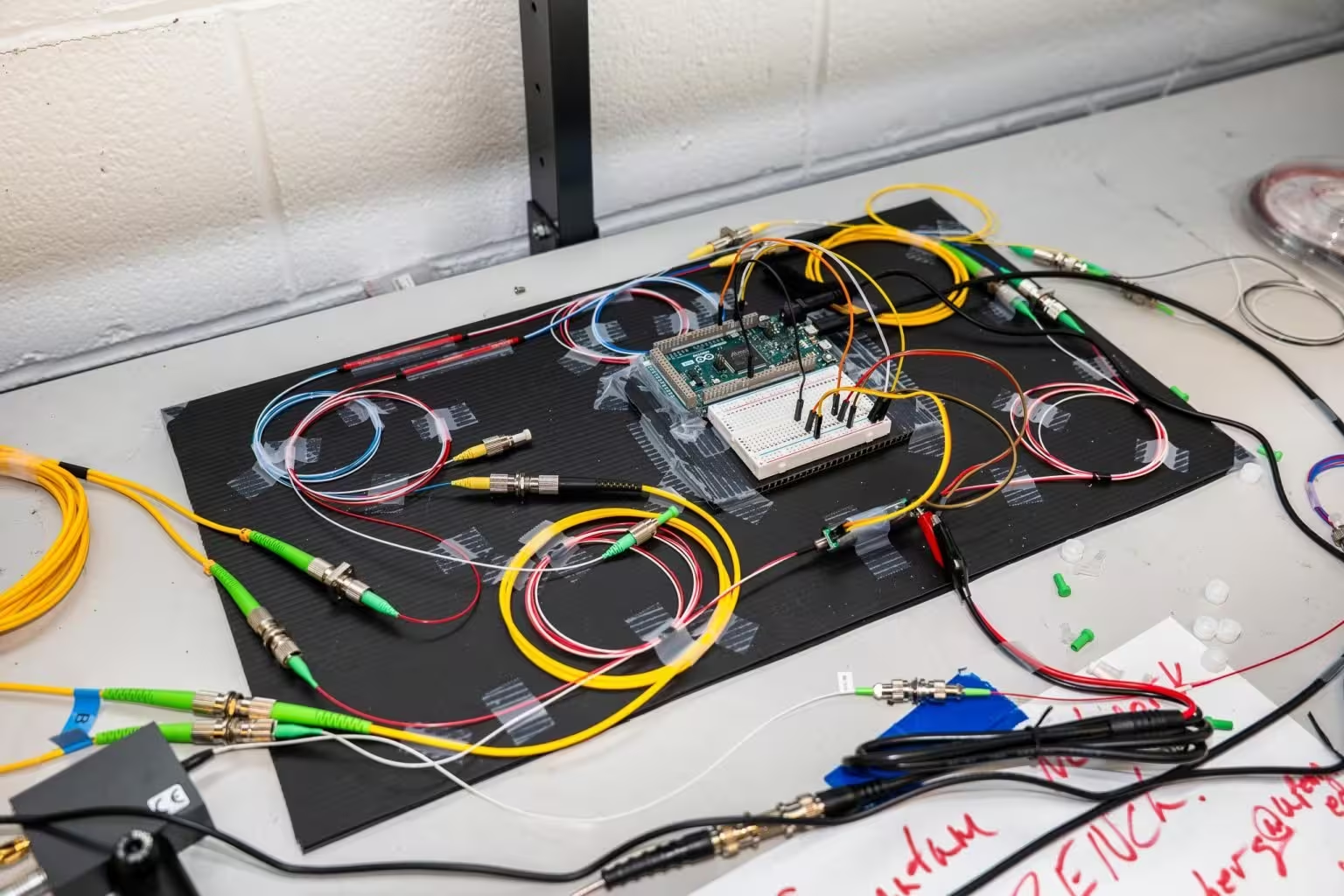
A node of the quantum network, roughly one kilometer’s worth of Verizon fiber optic cable away from the quantum signal’s source. Credit: Sylvia Zhang
Limitations and the Road Ahead
A major remaining obstacle is long-distance amplification. Unlike classical signals, quantum states generally cannot be amplified without destroying entanglement. Quantum repeaters and novel amplifiers will be required to extend networks beyond metropolitan scales. Existing quantum key distribution (QKD) approaches can span long distances for secure keys but do not yet support linking quantum processors for distributed computation.
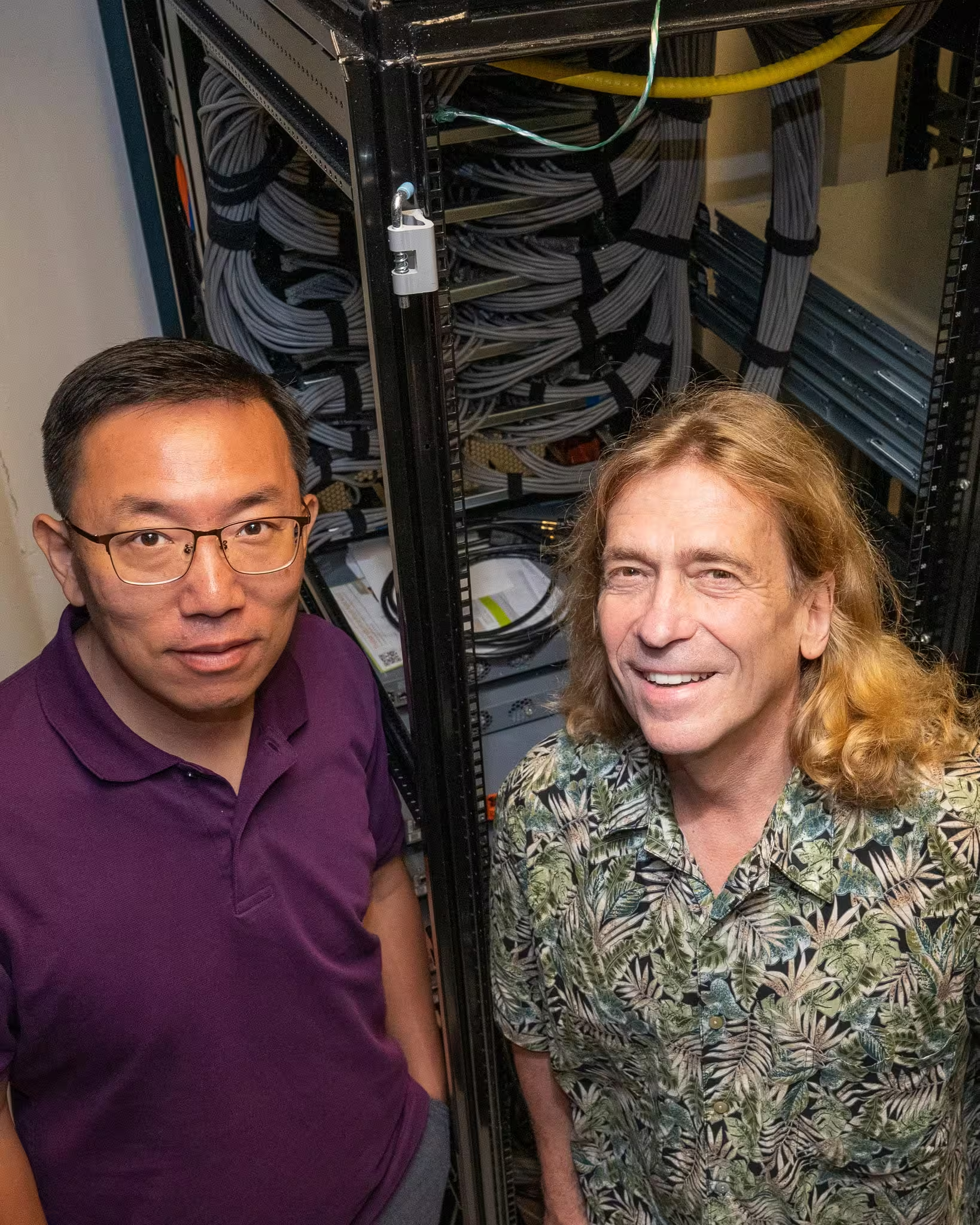
From left: Liang Feng, Professor in Materials Science and Engineering, and Robert Broberg, a doctoral student in Electrical and Systems Engineering. The wires behind them include a Verizon fiber optic cable that carried the quantum signal. Credit: Sylvia Zhang
Despite these technical hurdles, the Penn demonstration shows that quantum traffic can use familiar internet protocols and physical infrastructure, enabling incremental deployment and testing within current telecom ecosystems.
Expert Insight
Dr. Maria Alvarez, a senior researcher in quantum communications (fictional but representative), comments: "Integrating quantum signals into existing IP frameworks is a critical step. The ability to infer channel disturbances from classical headers and apply corrections without collapsing quantum states is elegant and practical. This approach accelerates near-term trials across city networks and helps focus research on scalable quantum repeaters for long-haul links."
Conclusion
The Q-chip experiment shows that quantum information can be routed and protected on commercial fiber alongside ordinary internet traffic using standard protocols. Achieving >97% fidelity over active telecom lines demonstrates practical compatibility with existing infrastructure and points to scalable deployments within metropolitan areas. Remaining challenges include long-distance amplification and repeater development, but embedding quantum traffic within the IP-driven architecture is a decisive step toward a functional quantum internet capable of linking quantum computers, enabling new cryptography, and advancing AI, materials discovery and other scientific frontiers.


Leave a Comment
Comments
No comments yet. Be the first.