
4 Minutes
The Moon is moving away from Earth at roughly 1½ inches (3.8 centimeters) per year. Scientists measure this recession with extraordinary precision using lunar laser ranging: lasers fired from Earth bounce off retroreflector mirrors placed on the lunar surface by Apollo astronauts and robotic missions. By timing the round-trip of light, researchers can detect tiny changes in the Earth–Moon distance and track how that distance evolves over decades.
Typical values place the Moon about 239,000 miles (385,000 km) from Earth, but the orbit is elliptical, varying by roughly 12,400 miles (20,000 km) over a month. This orbital eccentricity explains why some full moons—known as supermoons—appear larger in our sky.
Tidal forces and the mechanism of lunar recession
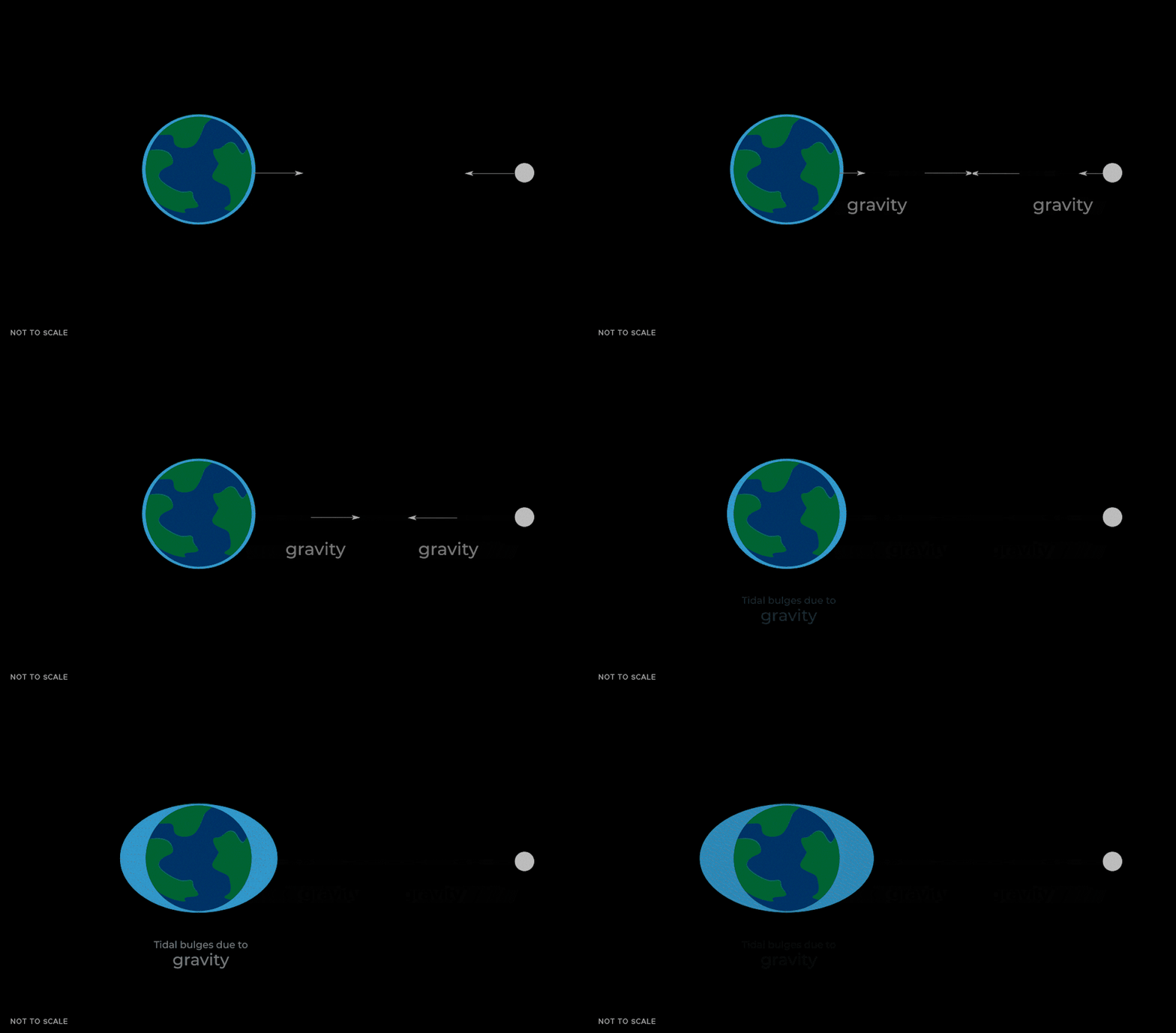
Tides arise from differences in gravitational pull across Earth. The Moon's gravity is stronger on the near side of Earth than on the far side, producing two tidal bulges in the oceans: one toward the Moon and one on the opposite side. A NASA animation, not to scale, shows how the Moon creates tides on the Earth. The water in the oceans sloshes toward and away from the Moon. (NASA/Vi Nguyen)
Because Earth rotates faster than the Moon orbits, these bulges are carried slightly ahead of the Moon's orbit. Friction between the moving ocean and Earth's surface causes the tidal bulges to "lead" the Moon, creating a gravitational torque that transfers angular momentum from Earth to the Moon. The near-side bulge pulls the Moon forward in its orbit, increasing the Moon's orbital energy and raising its mean distance from Earth over time.
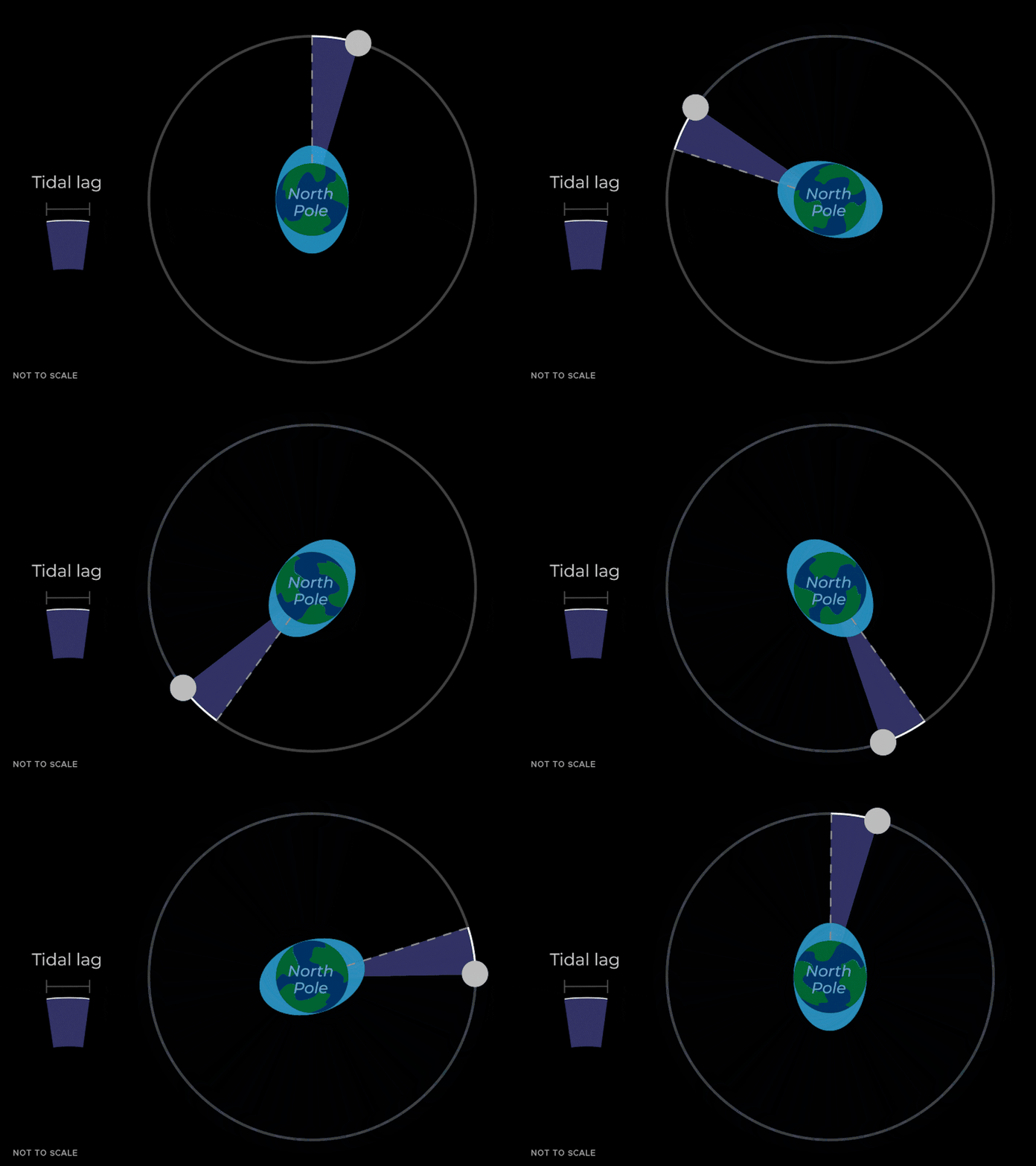
As the Moon orbits the Earth, the tidal bulges do not exactly point toward the Moon, but instead a little bit ahead of it because of friction between the bulges and the rotating Earth. (NASA/Vi Nguyen)
This process is slow but persistent. The energy and angular-momentum exchange slightly slows Earth's rotation—lengthening the day by fractions of a second per century—while increasing the Moon's orbital radius at the measured rate.
Scientific background and observational evidence
Lunar laser ranging (LLR) began with retroreflectors left by Apollo and Soviet missions. Those experiments underpin precise estimates for tidal dissipation, orbital evolution, and tests of gravitational theory. LLR also constrains Earth–Moon system parameters that feed into climate, geophysics, and planetary dynamics models.
Geological and fossil records provide independent confirmation of Earth's changing rotation. Analyses of growth rings in fossilized corals and shell growth patterns in ancient bivalves indicate that hundreds of millions of years ago days were shorter—consistent with higher rotation rates when the Moon was closer.

The prevailing formation hypothesis—the giant-impact model—posits that a Mars-sized protoplanet struck early Earth about 4.5 billion years ago, ejecting material that coalesced into the Moon. Initially much closer, the early Moon would have appeared larger and induced stronger tides.
Implications for Earth and long-term outlook
Does the Moon slowly moving away affect daily life? Practically speaking, no abrupt changes are expected. The current rate of recession—1.5 inches per year—is negligible relative to the Moon's average distance (about 0.00000001% per year). Tides, eclipses, and roughly 24-hour days will persist for millions to billions of years.
If we extrapolate far into deep time, tidal interactions could eventually synchronize Earth's rotation with the Moon's orbital period (a state called tidal locking). In that distant scenario, the Moon would appear fixed above one hemisphere and the recession would stop. However, stellar evolution intervenes: in roughly a billion years increasing solar luminosity will reduce oceans and weaken tidal dissipation, and in a few billion years the Sun's red-giant phase will profoundly alter or destroy the Earth–Moon system.
Missions and technologies
Key technologies include lunar retroreflectors, ground-based laser ranging stations, and precise timekeeping systems. Ongoing and planned lunar missions by NASA, ESA, and other agencies can enhance LLR networks, update geophysical models, and refine projections for tidal evolution.
Expert Insight
Dr. Elena Morales, planetary scientist (fictional), comments: "Lunar laser ranging gives us a unique, high-precision window into the coupled dynamics of Earth and Moon. The rate of recession tells a consistent story about tidal dissipation in Earth's oceans and mantle. While the numeric change per year is tiny, integrated over geological timescales it has measurable effects on Earth's rotation and the history recorded in fossils."
Conclusion
Tidal forces drive the Moon's gradual recession from Earth at about 1½ inches (3.8 cm) per year. Laser ranging experiments, geological records, and the physics of angular-momentum exchange provide a coherent explanation: oceanic tidal bulges, pulled slightly ahead by Earth's rotation, transfer momentum to the Moon and slow Earth's spin. Though the process alters day length and lunar distance over geologic time, its immediate effects are small, and familiar phenomena—tides, eclipses, and the view of the Moon—will persist for many millions of years.


Leave a Comment
Comments
No comments yet. Be the first.