
7 Minutes
Seismic breakthrough: evidence for a solid inner core on Mars
Researchers analysing seismic data from NASA's InSight lander now report evidence that Mars contains a solid inner core surrounded by a liquid outer core — an internal structure more like Earth's than previously confirmed. The study, published in Nature by Huixing Bi at the University of Science and Technology of China (Hefei) and collaborators, used refined signal-selection and novel data-processing methods to extract a weak seismic signature consistent with an inner core roughly 610 km in radius. These findings advance our understanding of Martian thermal evolution, its early magnetic field, and the processes that shaped the planet's atmosphere and surface.
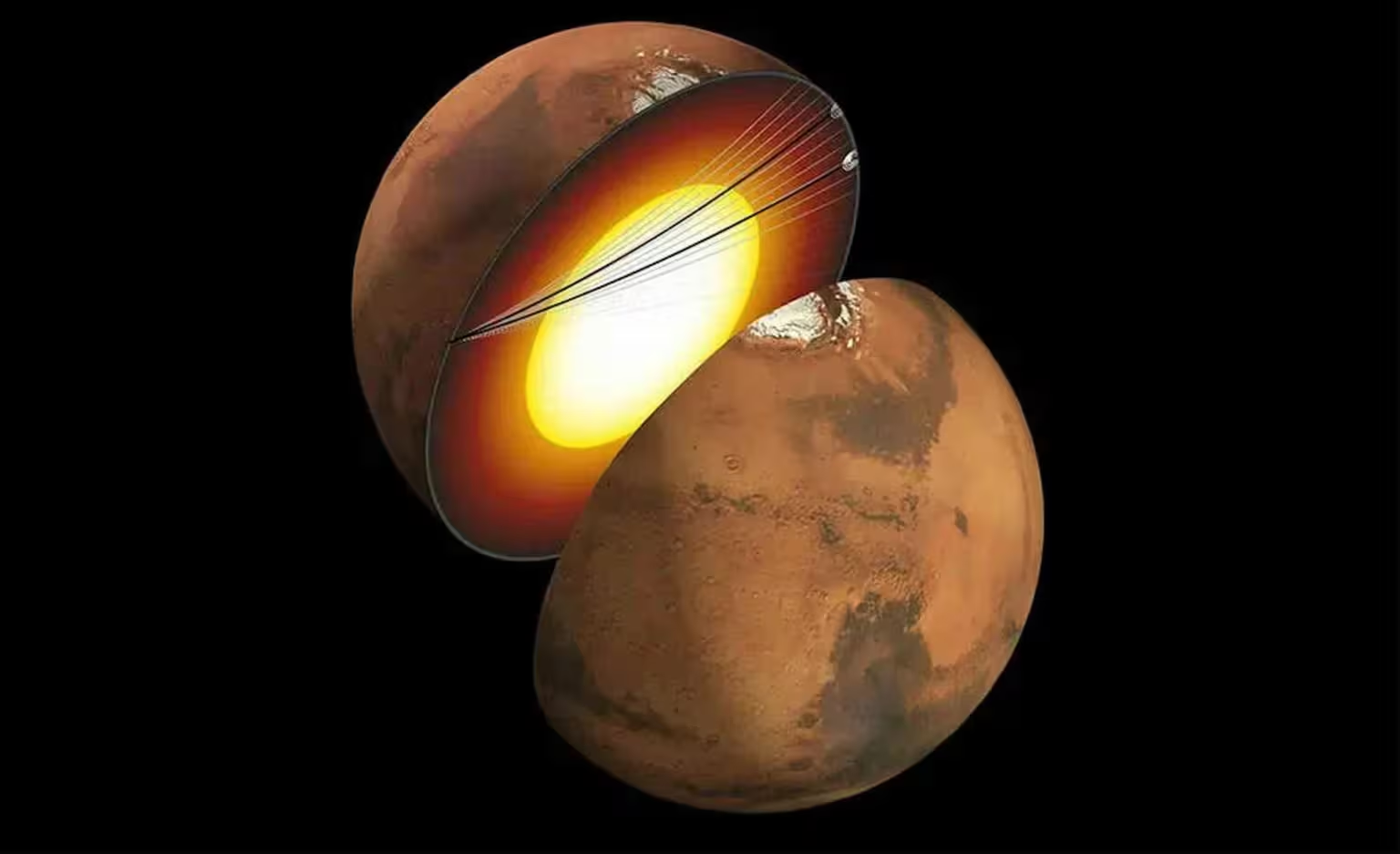
The findings will help guide scientists towards a better understanding of Mars’ evolution as a planet.
Scientific background: cores, dynamos and planetary protection
Why the core matters
A planet's core controls heat transport, internal convection and — through the dynamo mechanism — the existence of a global magnetic field. On Earth, solid iron in a central inner core is surrounded by a convecting liquid outer core. That convection, driven by heat and compositional changes as the inner core grows, produces a magnetic field that deflects charged particles from the Sun and helps prevent rapid atmospheric loss.
Clues embedded in magnetised rocks on Mars indicate the planet once hosted a global magnetic field. Ancient crustal magnetisation and extensive valley networks and dried lake beds imply that billions of years ago Mars had a denser atmosphere and liquid water on its surface. A now-lost magnetic shield is widely hypothesised to have allowed progressive atmospheric escape to space, turning Mars into the thin-atmosphere, cold desert we observe today.
InSight’s contribution and the sequence of discoveries
NASA's InSight lander, which touched down on Mars in November 2018, carried a highly sensitive seismometer designed to record marsquakes and other ground motions. Early InSight results established for the first time that seismic waves traversed Mars' deep interior and provided the initial detection and size constraints of a liquid core. In 2021, Simon Stähler and colleagues analysed seismic wave behaviour and modelled a liquid core that appeared larger and less dense than earlier expectations — a core roughly 1,800 km in radius, consistent with a high fraction of light elements (such as sulphur, carbon and hydrogen) lowering core density and melt temperature.

.avif)
The Insight mission landed on Mars in 2018.
Stähler's 2021 model did not exclude the possibility of an inner solid core; instead, the dataset available at that time lacked the signal strength needed to identify a boundary between liquid and solid at Mars' centre. Subsequent re-analyses and refinements, including a 2023 revision by Henri Samuel's team, adjusted core-size and density estimates and helped reconcile different lines of evidence from geology, geodesy and seismology.
Methods and the new detection
Huixing Bi and colleagues focused on particular seismic event types occurring at distances from InSight that favour the detection of waves refracting or reflecting at an inner-core boundary. By selecting a subset of higher-quality events and applying advanced noise-reduction and stacking techniques, the authors increased the signal-to-noise ratio for faint phases consistent with seismic waves passing through a solid inner core. Their analysis yields a best-fit model with a solid inner core radius of about 610 km nested inside a liquid outer core.
Key compositional implications arise from combining size and density constraints. Earlier estimates of a very low-density liquid core suggested a significant fraction of light elements. The existence of an inner solid core implies that crystallisation is occurring as Mars cools, and the balance of temperature, pressure and composition controls how and when solidification begins. The new result therefore constrains the core's thermal history and the range of plausible light-element concentrations.
Competing models and scientific progress
The apparent tension between a fully liquid-core interpretation and the detection of a small solid inner core illustrates normal scientific progress: successive studies refine models as more data and improved methods become available. Stähler's initial detection established that Mars' core is, overall, dominantly liquid; Bi's work now suggests that a solid phase exists at the very centre. These results are not mutually exclusive but rather reflect the increasing sensitivity of seismic analyses and the importance of event selection, distance geometry and noise treatment in extracting subtle signals.
Researchers will continue re-analysing the InSight dataset and integrating geological, geodetic and electromagnetic constraints to test whether a 610 km inner core fits all available observations, including core size, mean density and crustal magnetic anomalies. Independent support could come from future missions that carry seismometers, magnetometers or geophysical instruments to other locations on Mars.

Implications for Mars’ magnetic field, atmosphere and habitability
A Mars with an inner solid core strengthens the plausibility that it once produced a core dynamo similar in principle to Earth's. On Earth, crystallisation of the inner core releases latent heat and light elements, both of which can sustain convective motions in the outer liquid core and drive the dynamo over geological time. If Mars underwent a comparable sequence of inner-core growth and outer-core convection, a planetary magnetic field could have existed for a period sufficient to protect a thicker atmosphere and surface water early in Mars' history.
However, the presence of an inner core today does not automatically mean the ancient dynamo persisted as long as Earth's. Mars is smaller than Earth, cooled faster, and its inventory of heat-producing elements and core composition likely differs. The timing, intensity and duration of any Martian dynamo depend on these variables. Establishing when the dynamo ceased is essential for linking interior evolution to the timing of atmospheric loss measured by missions such as MAVEN and the water-cycle studies from ESA's ExoMars Trace Gas Orbiter.
Related technologies and future prospects
Advances in seismic data processing, instrument sensitivity and mission design are central to these discoveries. Techniques used to pull a faint inner-core signal from InSight noise include careful event selection, waveform stacking, and statistical methods to isolate expected seismic phases. Future landers equipped with broadband seismometers deployed at multiple sites would greatly improve global imaging of Mars’ mantle and core. Complementary approaches — improved gravity and rotation measurements, electromagnetic sounding and laboratory experiments to determine iron-alloy properties at Martian core pressures — will refine compositional and thermal models.
Moreover, proposed and planned missions that return samples, map crustal magnetism in greater detail or deploy long-lived geophysical networks would help close remaining gaps. Together, these technologies and missions will better constrain the timing of Mars' magnetic shutdown, the mechanisms of atmospheric escape, and the planet's early climate and habitability.
Expert Insight
Dr. Elena Morales, planetary geophysicist (fictional), comments: 'This new inner-core detection is a major step. It shows how much further we can push seismic datasets with careful selection and modern signal-processing. If an inner core exists, it provides a concrete mechanism for how Mars could have powered a dynamo early on. The challenge now is integrating seismology with geochemistry and atmospheric studies to build a consistent timeline for when magnetic protection faded and how quickly the atmosphere eroded.'
Her assessment reflects a common view in planetary science: single datasets rarely provide definitive answers, but they can decisively narrow the range of plausible models and motivate targeted follow-up observations.
Conclusion
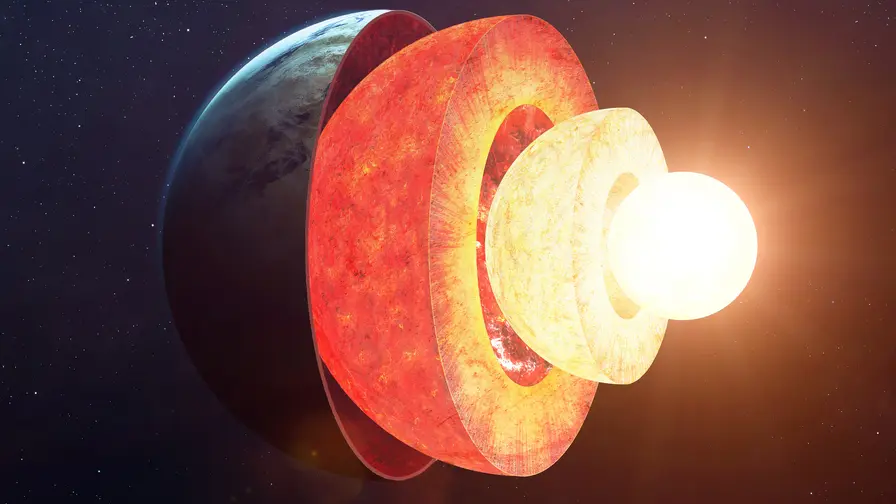
Seismic analyses from the InSight mission, refined and re-analysed with new methods, now point toward a Mars with an Earth-like layered core: a solid inner core approximately 610 km in radius encased by a liquid outer core. This structure increases the plausibility that Mars once generated a core dynamo, which in turn would have supported a magnetic shield and helped preserve a denser, warmer early atmosphere capable of hosting liquid water. The result highlights the value of sustained, high-quality seismic observations and the continued re-examination of mission data as analysis techniques improve. Future geophysical measurements and coordinated studies across seismology, magnetism, geochemistry and atmospheric science will be essential to fully reconstruct Mars’ internal evolution, its lost magnetic field, and the planetary processes that shaped its habitability.

Leave a Comment
Comments
No comments yet. Be the first.