
6 Minutes
Neutrino flavor changes reshape neutron star collisions
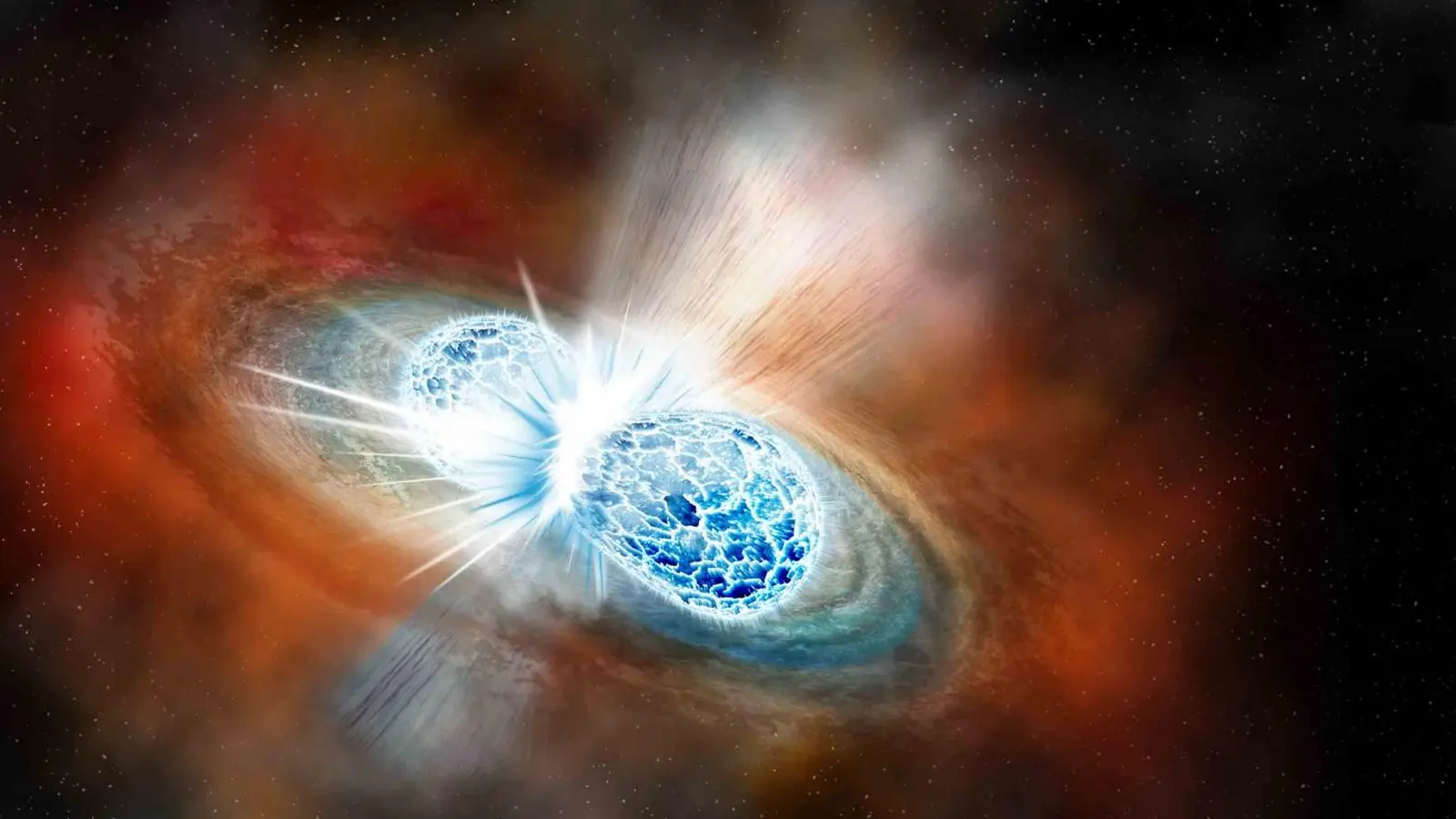
When two neutron stars collide, the encounter ranks among the most energetic and information-rich events in the cosmos. New computer simulations performed by researchers at Penn State and the University of Tennessee, Knoxville, show that subtle changes in neutrino behavior—so-called neutrino flavor transformations—can materially alter the dynamics, composition and observable signals produced by these mergers.
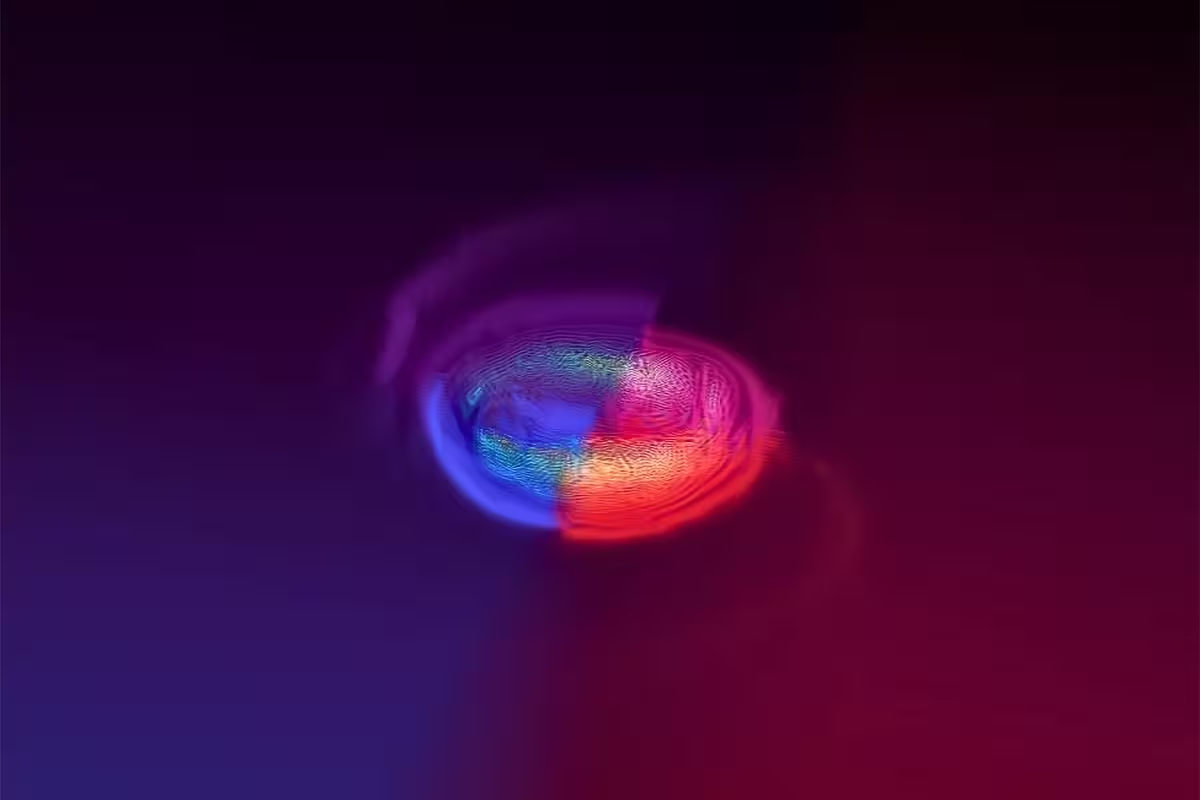
New simulations of neutron star mergers reveal that the mixing and changing of tiny particles called neutrinos impacts how the merger unfolds, including the composition and structure of the merger remnant as well as the resulting emissions. This image depicts the density of neutrinos within the remnant as varying textures, and the colors represent energy densities of different neutrino flavors.
Neutrinos are fundamental particles that interact only via the weak force and gravity, and they come in three varieties or "flavors": electron, muon and tau. Under extreme conditions—such as those found in the hot, dense environment of a neutron star merger—neutrinos can transform from one flavor to another. Because each flavor couples differently to matter, these conversions influence which nuclear reactions occur and, ultimately, which elements are produced.
Scientific background: why neutrino flavor matters
Neutron star mergers are prominent sites for rapid neutron-capture nucleosynthesis (the r-process), the sequence of reactions thought to generate many of the universe's heaviest elements, including gold, platinum and several rare-earth metals. The balance of neutrons and protons in merger ejecta is a critical parameter for r-process yields. Electron-flavor neutrinos and antineutrinos can change neutrons into protons and vice versa through weak interactions; muon- and tau-flavor neutrinos do not efficiently drive the same reactions in these environments. Therefore, when electron neutrinos convert to muon or tau flavors, they reduce the rate of neutron-to-proton conversions and alter the neutron richness of the outflow.
Modeling breakthroughs: first simulations to include flavor transformation

Published in Physical Review Letters, the study presents the first full simulations that incorporate neutrino flavor transformation within a general-relativistic merger model. The team built a simulation framework from the ground up that combines general relativity, relativistic hydrodynamics and a treatment of neutrino flavor mixing. They focused on conversions between electron and muon flavors—identified as especially relevant for the merger environment—and explored multiple scenarios that varied the timing and spatial location of flavor transformation as well as the density of surrounding material.
Lead author Yi Qiu, a graduate student at Penn State, noted the technical challenge: "Previous simulations of binary neutron star mergers have not included the transformation of neutrino flavor. This is partly because this process happens on a nanosecond timescale and is very difficult to capture and partly because, until recently, we didn’t know enough about the theoretical physics underlying these transformations, which falls outside of the standard model of physics." The new models apply recent theoretical advances to simulate how rapid flavor evolution can proceed in realistic merger conditions.
Key discoveries and implications
The simulations demonstrate that where and when neutrino flavor transformations occur has measurable consequences. Changes in the neutrino flavor composition alter the neutron-to-proton ratio in ejected material, which in turn affects the abundance and distribution of heavy elements created by the r-process. David Radice, co-author and Knerr Early Career Professor of Physics at Penn State, summarized the mechanism: "Electron type neutrinos can take a neutron and transform it into a proton and electron. But muon type neutrinos cannot do this. So, the conversion of neutrino flavors can alter how many neutrons are available in the system, which directly impacts the creation of heavy metals and rare earth elements. We found that accounting for neutrino mixing could increase element production by as much as a factor of 10."
Neutrino-driven changes also modify the physical structure of the merger remnant and the composition and amount of matter expelled into space. That affects electromagnetic observables—kilonova light from radioactive decay of heavy isotopes, X-ray and gamma-ray signals—and could even leave subtle imprints on the gravitational-wave signal.
Detectability and future observations
The results have practical consequences for multi-messenger astronomy. Current and next-generation gravitational-wave detectors (LIGO, Virgo, KAGRA and future facilities such as Cosmic Explorer) will expand the sample of observed neutron star mergers. Coupled electromagnetic follow-up—especially detailed kilonova light curves and spectra—provides a way to test model predictions about element yields and ejecta composition. Improved neutrino and gravitational-wave modeling will enable more accurate interpretation of future merger events.

"In our simulations, neutrino mixing impacted the electromagnetic emissions from neutron star mergers and possibly the gravitational waves as well," Radice said. "Better understanding how these emissions are created from neutron star mergers will help us interpret future observations."
Limits and open questions
Despite the advance, major theoretical uncertainties remain. Rapid flavor transformation physics is mathematically complex and occurs on extremely short timescales; its onset and spatial distribution depend sensitively on local neutrino densities and angular distributions—quantities still poorly constrained in current merger models. The authors stress that their results illustrate possible outcomes rather than definitive predictions.
Expert Insight
Dr. Elena Martinez, an observational astrophysicist at a major research university (commenting as an independent expert), said: "This work represents a necessary step toward closing the loop between microphysics and observable signals from neutron star mergers. Including neutrino flavor conversion brings theory closer to the full complexity of these events. Future observations that combine gravitational waves, high-cadence optical/infrared kilonova photometry, and spectroscopy will be essential to validate these models and to pin down where heavy elements are formed in the cosmos."
Future prospects and computational tools
Now that a simulation framework capable of handling flavor evolution alongside general relativity exists, the authors anticipate other groups will extend and refine the models—exploring different binary masses, equations of state and neutrino physics assumptions. Improvements in theoretical particle physics and enhanced computational power will reduce uncertainties and enable more predictive comparisons with observations.

Conclusion
The new simulations demonstrate that neutrino flavor transformations can significantly influence the outcome of neutron star mergers: they affect element synthesis, the structure of the remnant and the signals we detect on Earth. While theoretical and computational challenges remain, incorporating flavor physics into merger models is an essential advance for understanding where heavy elements form and for interpreting future multi-messenger detections of these cosmic collisions.

Leave a Comment
Comments
No comments yet. Be the first.