
4 Minutes
Unusual gravitational wave and a provocative interpretation
In 2019 the LIGO and Virgo observatories registered an extraordinarily short gravitational-wave signal—lasting less than a tenth of a second—named GW190521. Unlike the characteristic rising "chirp" produced by two black holes slowly spiraling together, GW190521 appeared as a single, sharp burst. The standard interpretation has been that two black holes met in a chance, hyperbolic encounter and merged without a prolonged inspiral. But a 2025 preprint led by physicist Qi Lai (University of Chinese Academy of Sciences) offers a far more exotic alternative: the observed burst could be the echo of a black hole collision in a separate universe, transmitted through a collapsing wormhole formed during that merger.
Scientific background: gravitational waves and the missing inspiral
Gravitational waves are ripples in spacetime generated by accelerating masses—most prominently, coalescing black holes and neutron stars. For binary systems that orbit and lose energy, the emitted signal shows a gradual frequency and amplitude increase called an inspiral, culminating in a merger and ringdown. This produces the familiar chirp waveform used to identify compact binary mergers.
GW190521 notably lacked the inspiral portion. At the inferred total mass of about 142 times the Sun, an inspiral should have been visible in LIGO/Virgo's sensitive band, making the brief, impulsive appearance puzzling. That observation motivated researchers to explore nonstandard explanations beyond a simple flyby capture.
Wormhole hypothesis: method and results
Lai and colleagues developed a theoretical waveform that would arise if a binary black hole merger produced, transiently, a wormhole connecting two distinct spacetimes or regions. If such a wormhole collapsed rapidly into a single black hole, the gravitational-wave signal reaching our detectors could be dominated by a short burst associated with the collapse and echoing modes, rather than a long inspiral chirp.
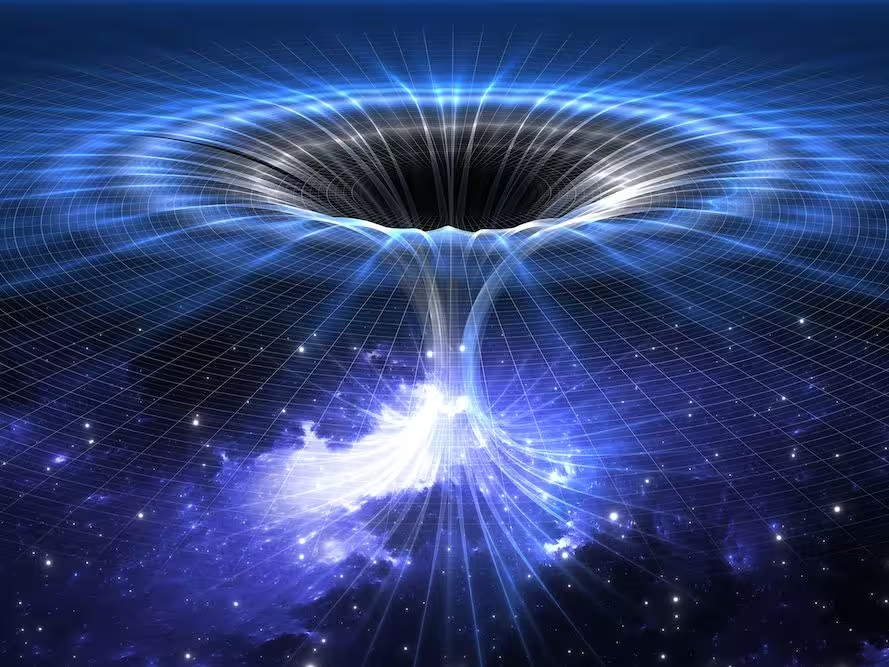
The team compared this wormhole-collapse waveform to the GW190521 data and to a conventional binary-black-hole template. Quantitatively, the standard binary-black-hole model provided a marginally better fit, but only by a small margin. The small difference leaves room for alternative interpretations: the wormhole model is not decisively ruled out by current data, the authors argue.
Why this matters

If gravitational-wave events like GW190521 were produced by wormhole dynamics, the implications would be profound. Detection would not just hint at exotic topologies of spacetime; it would offer a novel observational probe of those objects' properties. However, such an interpretation requires physics beyond established models and invokes matter or field configurations that are currently hypothetical.
Comparative events and future tests
Subsequent massive, short-duration events—most notably GW231123, which produced a remnant of roughly 225 solar masses—show similar brief signals. Researchers propose comparing waveform features across these events and future detections to discriminate between ordinary high-mass binary captures and exotic scenarios like transient wormholes.
Improvements in detector sensitivity (ongoing LIGO/Virgo upgrades, upcoming KAGRA updates, and future observatories such as LISA and the Einstein Telescope) will increase the number of high-mass, short-duration detections and expand bandwidth at lower frequencies, making inspiral signatures easier to detect or exclude. Better low-frequency coverage would clarify whether missing inspirals are genuinely absent or simply out of band.
Implications and caveats
The wormhole explanation remains speculative. It demands exotic physics—such as matter violating known energy conditions or stable traversable structures—that has not been observed elsewhere. The more conservative interpretation—an unusual dynamical capture and merger of two black holes within our Universe—remains the favored explanation because it relies on known general-relativistic dynamics. Still, the narrow statistical margin between models justifies further theoretical and observational study.
Expert Insight
"GW190521 challenges our standard templates and forces us to consider extreme possibilities," says Dr. Elena Morales, a fictional theoretical astrophysicist specializing in compact-object dynamics. "Even if the wormhole scenario is unlikely, modeling these alternatives strengthens our analysis pipelines and prepares us for genuinely novel signals. The next decade of gravitational-wave astronomy will tell whether these short bursts are quirks of massive mergers or signs of new physics."
Conclusion
GW190521 remains one of the most intriguing gravitational-wave detections to date. While the conventional binary-black-hole merger hypothesis fits the data slightly better, the wormhole-collapse model is not decisively excluded. Continued observations, improved detector sensitivity, and careful waveform modeling will be needed to determine whether these short, powerful bursts are products of known astrophysics or glimpses into far stranger structures of spacetime.

Leave a Comment
Comments
No comments yet. Be the first.