
4 Minutes
Asteroid belt basics and Jupiter's role
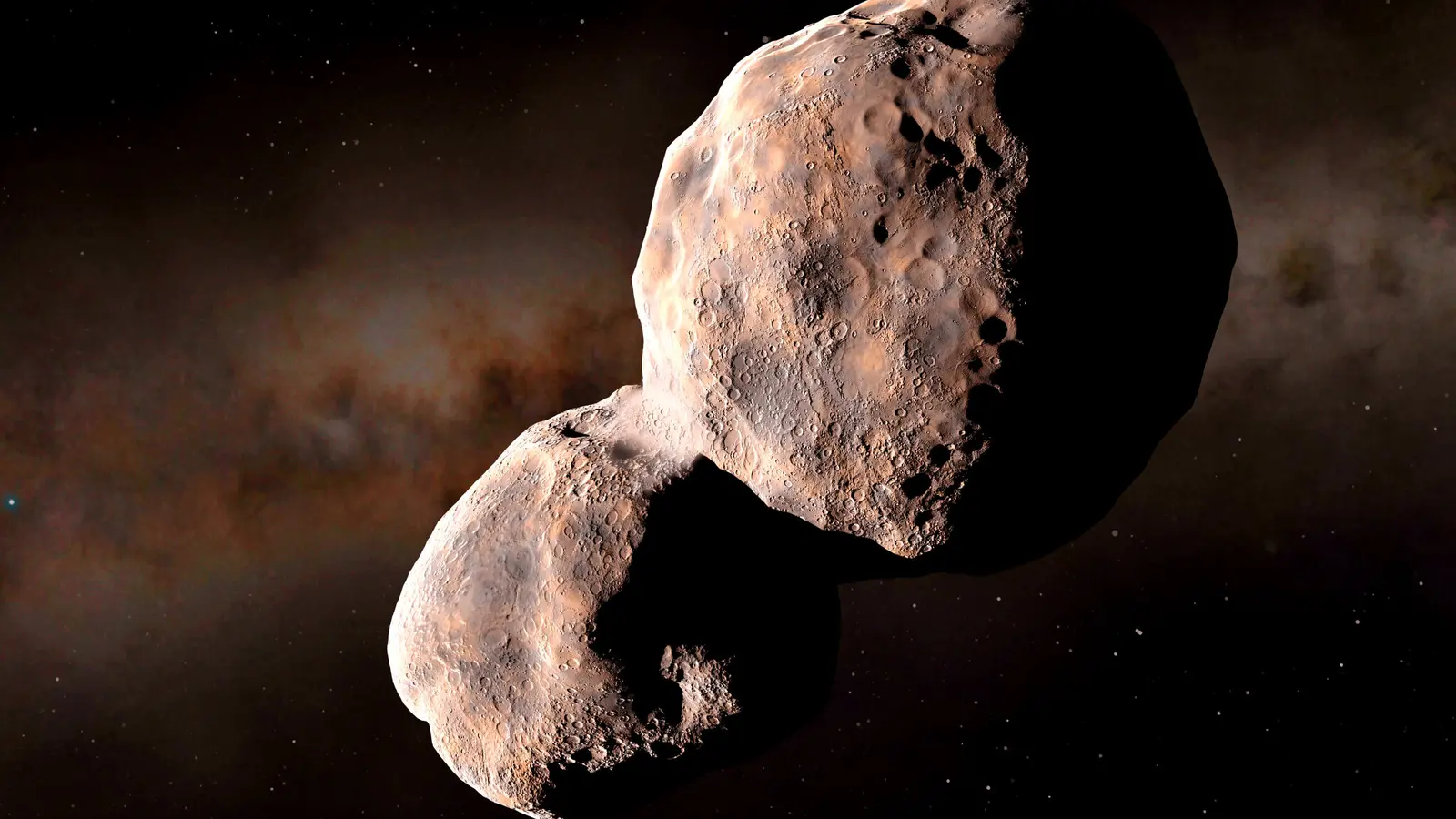
The asteroid belt — a vast, scattered ring of rocky bodies orbiting between Mars and Jupiter — is widely regarded as material that never assembled into a planet. When the Solar System formed about 4.6 billion years ago, the solids in this region should have accreted into a single body. Instead, Jupiter's strong gravity stirred the zone, increasing relative velocities so collisions tore objects apart rather than building them up. What remains now is only a tiny fraction of the original mass: roughly 3% of the Moon's mass distributed over millions of kilometres.
Gravitational resonances — locations where an asteroid's orbital period lines up regularly with Jupiter, Saturn or even Mars — act like dynamical slingshots. These resonances destabilise orbits, sending fragments inward toward the inner Solar System or outward toward Jupiter, or placing them on long-term chaotic paths. Material that does not escape is continually pulverised by collisions into ever-smaller fragments and dust.
New measurements: how fast the belt is disappearing
A team led by Julio Fernández of Universidad de la República (Uruguay) has quantified this long-term depletion. Using combined dynamical and collisional modelling, the group estimates that the actively colliding portion of the main belt is losing about 0.0088% of its participating mass per year. That fraction may appear tiny, but over millions to billions of years it represents a substantial transfer of material through the Solar System.
About one-fifth of the lost mass escapes the belt as intact asteroids and meteoroids that can evolve onto Earth-crossing orbits. These bodies are the parent sources of many near-Earth objects (NEOs) and the occasional spectacular meteor that lights up our atmosphere.
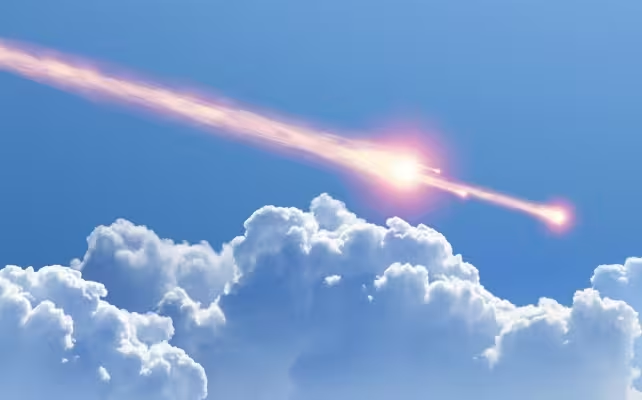
Pieces of an asteroid burning up in Earth's atmosphere as a meteor
The remaining roughly 80% is ground down by mutual collisions into micrometre- to millimetre-sized particles that form the zodiacal cloud — a faint band of interplanetary dust visible near the ecliptic after sunset or before sunrise. That dust gradually spirals inward under the influence of Poynting–Robertson drag and other non-gravitational forces, further redistributing material.
Exclusions, extrapolations and geological corroboration

The study deliberately excluded the largest, long-lived asteroids such as Ceres, Vesta and Pallas because these bodies have evolved into stable configurations and no longer participate in the same collisional depletion process. By focusing on the active collisional population the team could better estimate current loss rates and then extrapolate backward in time.
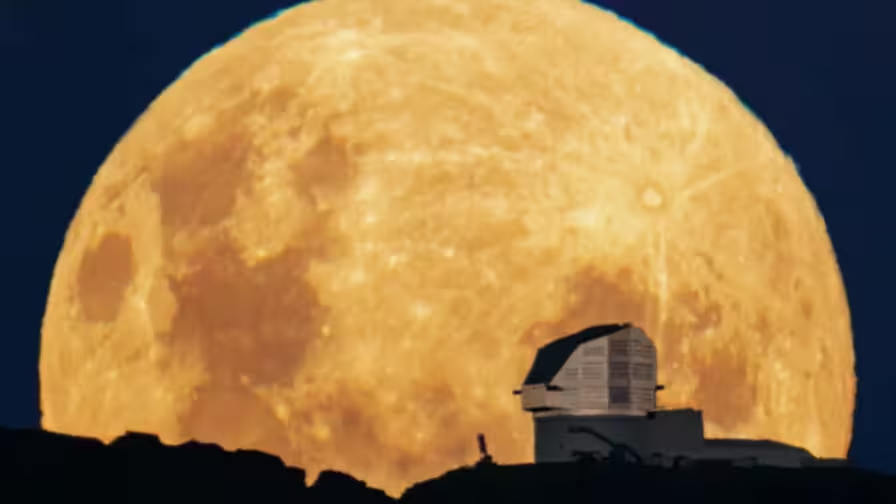
Their backward extrapolation suggests the main belt was roughly 50% more massive about 3.5 billion years ago, with a mass loss rate about twice today's value. That result aligns well with independent geological evidence: glass spherule layers in ancient terrestrial rocks and lunar stratigraphy imply a higher impact flux in early epochs, gradually declining to the relatively calmer rates we observe over the last few billion years.
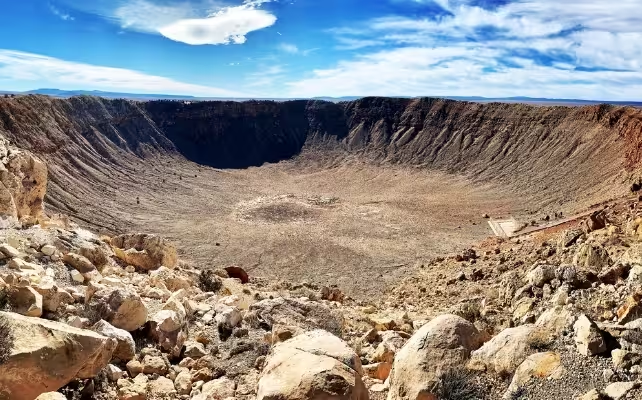
Earth's surface still shows signs of a declining bombardment over the past few billion years
Implications for Earth and planetary defense
Understanding the belt's steady leak of material has direct implications for assessing impact risk. Bodies that escape the main belt can evolve into near-Earth object populations that pose potential hazards. Accurate, physics-based estimates of the source flux from the main belt improve models of NEO delivery, refine impact probability forecasts and guide planetary defence priorities.
Beyond risk assessment, quantifying the collisional grinding that feeds zodiacal dust helps interpret observations of exozodiacal dust around other stars, informs sample-return mission planning (by constraining impactor flux), and improves our picture of Solar System evolution.
Expert Insight
"This study gives us a clearer, quantitative view of how the asteroid belt feeds the inner Solar System," says Dr. Elena Martínez, an astrophysicist specialising in small-body dynamics. "Knowing the current mass loss and how it has changed lets us link geological records to dynamical evolution models — which is crucial for both understanding planetary history and preparing for future planetary defense challenges."
Conclusion
The asteroid belt is not a static relic but a slowly fading reservoir of material shaped by Jupiter's gravity and continual collisional erosion. While the annual fractional loss is small, over billions of years it has reshaped the inner Solar System's impact record and continues to supply both dust and bodies that can reach Earth's neighbourhood. Continued observations, sample analysis and improved dynamical models will sharpen these estimates and help refine our understanding of long-term impact hazards and Solar System history.

Leave a Comment
Comments
No comments yet. Be the first.