
3 Minutes
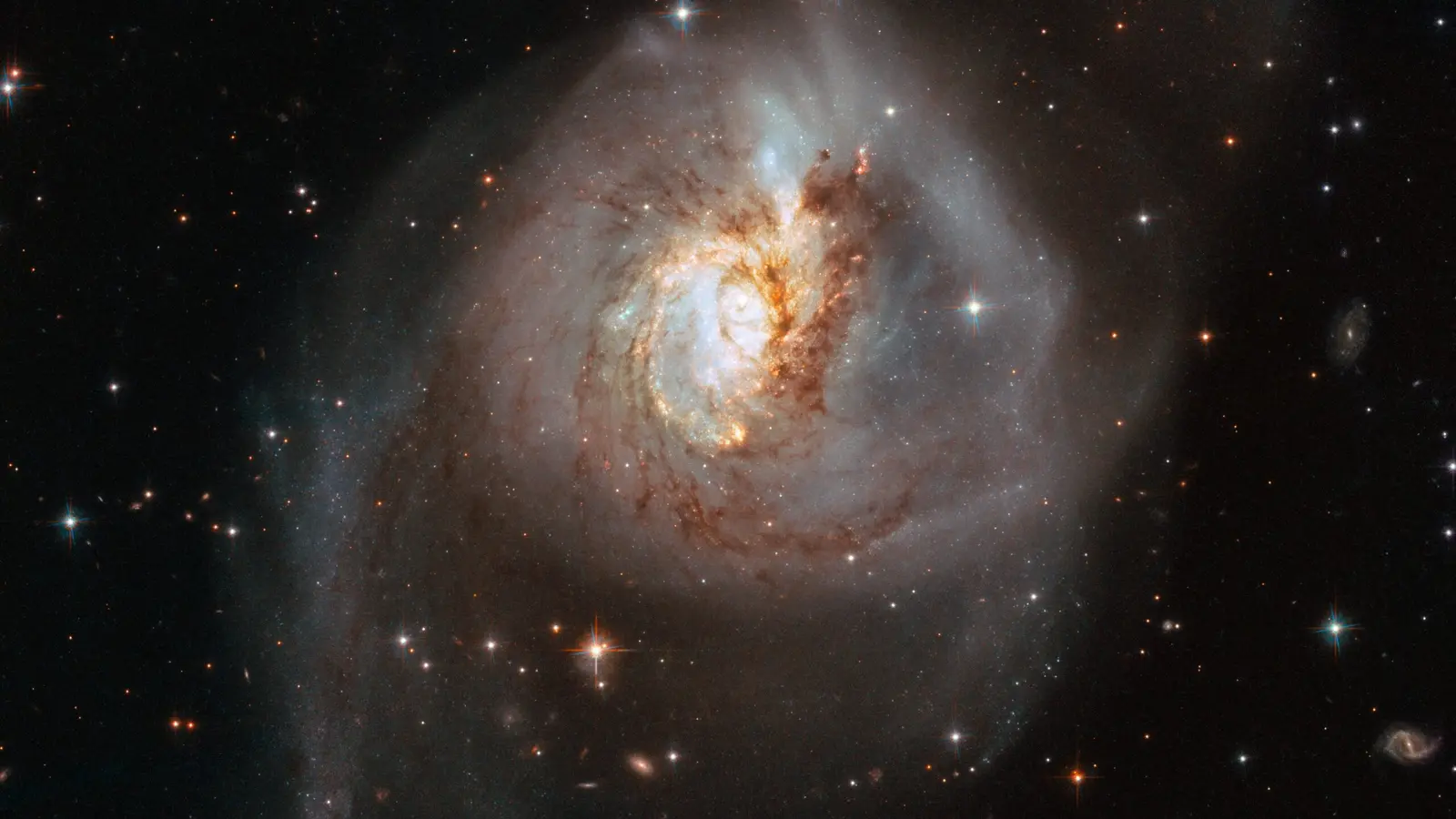
Hubble’s image of NGC 6000 reveals a glowing galactic masterpiece filled with both old red stars and young blue ones. Among the cosmic beauty, scientists also spotted the afterglow of past supernovae and a passing asteroid’s colorful tracks.
Overview: A colorful spiral 102 million light‑years away
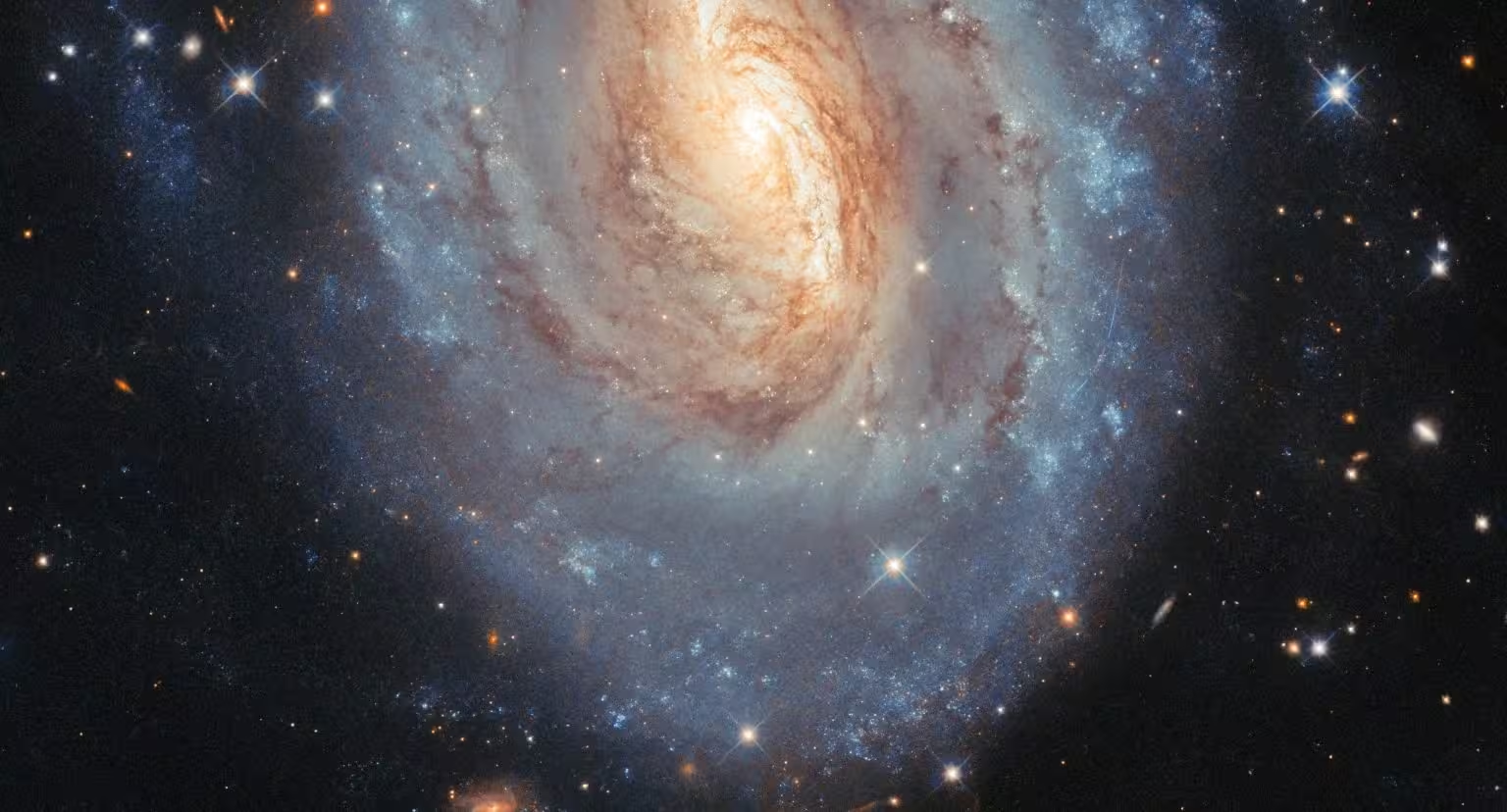
The Hubble Space Telescope has produced a striking view of the spiral galaxy NGC 6000, located about 102 million light‑years away in the constellation Scorpius. The image highlights a luminous golden central bulge set against brilliant blue spiral arms. This color contrast directly reflects differences in stellar populations: older, cooler stars dominate the core, while young, hot, massive stars trace the galaxy’s arms where star formation is active.
Stellar colors and what they reveal
Color is a powerful diagnostic in astronomy. Cooler, lower‑mass stars emit most of their light at longer, redder wavelengths and therefore appear yellowish or red, while hotter, more massive stars emit more blue and ultraviolet light and appear blue in images. In NGC 6000, the golden central region indicates an older stellar population and a concentration of evolved, lower‑mass stars. The bright blue knots scattered along the spiral arms mark clusters of recently formed, massive stars and H II regions where gas is ionized by intense ultraviolet radiation.
Why spiral arms are sites of star formation
Spiral density waves and the galaxy’s interstellar medium compress gas as it orbits the galactic center, triggering collapse of molecular clouds and subsequent star formation. The resulting young clusters are luminous in blue wavelengths, which is why Hubble’s multi‑filter imaging makes the arms stand out so vividly.
Tracing supernova echoes: survey context and insights
This observation of NGC 6000 was taken as part of a program that monitors galaxies which have recently hosted supernova explosions. NGC 6000 contains remnants of two relatively recent supernovae: SN 2007ch and SN 2010as. Hubble’s sensitive detectors can detect faint, late‑time emission from supernovae long after the initial explosion. Measuring this lingering light helps astronomers estimate the progenitor star’s original mass, probe explosion mechanisms, and check whether the progenitor had a close binary companion that might have influenced the event.
Asteroid streaks: a solar system interloper
Careful inspection of the image’s right disc reveals four thin, colored lines: the tracks of an asteroid that crossed Hubble’s field of view during the observation. The streaks appear as repeated lines because the final composite image combines multiple exposures taken through different filters with short gaps between them. Each exposure sampled specific wavelength bands (for example, centered near red and blue), so the asteroid’s path shows up as separate colored segments. While unwanted for deep extragalactic imaging, these transient streaks are a predictable consequence of long‑duration, multi‑filter observations and are easily identified by teams processing Hubble data.
Scientific implications and future observations
Images like this provide a multifaceted dataset: they map star formation across a galaxy, reveal late‑time supernova emission, and demonstrate observational challenges such as solar system interlopers. Continued Hubble monitoring and complementary data from ground‑based observatories or the James Webb Space Telescope can refine measurements of stellar ages, metallicities, and the properties of supernova remnants in NGC 6000. Such follow‑up helps place the galaxy in the broader context of spiral galaxy evolution and the life cycles of massive stars.
Conclusion
Hubble’s portrait of NGC 6000 is both visually striking and scientifically rich. The contrast between the golden core and blue arms highlights different stellar populations and active star formation, while faint supernova echoes and a passing asteroid add further layers of information about the galaxy and the observational process. Observations like this continue to deepen our understanding of how galaxies evolve and how individual stars end their lives.


Leave a Comment
Comments
No comments yet. Be the first.