
3 Minutes
Unusual Beryllium-10 Deposit Raises Supernova Question
An international team of researchers has proposed that a marked increase in the radioactive isotope beryllium-10 (Be-10) found in Pacific Ocean seafloor crusts could be the fingerprint of a nearby supernova that detonated in Earth’s cosmic neighborhood millions of years ago.
Be-10 is produced when high-energy cosmic rays strike nitrogen and oxygen in Earth’s atmosphere. The isotope then attaches to aerosols and precipitates out, eventually becoming locked in ferromanganese crusts and sediment. Because global Be-10 production from the steady flux of galactic cosmic rays is typically uniform, localized spikes in the sediment record are notable and prompt investigation into unusual cosmic or terrestrial causes.
What the Pacific Anomaly Shows
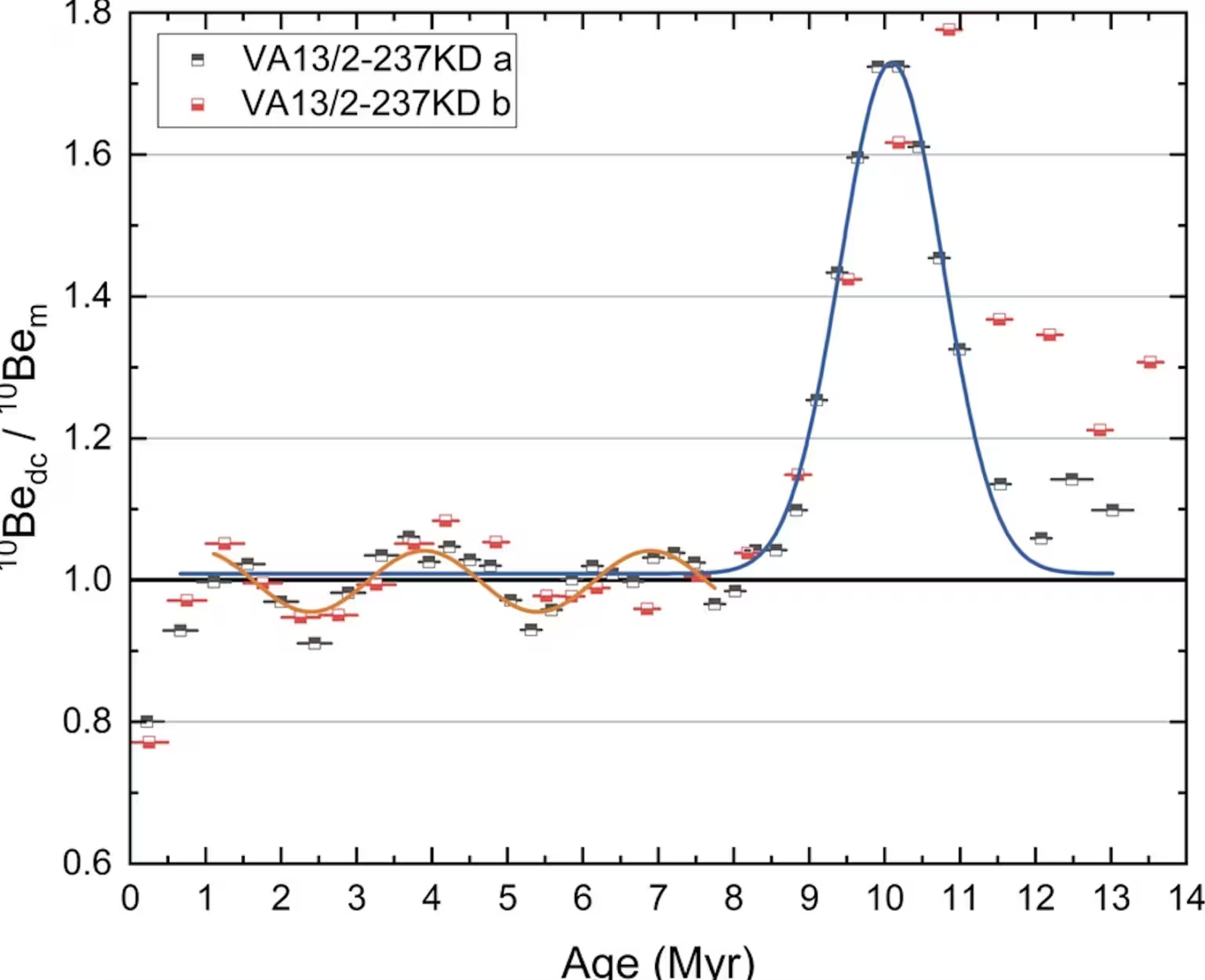
The discovery originated from measurements of ferromanganese crusts in the Pacific that revealed a pronounced Be-10 peak dated to roughly 9–12 million years ago. The anomalous layer stands out against the otherwise smooth background of Be-10 deposition, suggesting either a transient rise in cosmic-ray flux or a local concentrating mechanism, such as altered ocean currents.
To test the cosmic hypothesis, a separate research group used precise astrometric data from the European Space Agency’s Gaia mission to map the past trajectories of 2,725 nearby star clusters and the Sun over the last 20 million years. Gaia’s accurate positions, parallaxes and proper motions allow reconstruction of stellar motion through the Galactic potential and estimation of where and when massive stars (the progenitors of core-collapse supernovae) would have exploded.
Gaia Analysis and Statistical Findings
The team simulated expected supernova rates in those clusters and calculated the probability of a core-collapse event occurring within different radius bins around the Sun. Their results indicate approximately a 68% chance that at least one supernova exploded within about 326 light-years of the Sun within a million-year window centered on the Be-10 anomaly. They also identified 19 clusters with individual probabilities exceeding 1% of producing a nearby supernova at that epoch.
"Our results support the possibility of a supernova origin for the beryllium-10 anomaly," the authors write, noting that the Gaia-based trajectories make a nearby explosion a plausible contributor to the isotope spike.
Alternative Explanations and Next Steps
However, the supernova interpretation is not definitive. If the Be-10 spike is detected only in certain Pacific cores, a regional process—like an oceanographic change concentrating fallout—could explain the signal. If the source were cosmic, the same Be-10 enhancement should appear synchronously in sediment and ice records worldwide.
Resolving the origin will require geographically diverse sampling: coring of sediments and ferromanganese crusts from multiple ocean basins and comparison with terrestrial archives such as ice cores or loess deposits. Improved modeling of supernova nucleosynthesis and cosmic-ray propagation, combined with refined Gaia kinematics, will further constrain which stellar groups could have contributed.
Scientific Context and Implications
A confirmed nearby supernova 10 million years ago would have implications for astrophysics, heliophysics and Earth science. Nearby explosions can transiently increase the flux of high-energy particles and potentially deposit short-lived radioisotopes (including Fe-60, another supernova tracer) on Earth. Identifying such events helps reconstruct the Sun’s galactic environment and informs models of cosmic-ray modulation and potential biological impacts.
The new study, published in Astronomy & Astrophysics, demonstrates the value of combining terrestrial isotope records with precise stellar kinematics from Gaia to search for fingerprints of past nearby supernovae.
Conclusion
The Be-10 spike in Pacific ferromanganese crusts is a compelling clue that a nearby stellar explosion may have influenced Earth’s radiation environment around 9–12 million years ago. Confirming a supernova origin will require additional global sampling, multi-isotope analyses, and continued use of stellar motion data to trace candidate progenitor clusters.


Leave a Comment
Comments
No comments yet. Be the first.