
6 Minutes
New interferometer observations revise quasar J0529's mass
Peering into the first billion years of cosmic history requires both precise measurement and careful interpretation. A recent international study using the GRAVITY+ instrument on the European Southern Observatory's Very Large Telescope Interferometer (VLT-I) has revised the mass of J0529—the brightest known quasar in the Universe—down by an order of magnitude. The result recalibrates how astronomers estimate supermassive black hole masses at high redshift and highlights how powerful outflows can bias spectroscopic measurements.
Originally discovered in 2024 at a redshift that places it about 12.5 billion light-years away (when the Universe was roughly 1.5 billion years old), J0529 was first estimated to host a black hole of around 10 billion solar masses. That estimate relied on a standard approach: using the width of broad emission lines from the quasar’s accretion disc and an assumed orbital velocity-dominated Broad Line Region (BLR) to infer the central mass via virial scaling relations.
But the new GRAVITY+ observations spatially resolved the BLR and directly detected a powerful gas outflow—an expanding jet of material moving at roughly 10,000 km/s—that broadens emission lines independently of orbital motion. Subtracting the outflow contribution from the line profiles yields a revised black hole mass close to 8e8 (800 million) solar masses—about ten times smaller than the first estimate, yet still enormous by galactic standards.
How outflows bias mass estimates: methods and pitfalls
Black hole mass estimates for distant quasars frequently use single-epoch spectroscopy: measure broad emission-line widths (e.g., Hβ, Mg II, C IV), estimate the BLR size via scaling relationships or reverberation mapping, and apply a virial factor to convert velocity into mass. The underlying assumption is that line broadening primarily reflects Keplerian motion around the black hole.
When additional kinematic components are present—radial outflows or inflows, winds driven by radiation pressure, or jet-related shocks—the line profile widens for reasons unrelated to orbital speed. In J0529's case, interferometric imaging with GRAVITY+ allowed the team to spatially separate the BLR's rotating component from the high-velocity radial outflow. That decomposition made it possible to correct the line-width measurement and recalculate the virial mass more accurately.
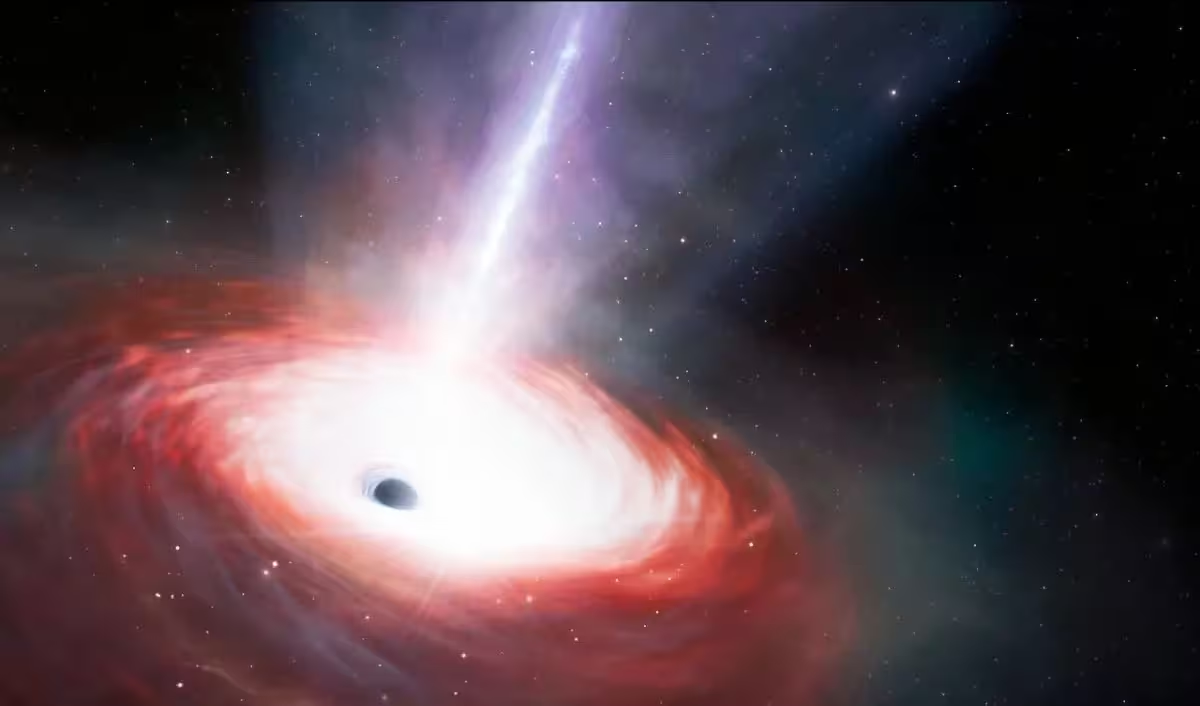
Artist's impression of a rapidly feeding black hole that is emitting powerful gas outflows.
This correction is important because overestimating masses at early cosmic times can skew our models for black hole seed formation and growth. If supermassive black holes are systematically smaller than previously thought, some high-redshift growth scenarios—such as rapid, continuous accretion or massive direct-collapse seeds—may need re-evaluation or recalibration.
Scientific background and observational details
GRAVITY+ enhances the VLT by coherently combining light from multiple 8-meter telescopes to form a virtual aperture with far greater resolving power than any single telescope. That interferometric capability enables spatially resolved spectroscopy at milliarcsecond scales—crucial for separating spatially overlapping velocity components in the BLR of distant quasars.
The study analyzed near-infrared interferometric spectra and reconstructed the BLR geometry and kinematics. By mapping the velocity field across the BLR, the team identified a rotating component consistent with bound orbital motion and a distinct radial component consistent with a fast outflow or jet. The outflow's velocity signature dominated the wings of the emission lines that had previously been interpreted as purely rotational broadening.
The authors attribute the energetic outflow to super-Eddington accretion episodes. In super-Eddington accretion, the accretion rate temporarily exceeds the classical Eddington limit—the luminosity at which radiation pressure balances gravity for a given mass—producing powerful radiation-driven winds that can carry away a substantial fraction of the inflowing mass. While these phases enable rapid growth over short intervals, they can reduce net mass accumulation by expelling material that would otherwise join the black hole.
Implications for early Universe black hole growth and galaxy evolution
Revising J0529 downward changes one data point in the population of early quasars, but the methodological lesson is broad: unresolved outflows can lead to systematic overestimates of black hole mass when relying on single-epoch spectral widths. A population-level reassessment that accounts for outflow signatures could lower inferred masses for some high-redshift quasars and alter constraints on seed models and accretion histories.

Outflows also have direct feedback effects on galaxy formation. Powerful jets and winds can clear gas from the central regions, quench star formation locally, and redistribute enriched material into the circumgalactic and intergalactic medium. In the case of J0529, the observed 10,000 km/s outflow demonstrates how a single active nucleus can influence its host galaxy and surrounding environment within the first few billion years after the Big Bang.
Related technologies and future prospects
The GRAVITY+ results underscore the value of high-angular-resolution interferometry and spatially resolved spectroscopy for disentangling BLR kinematics. Future facilities—like the Extremely Large Telescope (ELT), the James Webb Space Telescope’s follow-up programs, and proposed next-generation interferometers—will extend this capability to larger samples and fainter targets.
Combining interferometry with multi-wavelength monitoring (X-ray, UV, optical, IR, and radio) will be critical to identify outflow signatures across the electromagnetic spectrum, constrain geometry and ionization states, and measure mass-loss rates. That multi-pronged approach will refine our picture of how rapidly early black holes grow and how they shape galaxy evolution.
Expert Insight
"Spatially resolving the BLR is a game-changer for high-redshift quasar science," says Dr. Elena Márquez, a fictional astrophysicist specializing in AGN kinematics. "GRAVITY+ lets us separate rotation from outflow directly, reducing systematic biases in mass estimates. This isn’t just about one object—it's about improving the accuracy of the whole high-redshift black hole census."
Dr. Márquez adds, "As interferometric techniques and large telescopes advance, we should expect more mass revisions. Those corrections will help reconcile observations with theoretical models of seed formation and early growth."
Conclusion
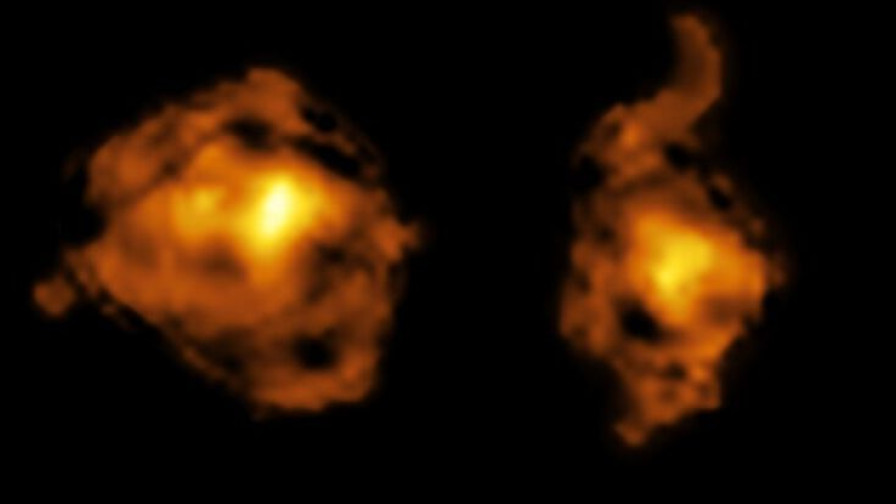
The GRAVITY+ observations of J0529 illustrate how advanced instrumentation can overturn assumptions embedded in standard analysis techniques. By spatially resolving the BLR and isolating a powerful 10,000 km/s outflow, researchers reduced the quasar’s estimated black hole mass by a factor of ten. That finding refines our view of early supermassive black hole growth, highlights the influence of super-Eddington accretion and feedback, and demonstrates the need for spatially resolved spectroscopy to obtain reliable mass measurements in the distant Universe. As next-generation telescopes and interferometers come online, astronomers will be able to apply these methods to larger samples and further sharpen our picture of the first billion years of cosmic evolution.

Leave a Comment
Comments
No comments yet. Be the first.