
4 Minutes
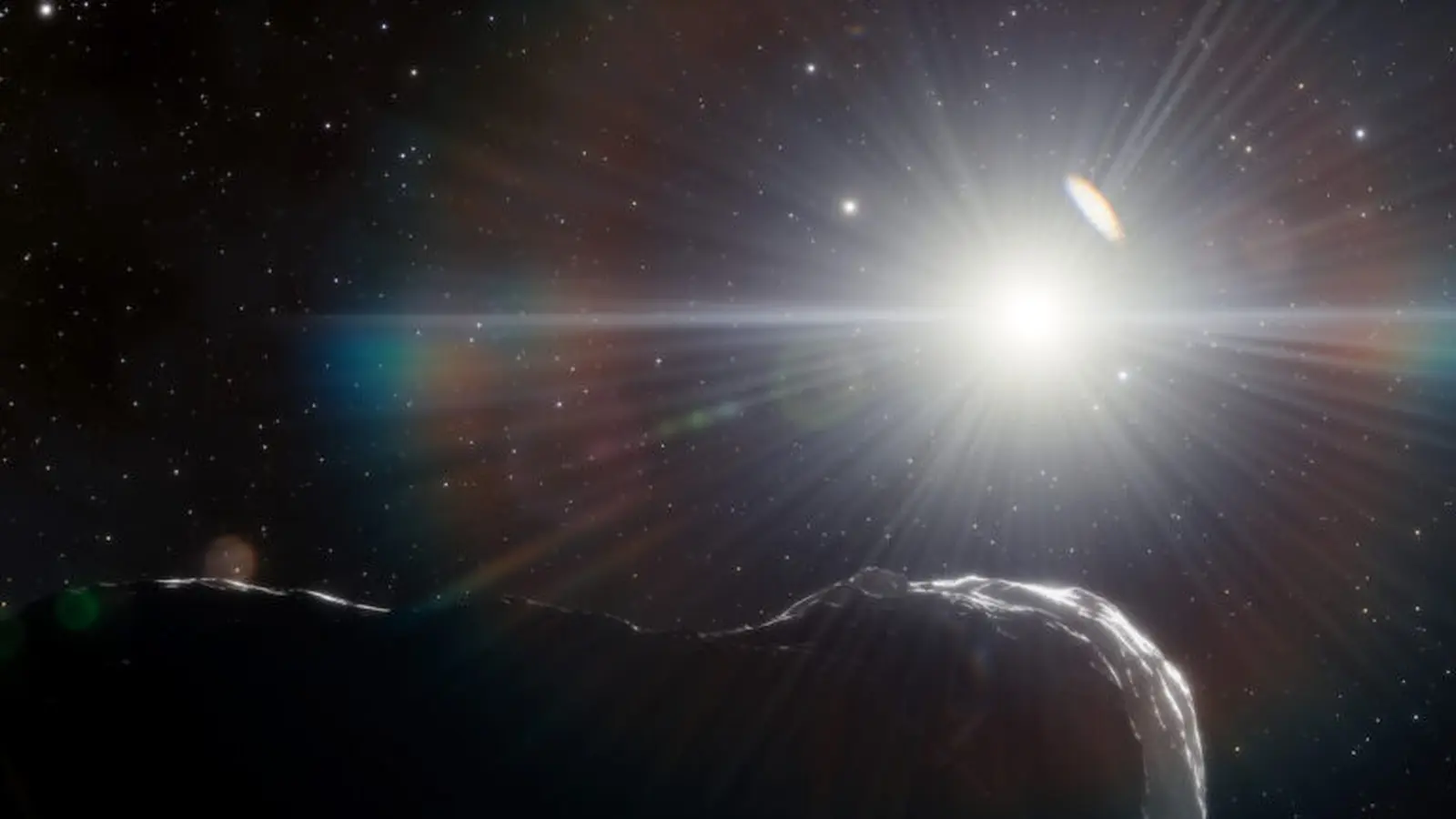
Scientists have found a previously unknown near‑Earth asteroid hiding in the Sun's glare. Catalogued as 2025 SC79, this rock joins the rare Atira class—objects whose orbits lie fully inside Earth's path around the Sun—and raises fresh questions about detection, origin, and planetary defense.
A compact, fast-moving asteroid in our neighborhood
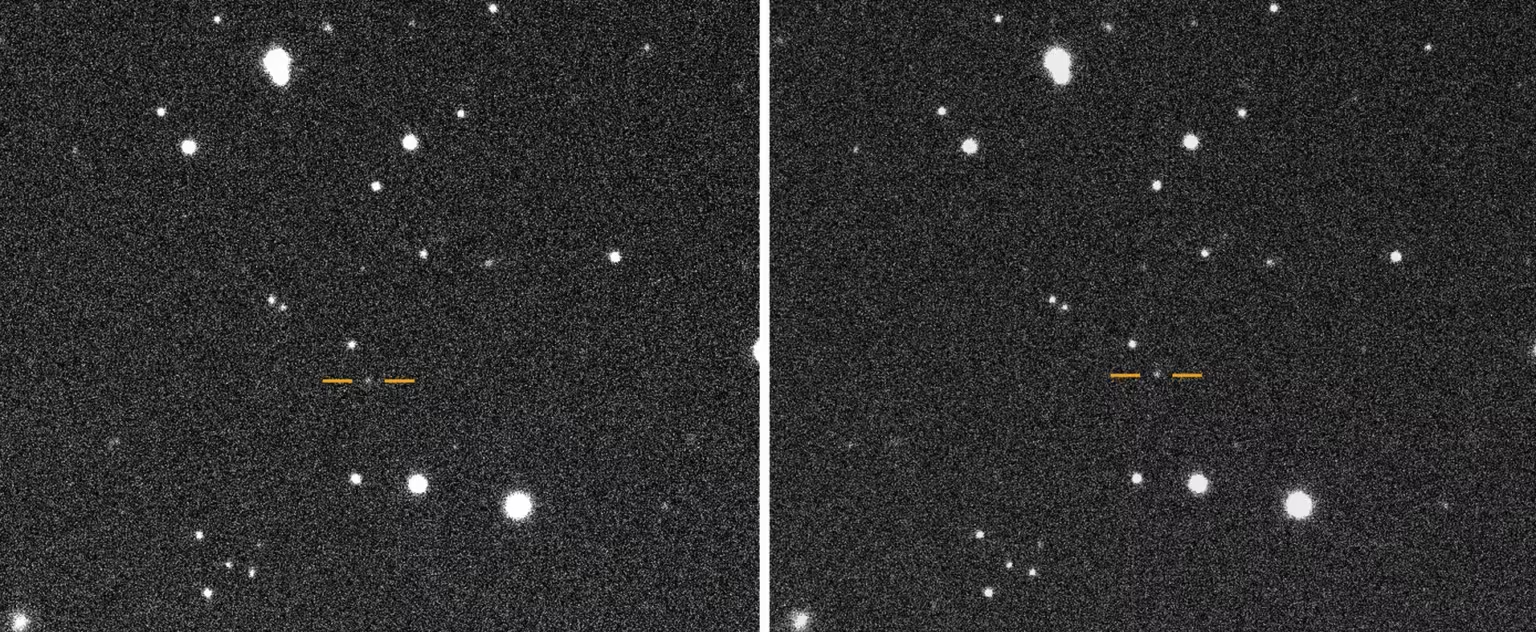
Discovered by Scott S. Sheppard of the Carnegie Institution for Science on September 27 using the Dark Energy Camera (DECam) mounted on the NSF’s Blanco 4‑meter telescope, 2025 SC79 is a surprising find. It is roughly 700 meters (about 2,300 feet) across and completes an orbit around the Sun in just 128 days—one of the shortest orbital periods measured for an asteroid. Only two known asteroids have faster orbits (about 115 days), while Mercury laps the Sun in 88 days for comparison.
2025 SC79 is the 39th confirmed member of the Atira group, a small and elusive family of near‑Earth objects whose entire orbits lie inside Earth’s orbit. This particular asteroid also ventures inward past Venus' orbit and crosses Mercury's orbit, making its path exceptionally close to the Sun—and difficult to observe.
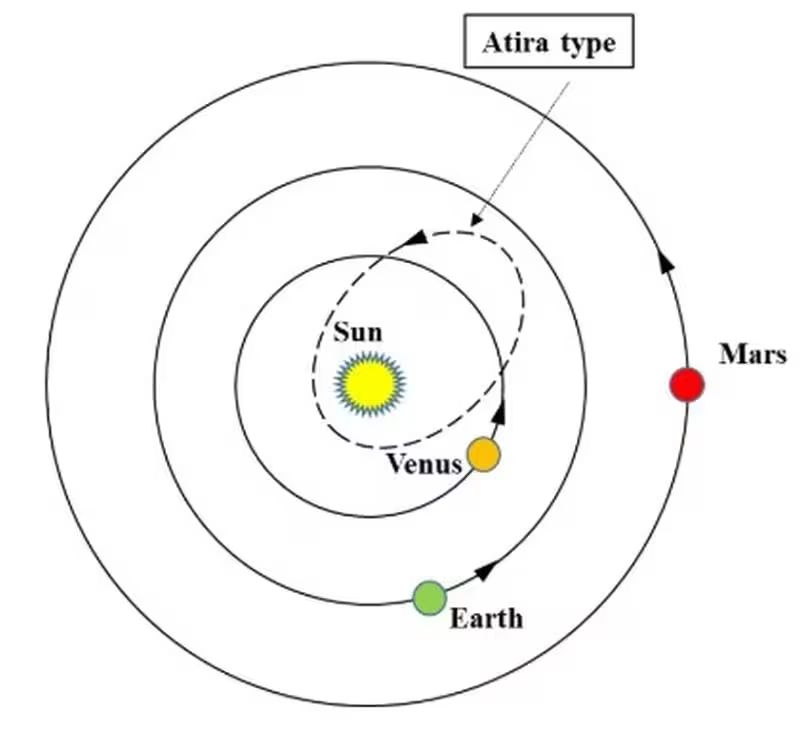
Atira asteroids follow orbits entirely within Earth's orbit.
Why Atira asteroids are hard to find
Objects like 2025 SC79 are faint and located very near the Sun from our point of view, so their reflected light is overwhelmed by sunlight. Most asteroid surveys operate at night and search the darker sky, but Atiras can usually be seen only during twilight—just before sunrise or just after sunset—when the Sun sits low and its glare is still strong.
"The most dangerous asteroids are the most difficult to detect," Sheppard said. "Most asteroid research finds these objects in the dark of night, where they are easiest to spot. But asteroids that lurk near the Sun can only be observed during twilight—when the Sun is just about to rise or set. If these 'twilight' asteroids approach Earth, they could pose serious impact hazards."

Detection techniques and follow-up
- Initial detection with wide-field instruments like DECam captures faint, fast-moving objects against dense star fields.
- Confirmations require rapid follow-up from other telescopes; 2025 SC79’s discovery was corroborated by the NSF’s Gemini telescope and Carnegie’s Magellan telescopes.
- Future improvements in twilight surveying, space-based observatories, and dedicated Sun‑proximate search strategies will increase the odds of spotting similar objects earlier.
Planetary risk and why size matters
At about 700 meters across, 2025 SC79 is much smaller than the Chicxulub impactor that triggered the end‑Cretaceous mass extinction, but it is still large enough to cause region‑to‑continental scale devastation. An impact from an object of this size could generate catastrophic consequences depending on where it strikes—coastal tsunamis, widespread infrastructure collapse, and potentially millions or more casualties in populated regions.
Asteroids that approach from near the Sun are especially concerning because they can arrive from directions poorly covered by ground-based surveys. Early detection is critical: more lead time gives space agencies and civil authorities options ranging from targeted deflection missions to localized evacuation planning.
Origins and mysteries: where did 2025 SC79 come from?
Understanding how an asteroid ends up on a tight, Sun‑interior orbit is an active area of research. One plausible scenario is that gravitational perturbations—interactions with planets or other asteroids—nudged a main‑belt object into a more eccentric path. Over time, resonances and close encounters can shrink and tilt orbits until some bodies become trapped on inner, Sun‑skimming trajectories.
Scientists are especially interested in composition: 2025 SC79 must withstand greater solar heating than most asteroids, and its surface and internal makeup may reveal clues about thermal alteration and space weathering close to the Sun. However, the object is currently lost to the Sun’s glare for several months; astronomers will resume observations once it reemerges to measure its spectrum, rotation, and precise orbit.
Expert Insight
Dr. Lina Márquez, an astrophysicist specializing in small bodies at a major research university, commented: "Discoveries like 2025 SC79 show the limits of our current surveys and the need for a diverse observational toolkit. Twilight searches and space telescopes that can look closer to the Sun offer complementary ways to find these hidden hazards. Each new Atira we characterize improves our understanding of Solar System dynamics and helps refine impact risk models."
As 2025 SC79 moves back into observational reach, astronomers will prioritize spectroscopy to assess its mineralogy, radar imaging to refine its size and shape, and continued tracking to pin down any future Earth approaches. The discovery underscores both the progress and the gaps in near‑Earth object detection—and it reinforces why planetary defense remains an active, urgent scientific priority.


Leave a Comment
Comments (2)
Wild that a 700m rock is tucked so close to the Sun. Kinda scary but also cool, wish we had better twilight surveys, pronto
Wait, only 39 Atiras? How many more hiding in sunlight... If one comes from that angle we could be blindsided, right?