
5 Minutes
For the first time, astronomers have detected complex organic molecules frozen in ice outside the Milky Way. Using the James Webb Space Telescope to study a newborn star in the Large Magellanic Cloud, researchers identified several prebiotic compounds — evidence that the chemical seeds of life can form in environments very different from our own galaxy.
What was discovered and where
The team, led by astrophysicist Marta Sewiło of NASA's Goddard Space Flight Center and the University of Maryland, targeted a young protostar labeled ST6 in the Large Magellanic Cloud (LMC). ST6 sits roughly 160,000 light-years away inside a superbubble known as N158, near the celebrated Tarantula Nebula. By analyzing mid-infrared spectra from JWST, the researchers found a suite of complex organic molecules (COMs) locked in icy mantles around dust grains.
The observations show confident identifications of methanol, ethanol, acetaldehyde, methyl formate and — notably — acetic acid (CH3COOH) in frozen form. Prior to this, acetic acid had only been seen in the gas phase in space; this is the first unambiguous detection of it in interstellar ice anywhere.
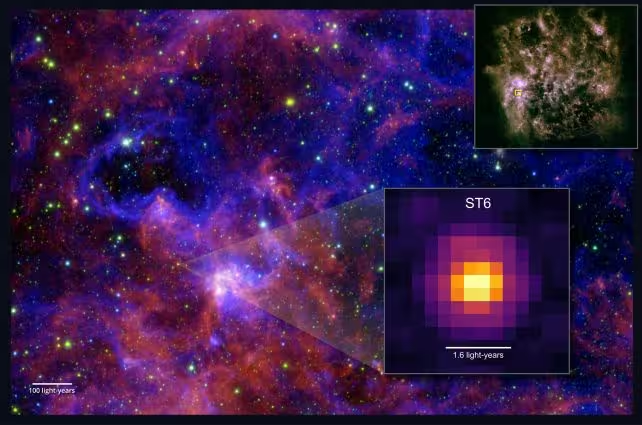
The location of the star ST6 within the Large Magellanic Cloud. The JWST image of ST6 is inset bottom right. (NASA/ESA/CSA/JPL-Caltech/M. Sewiło et al., 2025)
How the detection was made
JWST collected mid-infrared light from the icy dust surrounding ST6. Each molecule absorbs photons at characteristic wavelengths, leaving dark absorption features — a molecular fingerprint — in the spectrum. The team compared the JWST spectra to a laboratory- and observation-derived database of COM fingerprints to match those absorption lines to specific compounds.
Because complex organic molecules in astrophysics are defined as containing at least six atoms with carbon among them, species like ethanol (CH3CH2OH), methyl formate (HCOOCH3) and acetaldehyde (CH3CHO) qualify as COMs. These molecules are important because they are chemical stepping stones toward amino acids, sugars and nucleobases — the building blocks of prebiotic chemistry.
Why this matters: chemistry beyond the Milky Way
The Large Magellanic Cloud is not just another star-forming region — it's a different chemical world. The LMC is metal-poor compared with the Milky Way (it contains only about one-third to one-half the abundance of elements heavier than helium). It also has less dust and stronger ultraviolet radiation fields from intense star formation. These conditions raise a key question: can grain-surface chemistry that produces COMs operate under such harsh circumstances?
The new JWST results indicate the answer is yes. The molecules observed around ST6 are consistent with formation on the surfaces of dust grains. In cold interstellar clouds, thin ice mantles coat tiny dust particles. Atoms and simple molecules freeze onto those mantles, migrate across the surface, and — often aided by radiation — react to form more complex species. Finding the same kinds of COMs in LMC ice suggests that grain-surface chemistry is robust even in metal-poor, UV-rich galaxies.
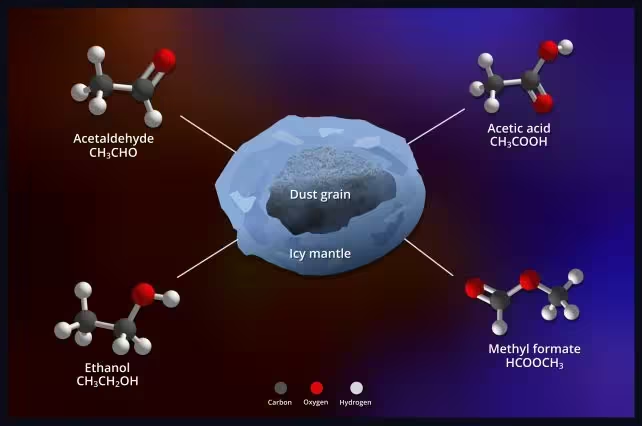
An illustration of some of the detected COMs in the ice coating on a grain of dust. (NASA's Goddard Space Flight Center)
Implications for prebiotic chemistry and planetary systems
Detecting frozen COMs in another galaxy expands the settings in which we can imagine prebiotic chemistry beginning. If molecules like acetic acid and methyl formate assemble on dust grains in the LMC, then the chemical precursors to life may be widely distributed across different galactic environments. These molecules can be incorporated into later generations of planets, comets or asteroids, potentially delivering preformed organic material to young worlds.
However, the current result is based on a single extragalactic source. Sewiło and collaborators note that sample sizes remain small: only one source in the LMC and four Milky Way sources with detections of COMs in ices. Larger surveys of young stellar objects in both galaxies are needed to map variations in molecular abundances and to test whether ST6 is representative or exceptional.
Mission and methods details
The discovery underscores JWST's power for astrochemistry. Its mid-infrared spectrometers can detect weak absorption bands from ices in regions that were previously inaccessible, especially beyond the Milky Way. The observations combined high spectral sensitivity with careful laboratory reference spectra to separate overlapping features and confirm molecule identities.
Future work will extend JWST observations to a broader sample of protostars in the LMC and other nearby galaxies, and will pair those data with laboratory experiments and chemical models that simulate grain-surface reactions under varying metal abundances and radiation intensities.
Expert Insight
"This detection is a striking piece of evidence that the same kinds of chemistry that seed planets with organic material can operate in very different galactic environments," says Dr. Amina Riaz, a fictional astrobiochemist and lecturer in planetary sciences. "Finding acetic acid frozen on dust grains beyond the Milky Way supports models where complex organics are built on grain surfaces, then delivered to forming planets — a process that may be common across the Universe."
"With this discovery," Sewiło says, "we've made significant advancements in understanding how complex chemistry emerges in the Universe and opening new possibilities for research into how life came to be."
The team intends to expand the survey to determine whether similar complex organic chemistry is widespread in the LMC or localized to special pockets like ST6's environment. That follow-up work will help scientists better understand the universality of prebiotic pathways and the potential distribution of life's chemical precursors in the cosmos.


Leave a Comment
Comments (2)
is this even true? lab spectra can overlap, bands messy etc. cool find but feels like a one-off until they survey more protostars. who else will follow up?
wow frozen acetic acid in another galaxy? mind blown... this is huge, but sample size tiny, 1 star only so i'm curious if it's common. JWST is wild