
5 Minutes
Researchers at Virginia Tech report that age-related memory decline is tied to specific molecular changes in the brain — and that manipulating those changes can restore memory performance in older animals. Using precision gene-editing tools, the team targeted two distinct molecular systems to improve memory in aged rats, opening new avenues for therapies aimed at dementia and cognitive aging.
How tiny molecular tags shape memory
Memory formation and recall rely on a vast orchestra of cellular signals. Among those signals are biochemical tags attached to proteins and DNA that alter how neurons communicate and store information. Two such mechanisms — K63 polyubiquitination and the activity of a growth-factor gene called IGF2 — emerged as focal points in Virginia Tech’s recent studies.
K63 polyubiquitination is a form of protein tagging that directs how proteins behave in synapses, the connections between neurons. Proper levels of this tag help strengthen synapses during learning, while imbalances can blunt communication and impair memory. Separately, IGF2 is a gene that supports memory consolidation. It is imprinted (expressed from one parental copy) and, with age, can become chemically silenced through DNA methylation.
Two experiments that rewired aging brains
In a pair of complementary studies, lead investigator Timothy Jarome and his graduate students used CRISPR-based tools to tweak these molecular systems in rats — a common model for studying cognitive aging.
Dialing down K63 polyubiquitination
Published in the journal Neuroscience, the first study examined how K63 polyubiquitination changes with age in two brain regions: the hippocampus (critical for forming and retrieving memories) and the amygdala (essential for emotional memories). The researchers found opposite trends: K63 tagging increased in the hippocampus but decreased in the amygdala as animals aged.
Using CRISPR-dCas13, an RNA-targeting editing system, the team selectively reduced K63 polyubiquitination where it was abnormally high and further lowered it where it was already reduced. The result: older rats showed measurable improvements in memory tasks. The experiments suggest that fine-tuning protein-tagging processes — not simply boosting or blocking them indiscriminately — can restore function in aging neural circuits.
Reactivating a silenced memory gene
The second study, appearing in Brain Research Bulletin, focused on IGF2. With age, DNA methylation accumulates on this imprinted gene in the hippocampus, effectively turning it off. Jarome’s team used CRISPR-dCas9 to remove those methylation tags and reactivate IGF2 expression. Older animals with the gene reactivated performed significantly better on memory tests, while middle-aged animals without memory deficits remained unaffected — underscoring the importance of timing in potential interventions.

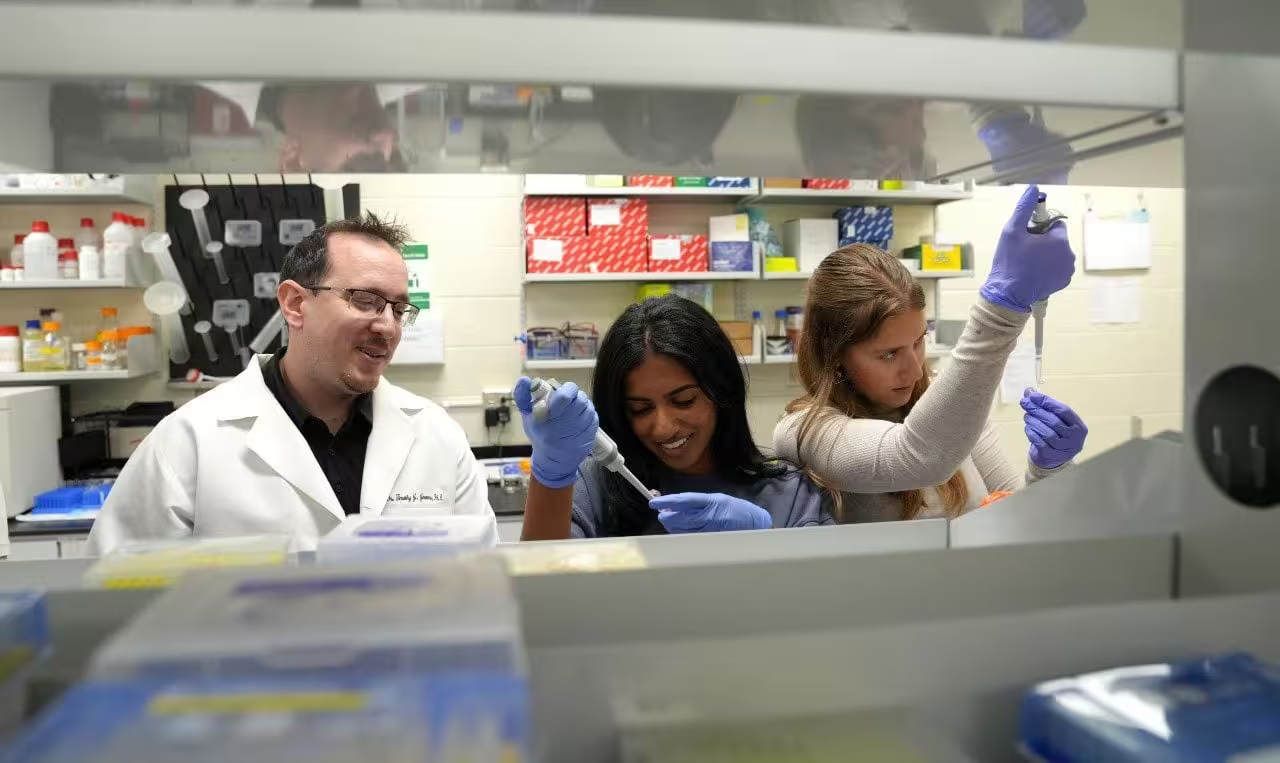
(From left) Associate Professor Tim Jarome works with seniors Harshini Venkat and Keira Currier at his lab in the School of Animal Sciences, where they collect protein samples for a Western blot. Credit: Marya Barlow for Virginia Tech
Why these findings matter for Alzheimer’s and cognitive aging
Memory decline affects a large fraction of older adults and increases risk for neurodegenerative diseases such as Alzheimer’s. These studies reinforce a growing view: cognitive aging is driven not by a single broken switch but by multiple, interacting molecular changes. That complexity means treatments will likely need to be targeted, timed, and tailored.
The work also demonstrates how modern gene-editing tools — here, CRISPR-dCas13 and CRISPR-dCas9 — can be used to make precise, reversible changes to gene expression and protein regulation without cutting DNA. Such specificity reduces some safety concerns associated with permanent edits and highlights a path for developing therapies that restore youthful molecular states in the aging brain.
Translational hurdles and future prospects
While the memory improvements in rats are compelling, translating these approaches to humans will require solving several challenges: ensuring safe and efficient delivery of gene-editing constructs to human brain regions, avoiding off-target effects, and understanding long-term consequences of manipulating epigenetic marks or ubiquitination pathways.
Furthermore, age-related cognitive decline likely reflects many simultaneous molecular shifts. Future therapies may combine approaches that rebalance several pathways — for example, restoring beneficial growth-factor signaling like IGF2 while normalizing protein-tagging systems such as K63 polyubiquitination.
Jarome emphasized the collaborative and graduate-driven nature of the research: his students Yeeun Bae and Shannon Kincaid led the respective projects, with partnerships across Rosalind Franklin University, Indiana University, and Penn State. Funding came from the National Institutes of Health and the American Federation for Aging Research.
Expert Insight
"These studies are an important step toward understanding memory at the molecular level," says Dr. Elena Morales, a fictional neuroscience researcher and science communicator specializing in aging and neurodegeneration. "Precision epigenetic and RNA-targeted interventions allow us to test causal links between specific molecular changes and behavior. The next challenge is translating those insights safely to humans — but the roadmap is clearer now than it was a decade ago."

Whether these molecular adjustments can be adapted to human therapies remains an open question, but the findings demonstrate that some aspects of memory decline are modifiable rather than inevitable. That shifts the narrative from passive acceptance of age-related forgetting to active investigation of how to preserve cognition across the lifespan.

Leave a Comment
Comments (2)
Cool proof-of-concept, but feels a bit overhyped. Restoring IGF2 ok, yet aging is messy - combo therapies needed. Show me long term data
Wait... CRISPR to tweak ubiquitination and IGF2 in old rats? sounds wild but how safe is delivery to human brain? curious about side effects, off-targets.