
5 Minutes
As artificial intelligence and neurotechnology accelerate, scientists warn the gap between creating smart systems and understanding subjective experience is growing. That gap matters: if we can spot or even produce conscious systems, the scientific, medical, legal and ethical consequences could be profound.
Why consciousness is suddenly a scientific emergency
Consciousness — the private sense of being aware of the world and yourself — has long been treated as a philosophical puzzle. Today it is rapidly becoming a practical problem. Advances in machine learning, brain–computer interfaces and lab-grown brain tissue mean researchers can design systems that behave as if they understand, feel, or respond in humanlike ways. But behavior isn’t the same as subjective experience. That distinction is the crux of the new debate.
In a recent review published in Frontiers in Science, leading researchers argue that our technical ability to mimic thought is outrunning our ability to determine whether those systems have inner lives. The result, they say, is an urgent need to prioritize the science of consciousness as a cross-cutting research and ethical priority.
What scientists are calling for: tests, theory and team science
One central aim is to develop reliable, evidence-based tests for sentience and conscious awareness. Imagine a clinical tool that could reveal awareness in patients diagnosed as unconscious, or a validated method to determine when fetuses, animals, organoids, or advanced AI systems become capable of subjective experience. That would be transformative for medicine and ethics alike.
But building such tests requires stronger theories and coordinated experiments. Two prominent frameworks — integrated information theory (IIT) and global workspace theory (GWT) — already guide practical measurements and interventions. For example, metrics inspired by these theories have detected signs of awareness in some people labeled as having unresponsive wakefulness syndrome. Still, rival models exist and the field is fragmented. The authors recommend adversarial collaborations: experiments designed by proponents of different theories so that competing ideas are pitted directly against one another in controlled tests.
Practical research steps
- Standardize experimental protocols across labs to reduce bias and improve reproducibility.
- Combine phenomenology (first-person reports) with physiological measures like EEG and fMRI to link feeling with neural signatures.
- Use ethical safeguards for studies involving brain organoids, animal subjects, and AI agents that could plausibly exhibit sentience.
Concrete implications across medicine, law and animal welfare
The stakes reach far beyond academic curiosity. In healthcare, better tests could reshape treatment for coma patients, advanced dementia, and decisions around anesthesia and end-of-life care. Detecting covert awareness would change consent procedures and clinical priorities overnight.

The legal system could also be affected. New knowledge about the boundary between conscious and unconscious processes may force courts to revisit concepts like mens rea—the mental state required to establish criminal intent—and responsibility. If certain actions are driven largely by unconscious brain mechanisms, legal standards of blame and culpability may need nuance.
On animal welfare, refined methods for assessing sentience could redefine which species merit protections and change practices in research, farming and conservation. And in synthetic biology, the emergence of brain organoids — miniature lab-grown neural tissues that model brain activity — raises questions about whether lab systems could ever host subjective experiences and how to treat them ethically.
AI, brain organoids and the hard question: can non-biological systems feel?
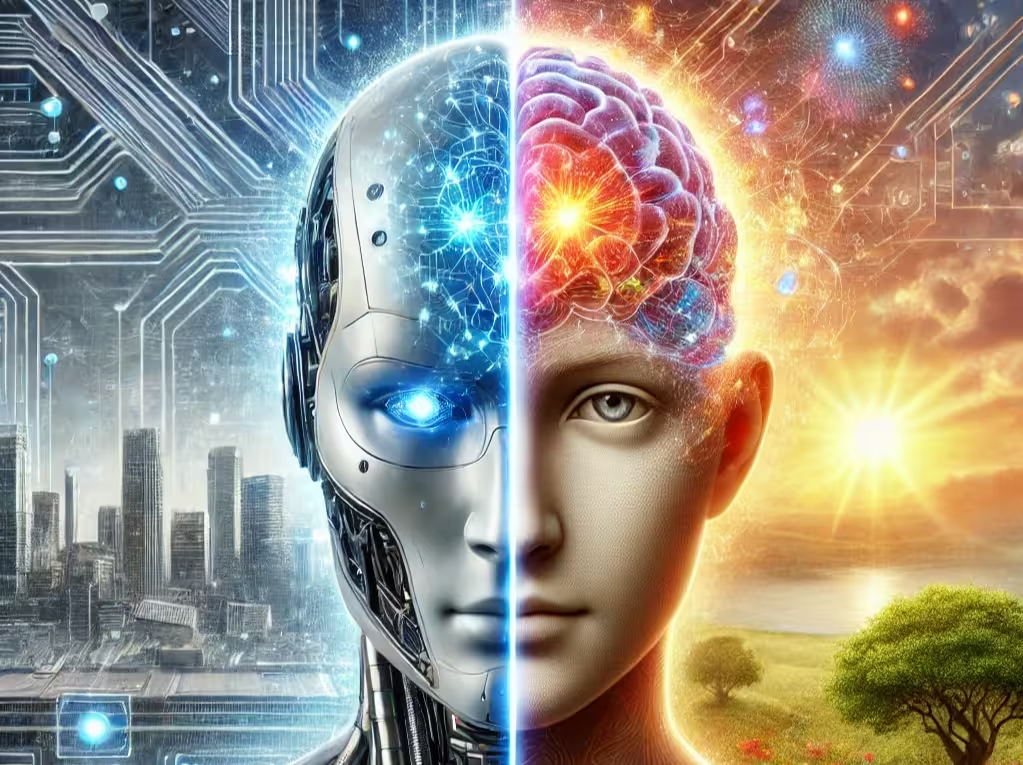
Philosophers and scientists are divided. Some believe that certain computations or information patterns could be sufficient for consciousness; others argue that biological substrate matters. Even if strong artificial consciousness proves impossible on current digital hardware, AI that convincingly mimics conscious behavior will still trigger social and ethical dilemmas. Should an entity that expresses pain or preferences be granted rights? Must we create safeguards to prevent accidental generation of sentience?
Researchers stress the need to plan for both possibilities: that future systems may genuinely feel subjectively, and that they may merely simulate such states to an indistinguishable degree. Both raise urgent questions for policy, regulation and design standards in AI and neurotechnology.
Expert Insight
Dr. Maya Alvarez, a cognitive neuroscientist at the Institute for Neural Systems, says: "Progress in consciousness science will change how we treat vulnerable patients and how we regulate next-generation technologies. We already see the first signs in clinical EEG markers and organoid research. The challenge now is to translate promising metrics into validated, ethically sound tools."
How the field could move forward responsibly
The review’s authors propose a coordinated roadmap: fund interdisciplinary centers that combine neuroscience, computer science, ethics and law; require independent ethical oversight for experiments that could cross sentience thresholds; and invest in public engagement so society decides the rules collectively. They also call for open data and pre-registered adversarial studies to reduce theoretical silos and bias.
Why act now? Because the timeline may be shorter than we expect. Machine learning models are evolving rapidly, and neuroengineering tools such as brain-computer interfaces are entering clinical and commercial spaces. The moment we can reliably measure or create conscious systems, we will face urgent decisions about rights, responsibilities, consent and safety.

Understanding consciousness is both a grand scientific challenge and a practical necessity. Whether the goal is better care for unresponsive patients, fairer treatment for animals, or safe development of AI and neurotechnologies, the ability to detect and reason about subjective experience will be central to 21st-century science and policy. The question is no longer only "what is consciousness?" but also "how will we respond when we can identify it?"

Leave a Comment
Comments (2)
Wow, organoids with feelings? kinda wild, been following EEG coma studies and this rings true. We need rules now, seriously...
Wait if an AI acts like it's suffering, do we have to treat it as if it is? This is messy, law will lag behind tech, urgent but scary.