
3 Minutes
Researchers in Taiwan have uncovered a fast, inflammation-driven pathway that can reactivate dormant hair follicles: by stimulating fat cells around hair roots, mice regrew visible hair in about 20 days. The discovery highlights a surprising role for adipocytes and immune cells in hair regeneration and points to a potential new direction for treating human hair loss.
How the experiment rewired the skin’s repair response
The team led by systems biologist Kang-Yu Tai at National Taiwan University started from an everyday observation: irritation, scrapes or burns often trigger local hair growth in mammals. To trace that effect, the researchers shaved mice and applied mild skin injuries with chemical irritants or heat, then tracked cellular activity with microscopic imaging and molecular assays.
What they observed was a coordinated cascade. Local irritation produced inflammation that pulled immune cells called macrophages into the damaged area. Those macrophages then signaled nearby adipocytes — the fat cells in the skin — to become active and release a mixture of fatty acids. Hair stem cells absorbed these fatty acids, received a biochemical cue, and exited their resting state to begin growing hair again.
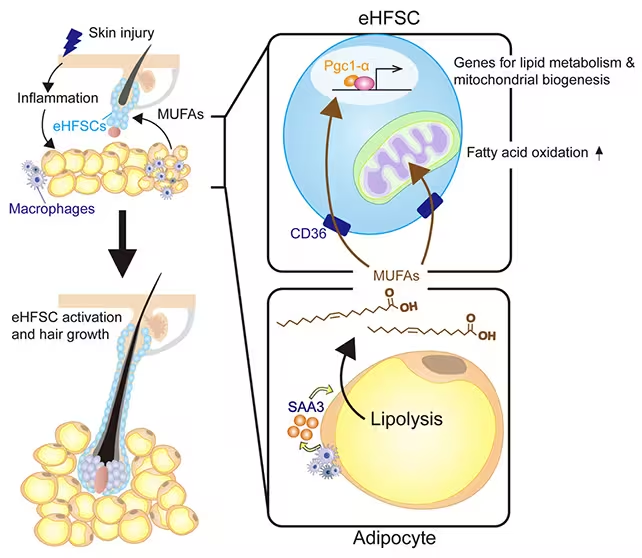
Fat cells are used to regrow hair after injury
Mechanism, evidence and a clever shortcut
The team's interpretation is straightforward: injury → inflammation → macrophage recruitment → adipocyte activation → fatty acid release → hair stem cell reawakening. Importantly, after mapping this pathway, the researchers asked whether they could skip the damaging step entirely. They formulated a topical serum composed of the same fatty acids released by activated adipocytes and applied it to shaved mouse skin.
The result: treated skin areas showed robust hair regrowth within roughly 20 days, matching the timing seen after physical irritation. This suggests that the fatty acids themselves are key mediators and, crucially, could be delivered without causing tissue damage.
Limits, translation challenges and clinical prospects
There are several important caveats. The fatty-acid treatment only works on hair follicles that are in a resting (telogen) phase and ready to receive a growth signal. Human scalp hair cycles asynchronously — different hairs sit in different stages — and long-term baldness often reflects follicle miniaturization or permanent loss, not simply an absence of a growth cue.
Because the experiments used shaved, intact follicles rather than follicles lost to scarring or extensive miniaturization, the jump from mice to humans is nontrivial. The researchers are moving toward clinical trials to test safety and efficacy in people, but larger, longer studies will be required to understand how well topical fatty-acid treatments might restore density on human scalps.
Why this matters
- It identifies adipocytes — often overlooked support cells — as active players in hair regeneration.
- The approach offers a potentially noninvasive route to trigger growth without surgery or cell transplantation.
- Existing knowledge of fatty acids and skin biology could speed formulation and safety testing.
In their paper the team notes that humans retain the regenerative biology to grow hair after skin injury — a remnant of evolutionary protection — and that harnessing fatty-acid signaling could exploit this latent capacity without harmful irritation. Further research will need to clarify exactly how macrophages decide to trigger adipocyte release of fatty acids and whether other immune or metabolic factors modulate the effect.
For now, the study offers a plausible, biologically grounded path toward new hair loss therapies and underscores the complex cross-talk between immune cells, fat cells and stem cells in skin repair.

Leave a Comment
Comments
No comments yet. Be the first.