

4 Minutes
We think of zoning out as a lapse of attention—annoying, sometimes embarrassing, and often blamed on boredom or fatigue. New research from MIT suggests there’s more going on: those brief moments of mental drift may be a built-in, sleep-like maintenance routine. The brain appears to trigger cerebrospinal fluid (CSF) flows while awake to clear metabolic waste, especially after missed sleep, and that cleanup comes with a temporary cost to attention.
How wandering attention became a window into brain cleanup
Researchers at the Massachusetts Institute of Technology combined electroencephalogram (EEG) caps with functional magnetic resonance imaging (fMRI) to watch what happens in the sleeping and sleep-deprived brain. They compared participants after a night of normal rest and after a night without sleep. The results revealed short bursts of CSF flowing out of the brain and then returning a second or two later during moments the study authors call "attentional failures"—times when participants briefly failed to respond to a task.
Those CSF waves closely resembled the fluid dynamics seen in deep sleep, a phase believed to support the brain’s waste clearance. In other words, the brain sometimes runs a mini-cleaning cycle during wakefulness, particularly when it’s short on sleep.
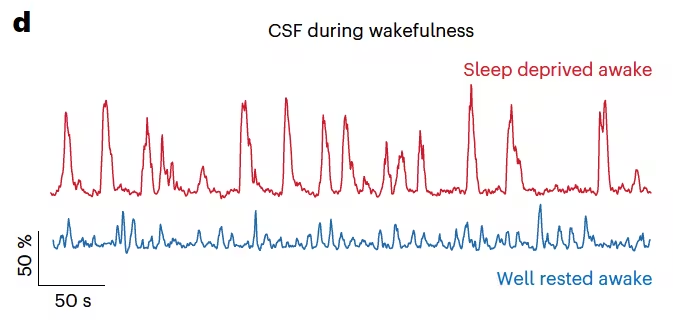
Larger fluid flows were observed when people were sleep-deprived
The experiment: measuring attention, fluid flow and physiology
Participants completed attention tasks while researchers recorded brain electrical activity and blood-oxygen signals. The team found that larger CSF flows were much more common after a night without sleep, and those flows coincided with slower reaction times and missed responses. Simultaneous measures also showed slowed breathing and heart rate and constricted pupils during these episodes.
What the signals tell us
- EEG detected shifts toward sleep-like electrical patterns at the moments attention lapsed.
- fMRI revealed corresponding waves of CSF moving through the brain, similar to flows observed in deep sleep.
- Cardiorespiratory and pupil changes suggested a broader, body-wide shift accompanying each micro-rest.
Why these micro 'rinse cycles' matter
The simplest interpretation is that, when sleep is lacking, the brain attempts to recover some restorative function without fully switching off. "When you don’t sleep, the CSF waves begin to intrude into wakefulness," MIT neuroscientist Laura Lewis tells the team, noting that these intrusions come with an attention trade-off. Zinong Yang, who led the study, describes it as the brain iterating between a high-attention state and a high-flow, restorative state to try to preserve function after sleep loss.

That trade-off has practical consequences. Missing sleep is already linked to cognitive decline, increased disease risk, and changes in mood and perception. These findings add a mechanism: the brain may compensate with brief, sleep-like events that restore some biochemical balance but momentarily reduce alertness—an internal microsleep program that protects neural health at the expense of immediate focus.
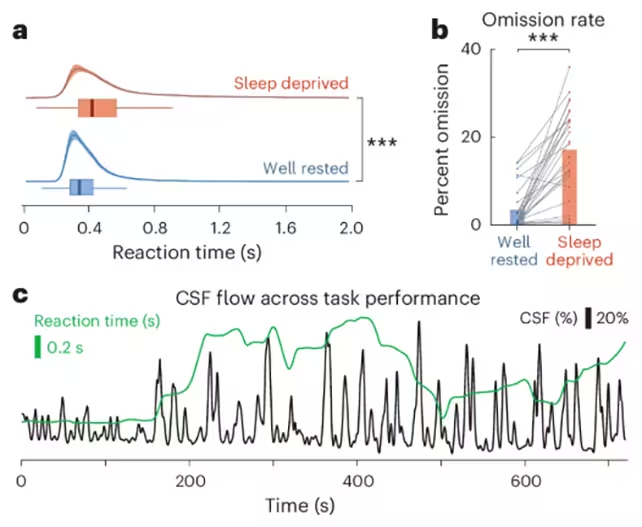
The researchers looked at CSF flow and periods of zoning out ("omissions") after a full night of sleep and after a night of no sleep. Higher flows were recorded when reaction times slowed down (C; data from one test run is shown).
Broader context and open questions
The study, published in Nature Neuroscience (Yang et al., 2025), strengthens a growing idea that sleep supports brain clearance via CSF flows. But it also raises new questions. Are these wakeful CSF waves as effective as those during full sleep? Which neural circuits trigger the switch between attention and flow states? And could chronic sleep loss, forcing more frequent intrusions, lead to long-term problems in brain clearance?
Researchers also noted the body-wide character of the events—breathing, heart rate, and pupil responses shifted alongside the fluid movement—pointing to a possible unified control system. If true, that system would coordinate high-level cognition and low-level physiological processes to balance immediate demands with long-term maintenance.
Expert Insight
Dr. Mira Patel, a sleep neuroscientist unaffiliated with the study, says: "This work provides an elegant link between attention lapses and physical clearance mechanisms. It helps explain why cognitive function collapses with sleep deprivation and suggests new biomarkers—like CSF wave signatures—for detecting when the brain is trying to compensate. The therapeutic implications are intriguing: if we can identify or modulate these intrusions, we might protect cognition in shift workers or people with sleep disorders."
Implications for everyday life
For most people, the message is straightforward: regular quality sleep remains essential. While brief zoning out may reflect an adaptive cleanup strategy, it’s not a substitute for sleep. Frequent intrusions likely signal cumulative sleep debt and could impair safety and performance. Imagine driving while the brain briefly runs a mini-cleaning cycle—those seconds of inattention are precisely what safety advice warns against.

Future work will look at whether pharmacological or behavioral interventions can reduce harmful attention lapses without blocking the brain’s necessary maintenance. For now, the best bet remains the simplest one: prioritize sleep, because when you skip it, your brain will find a way to catch up—and you’ll notice the cost.













Leave a Comment
Comments (2)
Is this even true? If CSF waves pop up while awake, are they as effective as during real sleep... seems plausible but need longterm studies, or is it just correlative?
Whoa, zoning out as mini-cleanups?! Mind blown. Kinda scary tho, imagine driving and your brain does a quick rinse, oops. Sleep ppl!!