
5 Minutes
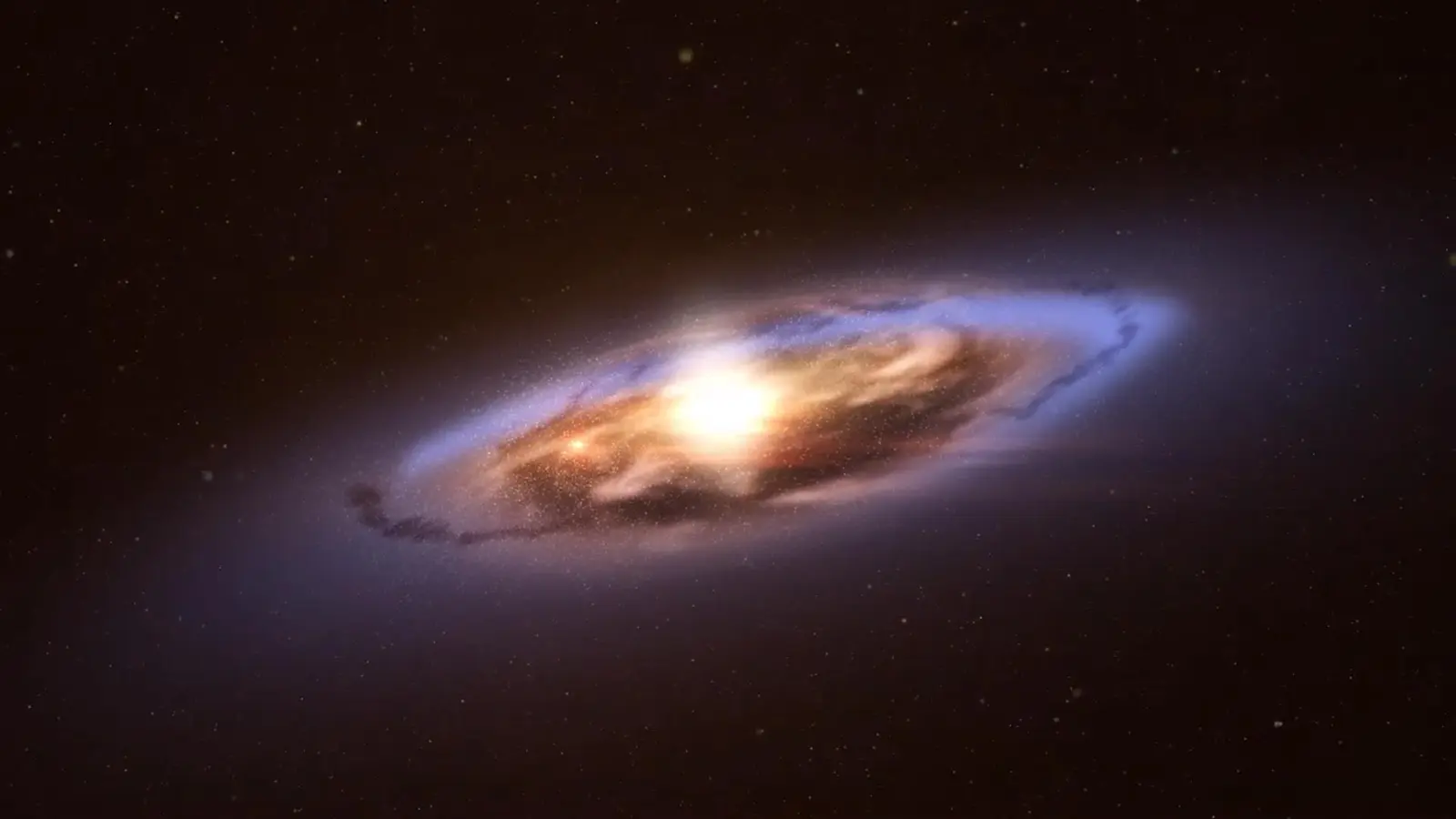
New analysis of stellar motions captured by the Gaia space observatory reveals a large, outward-propagating ripple in the Milky Way's disk. The vertical motions of thousands of young stars trace a coherent wave pattern stretching across the outer galaxy — a dynamic signature of an energetic event in our galaxy's past.
Mapping a galactic shiver: how the ripple was found
For the first time, astronomers have combined high-precision position and velocity data from Gaia with catalogs of pulsating and young giant stars to measure vertical motion — motion perpendicular to the galactic plane — across the outer disk. The study focused on two complementary samples: roughly 17,000 young giant stars out to about 23,000 light-years, and some 3,400 classical Cepheid variables reaching nearly 49,000 light-years. Together these stars probe a large fraction of the Milky Way's stellar disk, which spans approximately 100,000 light-years.
Using Gaia's DR3 release (the spacecraft's third major data release at the time of the study), researchers reconstructed how those stars move through space. The result was unexpected: both star samples show the same alternating pattern of vertical velocities — peaks and troughs consistent with a coherent wave traveling outward from the galactic center. Like ripples spreading across a pond, the wave's amplitude grows with distance, lifting stars higher above and lower below the galactic plane toward the disk's edge.
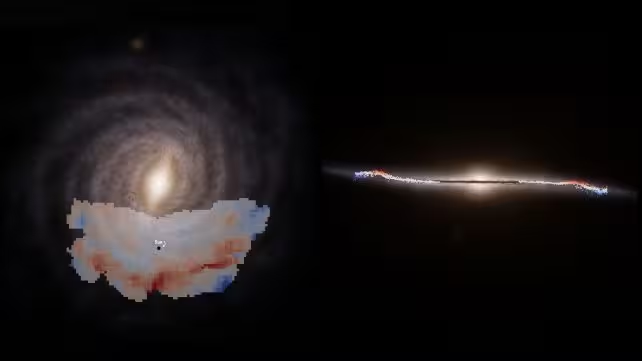
The positions and motions of the stars in the analysis, mapped against the disk of the Milky Way, viewed from above (left) and side-on (right).
What could have set the Milky Way ringing?
The short answer: we don't yet know for sure. The new paper highlights a few plausible triggers. One candidate is the Sagittarius dwarf galaxy, a small satellite that has been repeatedly plunging through the Milky Way's disk over billions of years. Each passage can produce a vertical disturbance that propagates outward as a wave.
Another possibility is a link to previously identified structures such as the Radcliffe Wave — a 9,000-light-year-long filament of gas and young stars running along one spiral arm. But the newly detected wave is much larger and located in a different region of the disk, so any connection remains speculative.
As the study's lead author, Eloisa Poggio, notes, 'Taken together, these findings lead us to explore the hypothesis that there is a vertical wave extending over a large portion of the outer disk that is moving away from the galactic center.' The research also suggests that the signal is especially clear in young stellar populations because those stars inherit the bulk kinematics of the gas clouds from which they formed. In other words, the wave could be primarily a gaseous feature revealed by the motions of recently born stars.
Why Gaia matters for galactic archaeology

Gaia has transformed our three-dimensional view of the Milky Way. Over more than a decade, the mission has measured positions, parallaxes, and proper motions for over a billion stars, and for many of those it has provided radial velocities, building a full 6D map of stellar phase space for wide swaths of the galaxy. That level of detail is essential for detecting subtle patterns like corrugation and vertical waves.
Stellar kinematics — how stars move — acts like forensic evidence for past interactions. Streams and shells can reveal the ghost of a cannibalized dwarf galaxy. Vertical waves, warps, and corrugations indicate gravitational perturbations that still echo through the disk. Detecting an outward-propagating vertical wave expands the catalog of dynamic phenomena that shape galactic structure on million-year timescales.
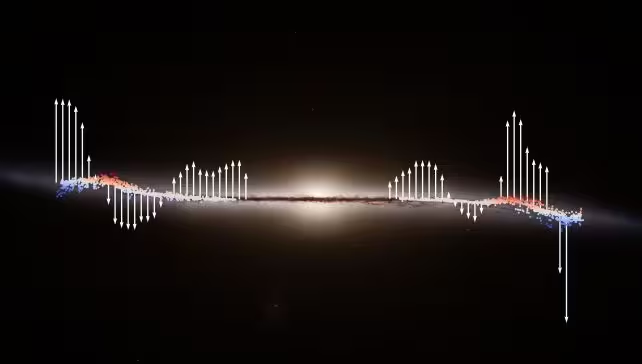
Compelling evidence for outward propagating ripples in the Milky Way.
Implications for star formation and disk evolution
If the ripple is primarily a gaseous disturbance, it may influence where and when new stars form by compressing or rarefying the interstellar medium as the wave passes. That could imprint age and velocity patterns in the youngest stellar cohorts and alter the large-scale vertical distribution of gas and dust. Over longer timescales, repeated perturbations from satellite interactions could thicken the disk and seed persistent warps or corrugations.
From a cosmological perspective, these findings emphasize that the Milky Way is not an isolated, static island. It is dynamically alive, shaped by mergers, flybys, and tidal interactions that leave measurable signatures across tens of thousands of light-years.
What's next: Gaia DR4 and deeper surveys
Gaia's next major data release, DR4, is expected to arrive in December 2026. The research team plans to revisit the ripple with a larger and more precise dataset to refine the wave's geometry, propagation speed, and origin. Deeper spectroscopic surveys and gas-mapping projects will also be valuable: if the disturbance is mainly gaseous, radio and millimeter observations that trace cold gas should show corresponding density and velocity structures.
Expert Insight
'Finding a coherent vertical wave in young stars is like hearing a bell ring across the galaxy,' says Dr. Amina Khatri, an astrophysicist not involved in the study. 'It tells us the disk remembers past impacts. With DR4 and targeted gas surveys, we can start timing these events and link them to specific satellite passages or internal instabilities.'
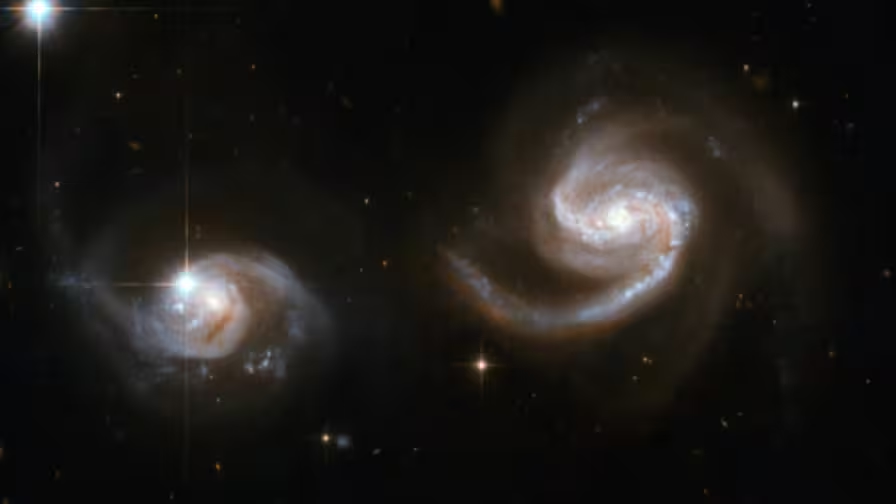
Ongoing work will test whether the ripple is a single pulse from a dramatic encounter or part of a more continuous pattern of disturbances driven by multiple processes. Either way, the discovery underlines how modern astrometry and stellar kinematics open a window into the Milky Way's living history.

Leave a Comment
Comments (2)
Is this just Sagittarius again? Feels like we blame that dwarf for everything. Need stronger timing evidence and gas maps, not convinced yet.
Whoa a galaxy-sized ripple... gives me chills! Imagine star nurseries wobbling after a cosmic whack, wild stuff, if true. kinda poetic and scary