

4 Minutes
Researchers have demonstrated a new way to coax a previously inaccessible portion of the electromagnetic spectrum out of exotic quantum materials. By combining topological insulators with carefully engineered nanostructures, the team observed both even and odd terahertz harmonics — a milestone that could shrink terahertz sources and accelerate applications in communications, sensing, and quantum devices.
Why symmetry matters for high-order harmonic generation
High-order harmonic generation (HHG) is a nonlinear optical process that converts incoming light into waves at integer multiples of its original frequency. Scientists use HHG to reach spectral regions that ordinary optics cannot access. But the efficiency and types of harmonics produced depend strongly on a material's symmetry.
Materials with perfect inversion symmetry — graphene being a prominent example — favor odd harmonics only. Even-numbered harmonics are suppressed because the underlying symmetry cancels out the required nonlinear response. That limitation leaves an incomplete harmonic palette for terahertz (THz) photonics, a band of the spectrum prized for imaging, spectroscopy, and emerging wireless systems.
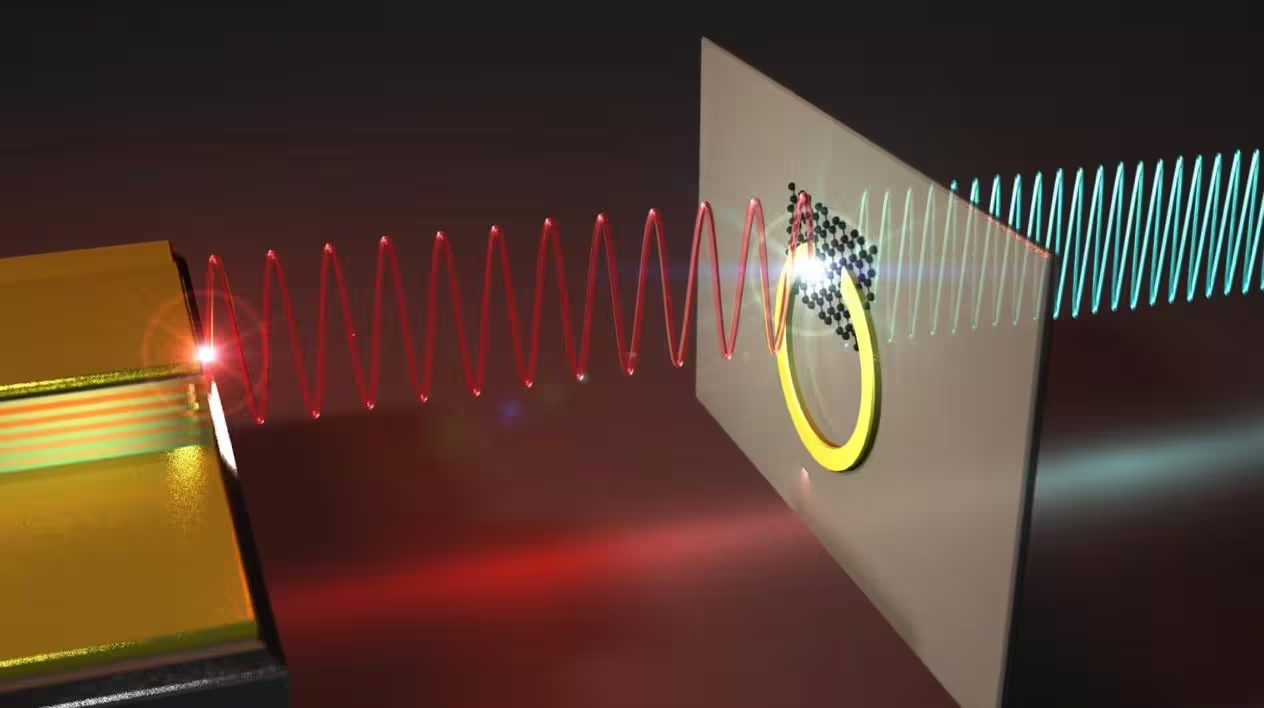
Topological insulators and nanostructures: a clever workaround
A research team led by Prof. Miriam Serena Vitiello has demonstrated that topological insulators (TIs) can break that symmetry constraint. TIs are a class of quantum materials that insulate in their bulk but conduct along their surfaces; the surface states are protected by the material’s topology and spin–orbit coupling. These special properties make TIs fertile ground for unconventional light–matter interactions.
To amplify those interactions, the researchers patterned split ring resonators (SRRs) and added thin films of Bi2Se3 plus van der Waals heterostructures of (InxBi1-x)2Se3. The SRRs act like microscopic antennas, concentrating the incoming THz field into the TI layers. When pumped by a 2.5 W terahertz quantum cascade laser (QCL), the hybrid devices produced both even and odd harmonics — a rare, experimentally verified occurrence in the THz range.
What the experiments revealed

The team observed frequency up-conversion spanning an even harmonic at 6.4 THz and an odd harmonic at 9.7 THz. This simultaneous generation indicates that both the symmetric bulk response and the asymmetric surface states of the TI contribute to HHG. In other words, the surface breaks inversion symmetry locally while the bulk retains other symmetry properties, and the combination enables a fuller harmonic spectrum.
These results provide the first clear experimental evidence that topological surface states can be harnessed for complex harmonic generation in the terahertz domain, confirming theoretical predictions and opening a practical route for compact THz sources.
Real-world impacts: tunable THz sources and faster wireless
Why does this matter? Tunable, compact terahertz light sources are a long-sought component for several fast-growing technologies. Potential applications include:
- Next-generation wireless communication (e.g., beyond 5G/6G) using THz carrier bands for ultra-high data rates.
- Non-invasive medical imaging and security scanners that rely on THz penetration of materials.
- Ultrafast optoelectronic components and sensors benefiting from on-chip THz generation.
- Quantum information platforms that need precise control of light–matter coupling on the nanoscale.
The combination of optically pumped QCLs, topological materials, and resonant nanostructures points to miniaturized, frequency-tunable THz emitters that could be integrated into lab equipment and eventually deployed in portable devices.
Expert Insight
“This work shows how material topology can be used as a lever to access parts of the spectrum we once considered impractical,” says Dr. Elena Marconi, an applied physicist specializing in terahertz devices. “By engineering both the nanoscale geometry and the quantum states at the surface, the researchers opened new degrees of freedom for device design. The next step is improving conversion efficiency and integrating these structures with standard semiconductor platforms.”

Moving forward, the field will focus on optimizing heterostructure composition, resonator geometry, and pumping conditions to maximize harmonic yield and device stability. If successful, compact TI-based THz generators could become a practical tool for scientists and engineers working at the intersection of photonics and quantum materials.

Leave a Comment
Comments (2)
Is this even practical tho? Seems cool but how real is the conversion efficiency, thermal issues, and integration with chips? sounds a bit optimistic
Wow, topological surface states making even THz harmonics? mind blown. If they fix efficiency and stability, this could change portable THz gear… curious