
5 Minutes
Scientists have produced the clearest, most detailed picture yet of how neutrinos — the universe’s most elusive particles — change identity as they travel. By combining data from two long-running international experiments, researchers have sharpened measurements of neutrino oscillations and opened new pathways to probe why the cosmos favors matter over antimatter.
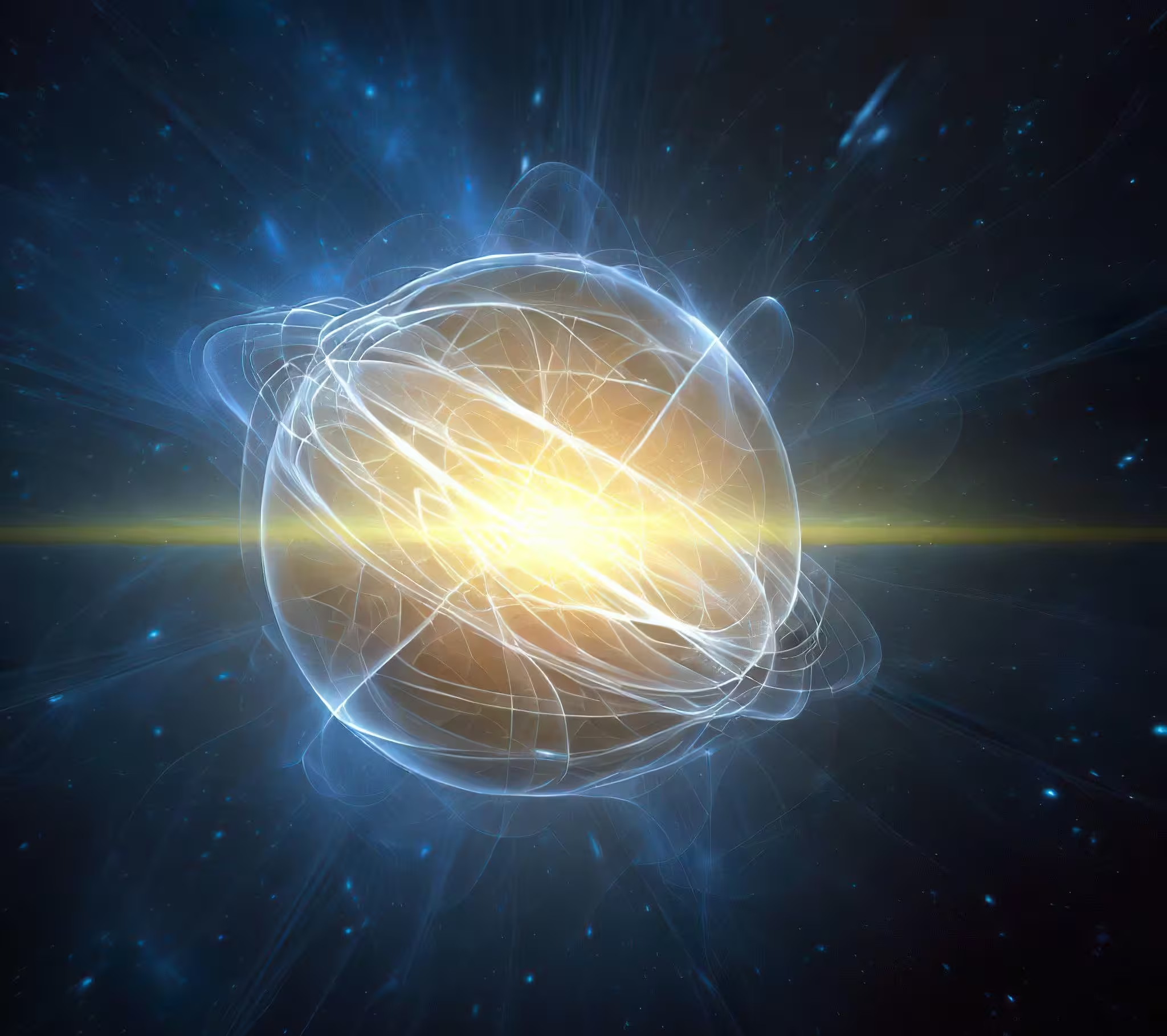
A new global study uncovers surprising behavior in the universe’s most elusive particles, hinting at answers to why anything exists at all. Credit: Stock Collaborative experiments focus on uncovering the unusual properties of the ghost particle.
Why neutrinos matter: tiny particles with huge implications
Neutrinos are fundamental particles produced in the Sun, in supernovae, in the Earth’s atmosphere and in particle accelerators. They interact so weakly with matter that billions pass through your body every second without a trace. Yet their subtle behavior — especially the fact that they oscillate between three known types (electron, muon and tau) — carries crucial information about particle physics and cosmology.
Neutrino oscillations imply neutrinos have mass, a discovery that already required extending the Standard Model of particle physics. How much mass each neutrino type carries, whether neutrinos differ from their antiparticles, and whether they helped tip the early universe toward matter are open questions with profound consequences.
Two experiments, one clearer picture
To capture oscillations with higher precision, researchers combined results from two complementary long-baseline experiments: NOvA in the United States and T2K in Japan. Each project fires beams of muon neutrinos across hundreds of kilometers and measures how many arrive as a different flavor at far detectors.
How NOvA and T2K complement each other
- NOvA sends a muon-neutrino beam from Fermilab near Chicago to a detector in Ash River, Minnesota. Its longer baseline and different neutrino energies provide sensitivity to certain oscillation patterns.
- T2K launches its beam in Japan and measures changes at a detector embedded in mountain rock. The experiment’s lower energy and different geometry probe oscillation parameters in a distinct regime.
Pooling the two data sets is more than a sum of parts: the experiments’ different baselines and energy ranges break degeneracies and tighten constraints on oscillation parameters that a single experiment struggles to resolve alone.
Key findings: what the combined analysis revealed
The joint study — published in Nature — delivers the most detailed map yet of how neutrinos change flavor as they travel. Among the takeaways:
- Improved precision on oscillation parameters that describe the probability neutrinos switch types.
- Stronger but still inconclusive hints about Charge-Parity (CP) violation in the neutrino sector — the possibility that neutrinos and antineutrinos oscillate differently.
- Refined constraints on neutrino mass ordering, an essential piece for interpreting future measurements.
These results do not yet deliver definitive answers about whether neutrinos violate CP symmetry or exactly how their masses stack up, but they narrow the landscape and indicate which experimental directions are most promising.
Why CP violation in neutrinos would be a game-changer
If neutrinos and antineutrinos oscillate differently, it could help explain the cosmic matter–antimatter asymmetry: why the observable universe contains far more matter than antimatter. The CP-violating effects seen so far are small and statistically uncertain, so researchers emphasize the need for more data and new detectors to confirm or refute these early hints.
"The more we combine independent measurements, the better we can separate subtle physics from experimental quirks," said John Beacom, professor of physics and astronomy. Collaborations that once competed are increasingly pooling information because the questions at stake — the origin of mass and matter dominance — are so fundamental.
Building toward the next generation of detectors
Ohio State’s Zoya Vallari, a leading member of the NOvA collaboration, is assembling a team to design a next-generation neutrino detector expected to come online later this decade. Larger detectors, improved beam technology, and more years of data will be crucial to moving from suggestive trends to decisive discoveries.
Future facilities will aim to measure CP violation with high significance, pin down the neutrino mass ordering, and probe whether neutrinos are their own antiparticles — a property with major theoretical implications.
Expert Insight
"Neutrinos are nature’s subtle messengers," says Dr. Mira Patel, a neutrino physicist at a national laboratory. "They don’t shout; they whisper. To decode what they tell us about mass and the early universe we need complementary experiments, patient data collection, and detectors that can read those whispers clearly. This combined NOvA–T2K analysis is a crucial step toward that clarity."
Researchers plan to continue joint analyses as more data arrive, iteratively improving precision. The techniques and collaborative model used here will also inform next-generation projects such as the Deep Underground Neutrino Experiment (DUNE) and Hyper-Kamiokande, which are designed specifically to settle questions about CP violation and mass ordering.
Particle physics often yields technologies far beyond its immediate aims, but the deeper motive remains an age-old human curiosity: to understand why the universe is the way it is. By tracking the shape-shifting behavior of neutrinos, physicists are following one of the most promising trails toward that answer.









Leave a Comment
Comments (2)
is this even definitive? sounds promising but CP violation still just a hint. wait for DUNE or Hyper-K to confirm, right, not gonna jump yet
wow neutrinos whispering secrets... combining NOvA and T2K actually sharpens those tiny CP hints. if it's real, that's huge, goosebumps. tho still want more data