

4 Minutes
Most natural diamonds reach the surface inside a rare, carrot-shaped volcanic rock called kimberlite. New computer models from the University of Oslo show how tiny amounts of volatile components—mainly carbon dioxide and water—alter kimberlite chemistry and buoyancy, determining whether these deep-origin magmas can blast through the crust and deliver diamonds to the surface.
Why kimberlites matter: a window into Earth’s deep interior
Kimberlites are geological oddities. They form as narrow pipes that originate more than 150 km beneath the surface in the mantle and erupt explosively, at speeds that may exceed 80 miles per hour. Because they sample such great depth, kimberlites carry fragments of mantle rock and precious minerals—including diamonds—captured during their rapid ascent. That makes them invaluable to geologists trying to understand Earth’s interior and the conditions that preserve diamonds on their journey to the surface.
Modeling volatile chemistry: CO2 and water play different roles
Researchers led by doctoral fellow Ana Anzulović used molecular dynamics and chemical modeling to recreate how a parental or proto-kimberlite melt behaves as it rises through the mantle and crust. Their target was the Jericho kimberlite in Canada’s Slave craton, a well-documented example that provides a realistic case study for testing volatile contents. By varying CO2 and H2O in the simulated melt and tracking density, viscosity, and diffusivity, the team quantified the precise volatile budget needed for an eruption to succeed.
The study finds that water and carbon dioxide influence the melt in complementary ways. Water increases diffusivity, keeping the melt mobile and preventing early crystallization. Carbon dioxide, by contrast, helps structure the melt at depth—reducing density relative to surrounding peridotite—and then exsolves (degasses) near the surface to provide the explosive buoyant push that drives eruption. In short: H2O keeps the magma flowing; CO2 makes it float and then powers the blast.
How much CO2 is enough?
One of the paper’s most concrete results is a threshold for the Jericho system: the parental melt must contain at least about 8.2% CO2 to remain buoyant and erupt through the thick cratonic lithosphere. Without that volatile fraction, the modeled melt becomes denser than the surrounding cratonic mantle and will stall, leaving diamonds trapped at depth where they would more likely revert to graphite.
Even with modest CO2, the melt can entrain astonishing amounts of mantle fragments: the researchers’ most volatile-rich model carried up to 44% mantle peridotite entrained as xenoliths and xenocrysts. That balance between low viscosity (so it can flow fast) and volatile-driven buoyancy (so it can rise at all) explains why kimberlite eruptions are both rapid and violently explosive.
Why rapid ascent matters for diamonds
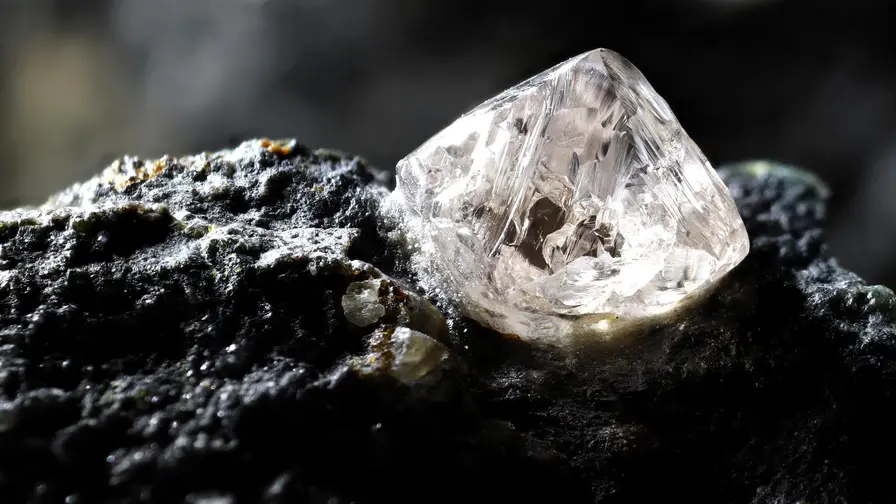
Diamond stability depends on pressure and temperature. At mantle depths diamonds are stable, but as conditions become shallower and hotter relative to graphite, they can transform. The speed of kimberlite ascent is crucial: a fast-rising, volatile-charged kimberlite can ferry diamonds to the surface before they convert into graphite. This explains the empirical observation that more than 70% of mined natural diamonds come from kimberlite-hosted deposits.
Diamond mine
Broader implications and future research
This modeling approach links atomistic-scale interactions to large-scale geological processes. By constraining volatile proportions in parental melts, scientists can better predict which ancient magmatic events were capable of delivering deep mantle material to the surface. That has implications beyond diamonds: it helps explain how volatile-rich magmas transport deep carbon, how cratons evolve, and why kimberlite eruptions are so spatially and temporally rare.
Future studies will likely pair advanced simulations with geochemical analyses of kimberlite xenoliths and isotopic work to refine volatile estimates across different cratons. Improved constraints could also aid mineral exploration by highlighting the pressure-temperature-volatile windows most likely to produce diamond-bearing eruptions.
Expert Insight
“Modeling gives us the missing link between what we observe at the surface and the invisible chemistry at depth,” says Dr. Evelyn Mercer, a petrologist not involved in the study. “Quantifying the CO2 and H2O budget shows why only a few melts become eruptive kimberlites—most melts stall and crystallize long before they reach the crust.”

These results underscore a larger truth about Earth dynamics: small changes in composition—mere percentages of volatiles—can control spectacular, planet-shaping events. For kimberlites, the right mix of CO2 and water turns an otherwise ordinary melt into an explosive elevator, briefly opening a conduit between the planet’s deep mantle and its surface.

Leave a Comment
Comments (2)
Is this even true? Models look neat but real rocks are messy, isotopes and local chemistry could flip this. hmm, need more field evidence
wow that 8.2% CO2 threshold is wild! So tiny a change decides if diamonds make it up... 44% entrained mantle? insane, geology hits hard