
4 Minutes
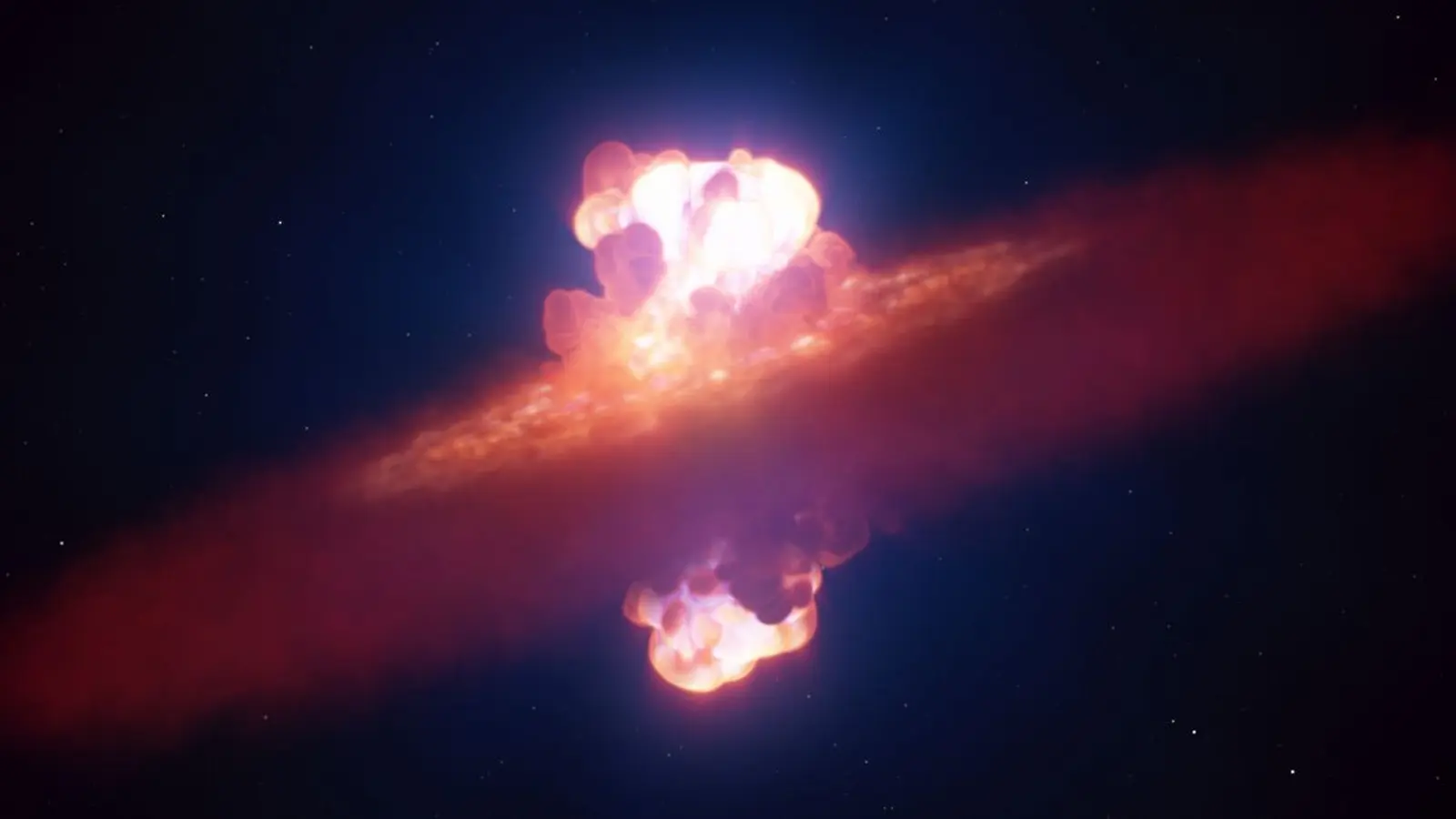
For the first time, astronomers have mapped the precise shape of a supernova's shock front as it punched through the surface of its parent star. The event — supernova SN 2024ggi, spotted in April 2024 — briefly revealed an ovoid, olive-like breakout before the shock hit surrounding gas. This rare snapshot fills a crucial gap in our understanding of how massive stars end their lives.
How the breakout was caught in action
SN 2024ggi erupted in a galaxy about 23.6 million light-years away and was observed exceptionally early, within hours of its initial flash. That narrow window matters: the shock-breakout phase—the instant the blast wave bursts through the stellar surface—lasts only hours. If astronomers had missed the first day, those geometric details would have been lost.
The team began spectropolarimetric observations just 26 hours after the discovery and continued tracking the object over several days using the European Southern Observatory’s Very Large Telescope (VLT). Spectropolarimetry measures how light is polarized across wavelengths, and it can reveal asymmetries on angular scales far too small to resolve directly with an ordinary telescope.
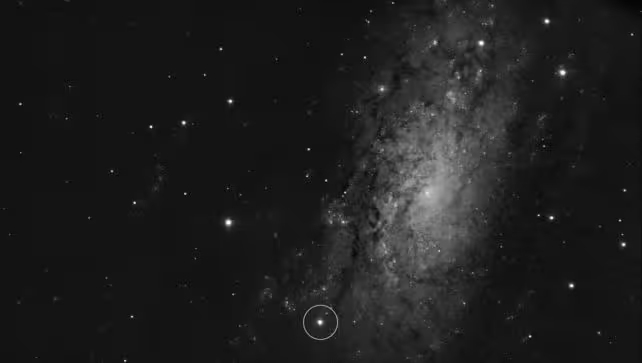
The circled dot is the supernova in the galaxy NGC 3621 as imaged on 11 April 2025
Spectropolarimetry: a geometry probe
“Spectropolarimetry delivers information about the geometry of the explosion that other types of observation cannot provide because the angular scales are too tiny,” explains Lifan Wang of Texas A&M University, a co-author on the study. By decomposing the polarized light across spectral lines, the technique exposes whether the expanding material is spherical or has a preferred axis.
What the observations revealed — and why it matters
During the breakout, the shock front was not a perfect sphere. Instead, the VLT data showed an elongated, olive- or football-shaped geometry aligned along a definite axis. That same preferred axis was evident again in the later expansion of hydrogen-rich ejecta, implying that the asymmetry was not a fleeting irregularity but a large-scale feature of the explosion.

“The geometry of a supernova explosion provides fundamental information on stellar evolution and the physical processes leading to these cosmic fireworks,” says Yi Yang of Tsinghua University, the paper’s lead author. The observations suggest that whatever set the explosion’s axis acted early and persisted as the remnant expanded.
However, as the shock ploughed into the circumstellar material—the slower gas the star had shed in the centuries before collapse—the apparent axis shifted. That mismatch implies the surrounding material had a different orientation from the explosion itself, and it raises intriguing possibilities about the star’s recent history.
A binary past or complex mass loss?
One plausible explanation is that the progenitor had a binary companion. Interactions in a binary system can torque and shape stellar winds and mass loss, producing an anisotropic circumstellar environment. If the companion influenced how the outer layers were shed, the shock would eventually meet gas with a different orientation, producing the observed change in axis.
Alternatively, uneven mass loss from rotationally driven winds or magnetically channeled outflows could create similar structures. Distinguishing these scenarios requires a larger sample of early-time spectropolarimetric observations, which this study demonstrates is both possible and scientifically valuable.
Implications for supernova science and observation strategies
Capturing shock breakout geometry offers multiple payoffs. It constrains explosion mechanisms in core-collapse events, informs models of late-stage stellar evolution, and helps interpret electromagnetic and neutrino signals from nearby explosions. Practically, it also highlights the importance of rapid-alert networks and flexible telescope scheduling so instruments like the VLT can be pointed quickly at freshly discovered transients.
As Dietrich Baade of the European Southern Observatory noted: “For a few hours, the geometry of the star and its explosion could be, and were, observed together.” That fleeting overlap is where some of the most diagnostic physics is revealed.
Expert Insight
Dr. Maya Suresh, an astrophysicist who works on transient surveys, highlights the broader value of these measurements: “Early polarimetric snapshots are like CT scans for exploding stars. They let us see the orientation and internal motion of the blast in ways that light curves alone cannot. With more facilities capable of rapid spectropolarimetry, we can start to map diversity across many supernovae and test whether asymmetry is a rule or an exception.”

The new SN 2024ggi results were published in Science Advances. They underscore that early detection, the right instrumentation, and coordinated follow-up are essential to decode the final moments of massive stars. Every early supernova observed with spectropolarimetry will add to a growing picture of how explosions are shaped—by rotation, magnetic fields, companions, or a combination of factors.








Leave a Comment
Comments (2)
Sounds exciting but how certain is the axis alignment? Spectropolarimetry is subtle, could other effects mimic that shape? curious, not convinced yet
holy wow, an olive-shaped shock? mind blown. they really caught it within hours, thats insane. if the axis shift means a binary companion, whoa... so cool and weird, need more data