
3 Minutes
Hubble Captures a Galaxy Scarred by Cosmic Collisions
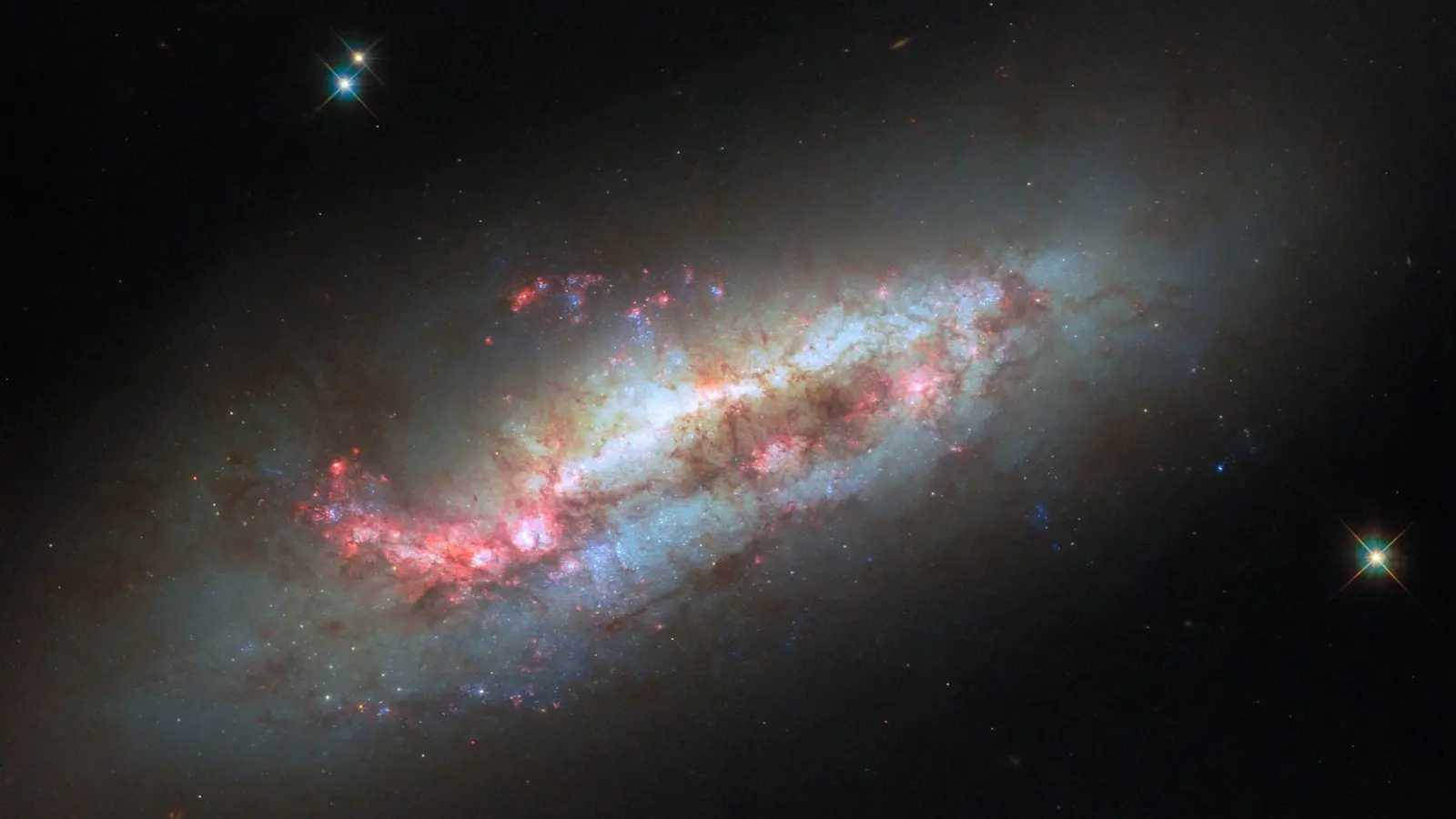
Hubble's latest image of NGC 1511 reveals a spiral galaxy still reshaping itself after violent encounters with smaller companions. Located roughly 50 million light-years away in the southern constellation Hydrus, NGC 1511 shows warped spiral arms, distorted gas lanes and a faint hydrogen bridge that ties it to a nearby neighbor — clear evidence of past gravitational crashes that have triggered a fresh wave of star formation across its dusty disk.
Remnants of a Galactic Crash
NGC 1511 shares space with two smaller companions, catalogued as NGC 1511A and NGC 1511B. Studies indicate that NGC 1511B likely collided with the larger galaxy long ago: a thin filament of hydrogen still stretches between them, and NGC 1511B bears telltale signs of being stretched and pulled apart. Astronomers also suspect a third, even smaller galaxy was shredded entirely in earlier interactions, leaving behind arcs and plumes in the main disk.
These features make NGC 1511 an ideal laboratory for studying how gas moves from diffuse interstellar clouds into dense star-forming regions — a process that informs our understanding of galaxy evolution.
Starbursts and Turbulent Engines
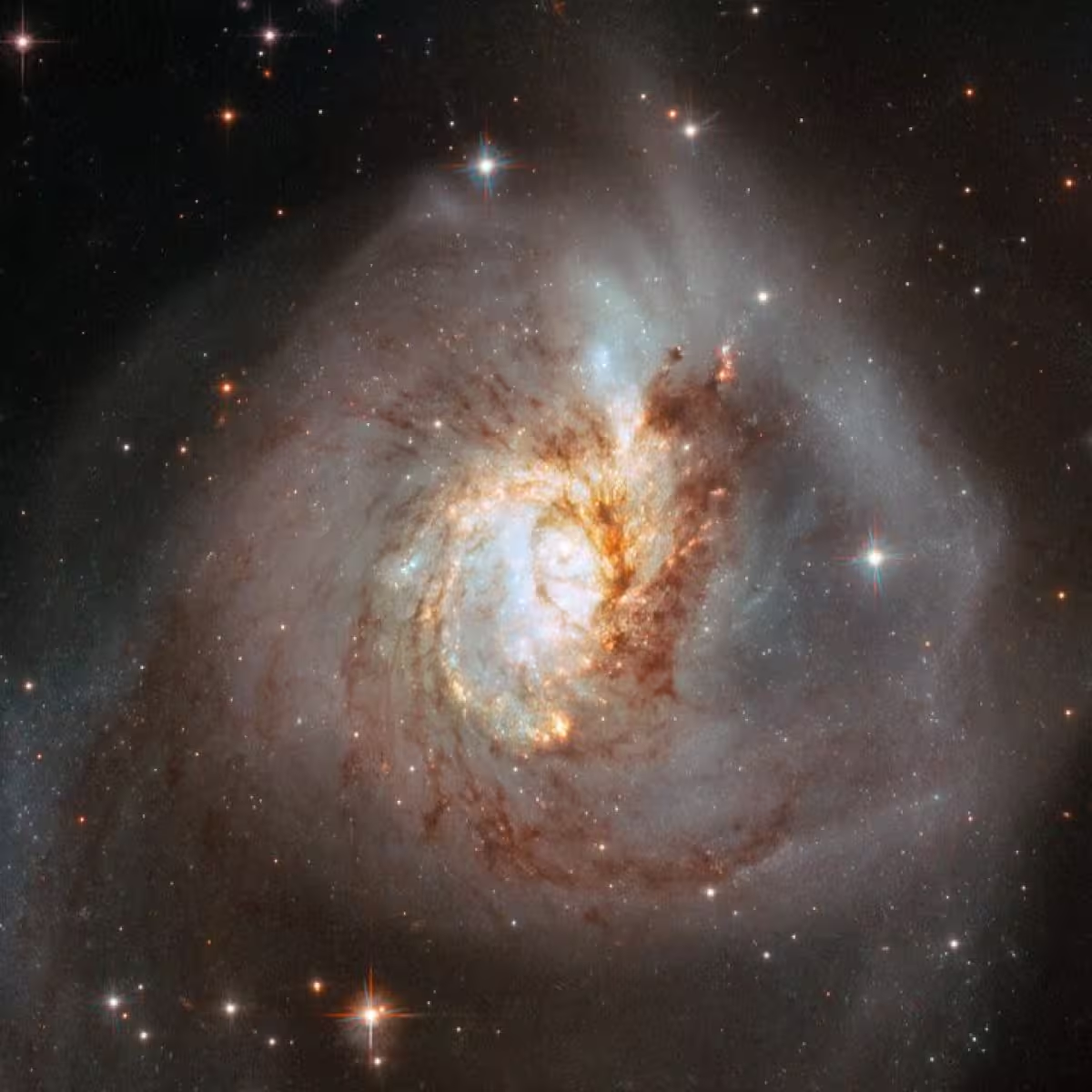
The gravitational turbulence has lit up pockets of intense star formation. The resulting star clusters pierce the dusty lanes, much like headlights suddenly blazing after an engine roar. For observers who follow automotive design and performance, the metaphor is apt: collisions reveal structural weaknesses and drive rapid change, whether in metal and composite or in gas and stars.
"This galaxy tells us a story of damage, repair and rebirth," says one researcher. "The starburst regions are the equivalent of an engine revving back to life after a hard crash."
- Key highlights:
- Clear hydrogen bridge linking NGC 1511 and NGC 1511B
- Warped arms, loops and plumes from past interactions
- Active star formation offering insight into gas recycling
Why Car Fans Should Care
Automotive enthusiasts often study vehicle crash tests, materials engineering, and design resilience to improve safety and performance. In a similar way, astronomers analyze galactic collisions to learn how structures respond under extreme stress. Lessons about damage assessment, reconstruction and long-term stability resonate across engineering disciplines — from chassis design and aerodynamics to market positioning of safer, more durable vehicles.
Context and Takeaways
While NGC 1511 is not a model of peaceful stability, its chaotic state gives scientists a rare peek at how galaxies recover and evolve. For readers interested in both space and automotive fields, the image is a reminder that systems — be they galaxies or vehicles — reveal their true design under strain.
Whether you follow horsepower and torque or star formation rates, NGC 1511 is a striking example of how collisions reshape form, function and future potential.






Leave a Comment
Comments
No comments yet. Be the first.