
5 Minutes
Scientists report evidence for a previously unrecognized human ability — a kind of "remote touch" that helps people detect objects hidden beneath sand or soil without direct contact. The finding, presented at IEEE ICDL 2025 and published on IEEE Xplore, reshapes how we think about tactile perception and suggests new directions for robotics, archaeology, and planetary exploration.
Discovery: a surprising seventh sense for hidden objects
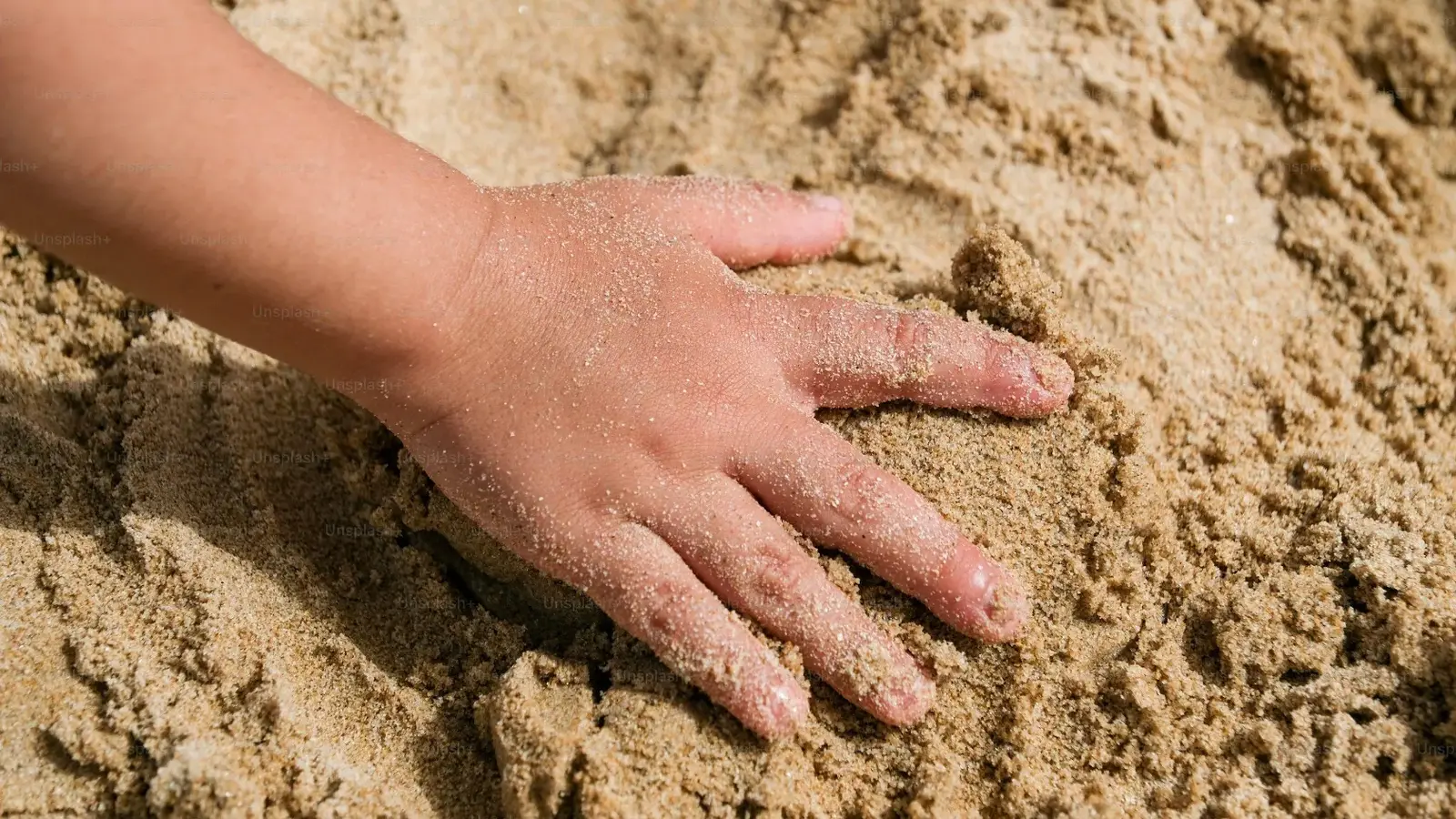
We usually speak of five senses, sometimes six when intuition or "sixth sense" gets invoked. Now researchers at Queen Mary University of London propose a distinct seventh faculty: remote touch. "This discovery changes our understanding of sensory perception and the reach of tactile sensing in living organisms," says Elisabetta Versace, professor of psychology and director of the Ready Minds Lab at Queen Mary. The team’s experiments indicate people can detect and identify objects buried beneath a thin layer of granular material — like sand — by using only the tips of their fingers, even when they never physically contact the hidden item.
How the experiment worked: feeling through sand
Protocol and performance
In the first set of trials, volunteers were instructed to use just their fingertip to determine whether an object lay beneath a shallow layer of sand. Remarkably, participants correctly identified hidden items about 71% of the time, despite the intervening grains. Detection distances averaged around 6.9 centimeters, with a median success distance near 2.7 centimeters. These results, reported at the international learning and development conference IEEE ICDL 2025, suggest that tiny mechanical cues transmitted through granular media can be perceived and interpreted by the human nervous system.
Physical mechanisms: how can this be possible?
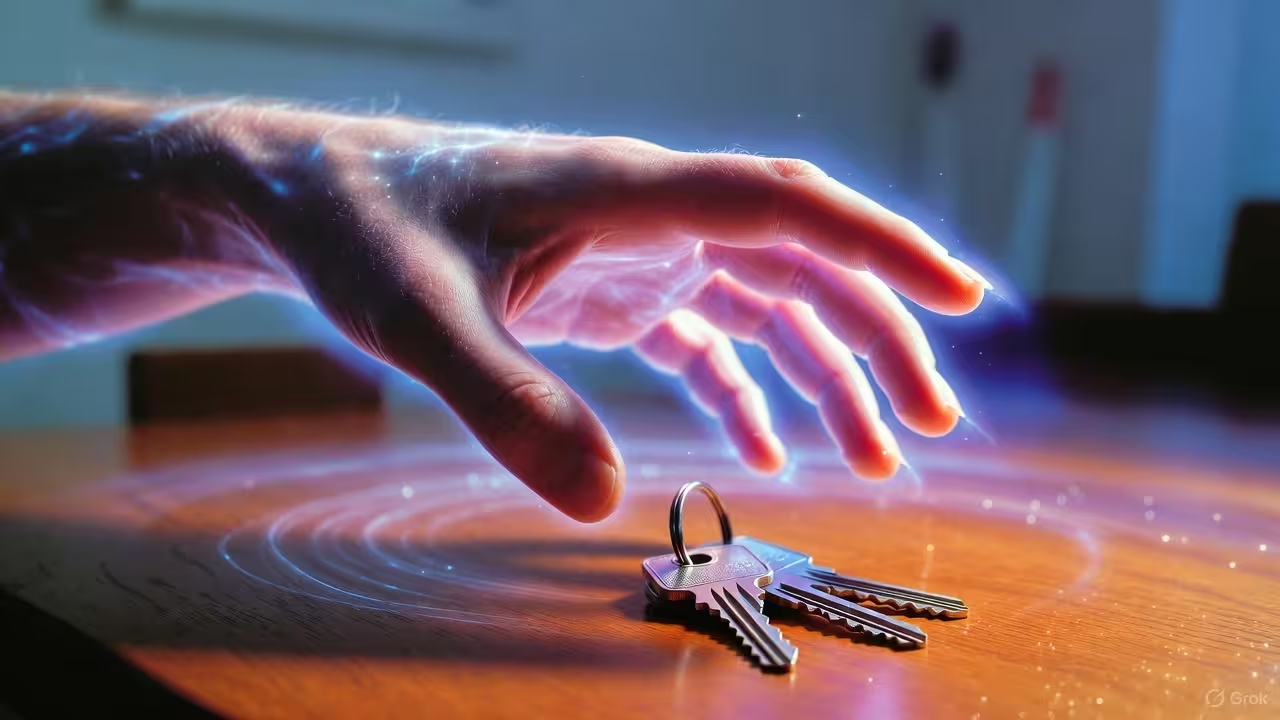
At first glance, the signals produced by a buried object appear vanishingly small. Physically, the object perturbs adjacent grains, generating minute displacements and pressure gradients. Standard models predict such perturbations drop off within a few millimeters of the contact point. But the research team combined careful measurement and theoretical modeling and found that subtle displacements can propagate farther through granular networks — sometimes up to several centimeters under the right conditions. In practice, this means a fingertip interacting with sand detects faint patterns of grain movement and vibration that betray a hidden object’s presence.
Robotic replication: teaching machines to 'feel' at a distance
To explore practical uses, the team replicated the human experiment with tactile sensors on a robotic arm. They trained a long short-term memory (LSTM) neural network on sensor readings to classify whether an object was buried beneath sand. Robots achieved lower accuracy — roughly 40% correct — but could detect objects at slightly greater distances, up to 7.1 centimeters in some trials.

Human data informing AI models
"The most interesting part was the feedback loop between human and robot experiments," explains Lorenzo Jamone, professor of robotics and artificial intelligence at University College London. Human behavioral data improved the robot’s training set, and robotic performance suggested new hypotheses about the sensory cues humans exploit. This cross-disciplinary approach — combining psychology, tactile sensing, and machine learning — reveals how biological perception can inspire novel sensor systems for machines.
From archaeology to Mars: potential applications
Discovering that tactile cues propagate farther through granular materials than previously thought opens wide practical avenues. Zhangchi Chen, a doctoral researcher in the Advanced Robotics Lab at Queen Mary, notes that "remote touch could enable non-invasive archaeological surveys, where fragile artifacts are detected without excavation, or allow landers and rovers to sense buried structures on sandy planetary surfaces like Mars." Robots equipped with sensitive tactile arrays and AI could operate where human touch or optical imaging is limited — under murky water, beneath dust layers, or in hazardous environments.
- Archaeology: detect buried artifacts with minimal disturbance.
- Robotics: improve haptic sensing for manipulation and search tasks.
- Planetary science: let rovers probe subsurface anomalies on Mars or icy moons.
- Search & rescue: locate objects or survivors under rubble where vision fails.
Expert Insight
Dr. Maya Rosenthal, a tactile-sensing researcher at a NASA-affiliated lab, comments: "This work reframes touch as an active, environmental process. It's not just about skin contacting surface textures — it's about interpreting the mechanical language of materials. For planetary robotics, that could mean new low-power sensors that 'listen' to soils and sands to find buried caches or geological interfaces." Her view underlines practical paths forward: miniaturized tactile arrays paired with temporal neural networks could translate faint mechanical signatures into actionable information.
What this means for sensory neuroscience and technology
The idea of a seventh sense — remote touch — is provocative but grounded in measurable behavior and physics. For neuroscience, it points to the human nervous system’s remarkable sensitivity to spatiotemporal patterns of mechanical input. For technology, the research charts a roadmap for sensors and algorithms that extend the reach of touch beyond direct contact. As the authors note in their IEEE Xplore paper, future work will refine models of granular transmission, optimize tactile sensor designs, and explore real-world tasks from fragile artifact recovery to extraterrestrial surface exploration.
Whether called a new sense or an extension of haptic perception, the phenomenon pushes the boundary of how organisms and machines can gather information from their physical environment. Imagine a rover gently brushing remote sand and, without digging, detecting the shape of a buried rock or a layered soil interface — a small step toward smarter, subtler exploration.
.avif "Caffeine Activates Cellular Pathways Linked to Slowing Aging, New Research Reveals")

Leave a Comment
Comments (2)
Is this even real? 71% detection sounds high for fingertip through sand, maybe experiment bias or volunteers were cued? if that's true tho, robots could get a big upgrade
whoa remote touch? wild, feels like sci-fi but 71% is kinda convincing. Curious how much practice helps, and if it's just vibrations or something deeper... neat, gotta read the paper