

4 Minutes
Everyday cooking methods — grilling, smoking, roasting — can introduce invisible hazards into food. A recent study from Seoul National University of Science and Technology demonstrates a faster, greener technique to detect polycyclic aromatic hydrocarbons (PAHs), a group of carcinogenic chemicals that can accumulate in oils, meats, and even fruits and vegetables.
How PAHs make their way onto your plate
Polycyclic aromatic hydrocarbons (PAHs) are hydrophobic organic compounds made of multiple fused aromatic rings. They form when organic material — fats, oils, plant tissues — burns or undergoes incomplete combustion. That means common cooking techniques like grilling, smoking, frying, and roasting are prime sources. Charred meat and heavily browned edges typically concentrate higher PAH levels.
PAHs are not limited to cooked animal products. Plant-based foods may carry PAHs through atmospheric deposition from industrial emissions and vehicle exhaust, irrigation with contaminated water, or uptake from polluted soils. Smoked fish, roasted coffee, certain cheeses, and some baked goods can also contain measurable PAH levels. Because several PAHs are classified as carcinogenic, their widespread occurrence across many food categories is a public health concern that calls for reliable monitoring throughout the food supply chain.
A faster path to detecting PAHs: QuEChERS–GC–MS
Traditional extraction techniques — solid-phase extraction, liquid-liquid extraction, or accelerated solvent extraction — work but can be time-consuming, labor-intensive, and chemically wasteful. Enter QuEChERS: Quick, Easy, Cheap, Effective, Rugged, and Safe. Originally developed for pesticide residue analysis, QuEChERS shortens preparation time, reduces solvent use, and simplifies sample cleanup. When combined with gas chromatography–mass spectrometry (GC–MS), it becomes a powerful workflow for PAH analysis.
Researchers led by Professor Joon-Goo Lee in the Department of Food Science and Biotechnology at SeoulTech applied a QuEChERS–GC–MS protocol to measure eight priority PAHs: Benzo[a]anthracene, Chrysene, Benzo[b]fluoranthene, Benzo[k]fluoranthene, Benzo[a]pyrene, Indeno[1,2,3-cd]pyrene, Dibenz[a,h]anthracene, and Benzo[g,h,i]perylene. Their method used acetonitrile for extraction and tested several sorbent combinations for cleanup, optimizing recovery across diverse food matrices.
The analytical performance was strong. Calibration curves for each PAH showed excellent linearity (R2 > 0.99). Limits of detection ranged from 0.006 to 0.035 µg/kg and limits of quantification from 0.019 to 0.133 µg/kg. Recovery experiments returned values between 86.3% and 109.6% at 5 µg/kg and similarly robust recoveries at higher spikes, with precision values under 7% across matrices. These numbers indicate a method that is sensitive, reproducible, and fit for regulatory or industrial screening.
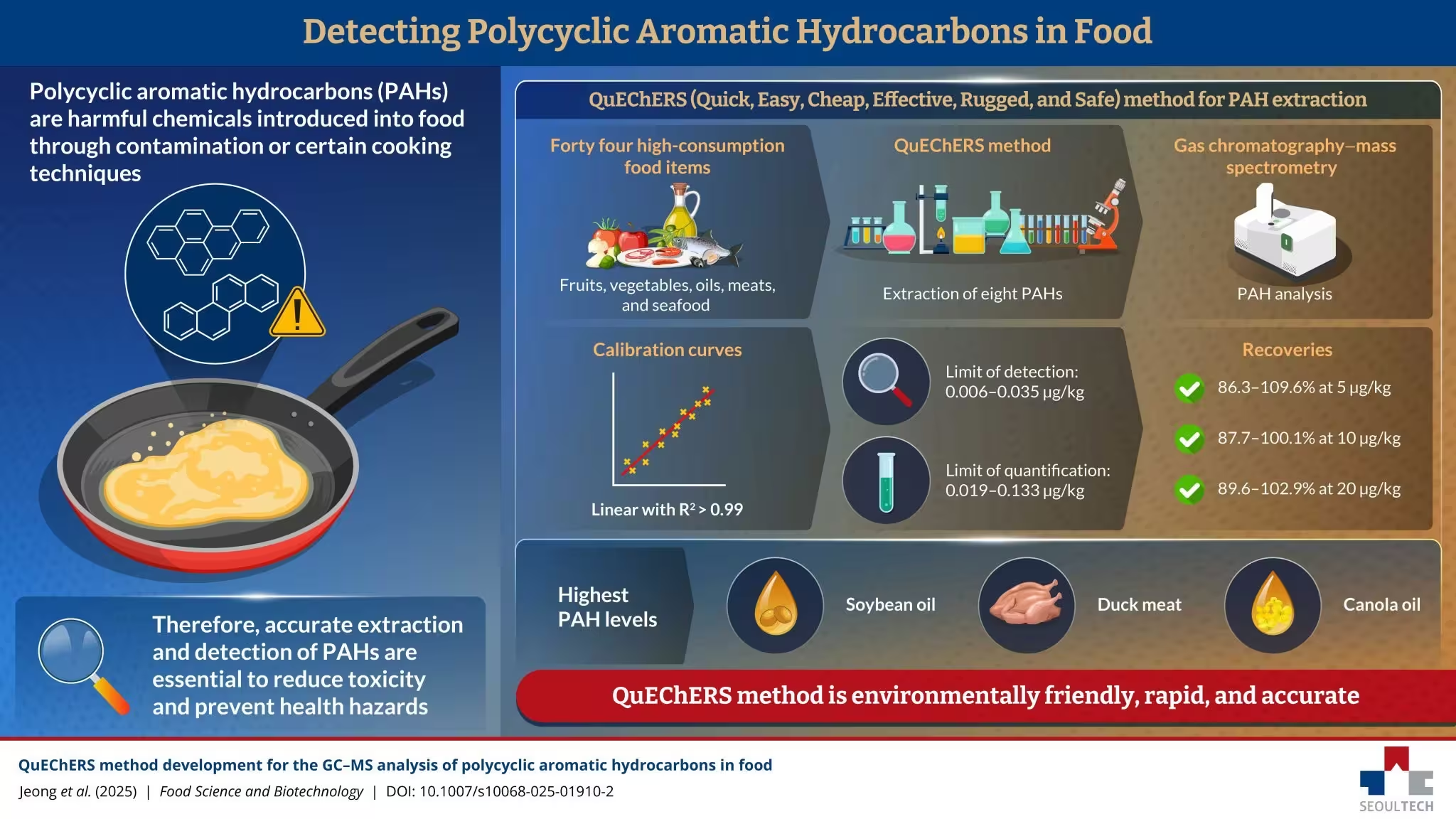

Image: Researchers uncover high carcinogenic compounds in common foods using an advanced QuEChERS (Quick, Easy, Cheap, Effective, Rugged, and Safe) detection method. Credit: Prof. Joon-Goo Lee from SeoulTech, Korea
Industry implications: safety, cost, and sustainability
Professor Lee emphasizes the practical advantages: “This method not only simplifies the analytical process but also demonstrates high efficiency in detection compared to conventional methods. It can be applied to a wide range of food matrices.” For food manufacturers and safety labs, QuEChERS–GC–MS could reduce turnaround times and lower solvent consumption, which translates into cost savings and fewer hazardous chemicals in the lab environment.
From a regulatory perspective, sensitive and fast testing supports better monitoring programs. Faster detection can help identify problematic production steps — for example, excessive smoking or high-temperature processing — and allow manufacturers to adjust practices to limit PAH formation. For consumers, improved testing means more accurate labeling and safer products on supermarket shelves.
What this means for public health and future research
Reducing dietary exposure to carcinogenic PAHs is a multi-pronged effort. Better testing is one pillar: it informs regulation and industry best practices. The QuEChERS approach also aligns with sustainability goals by cutting solvent use and simplifying workflows. Future research could expand the method to more food categories, integrate high-throughput automation, or combine PAH screening with other contaminant analyses in a single run.
There are also practical steps consumers can take: avoid excessive charring, use lower cooking temperatures, trim burned portions, and favor cooking methods that limit smoke and direct flame contact. While individual choices matter, scalable lab methods are crucial so regulators and producers can ensure food safety at population scale.
Expert Insight
Dr. Maria Alvarez, a food-safety chemist and science communicator, notes: “QuEChERS–GC–MS represents a meaningful shift in routine contaminant testing. Its balance of sensitivity and efficiency makes it well-suited for both research labs and quality-control environments. The next priority is integrating these protocols into standard regulatory guidance so industry-wide monitoring becomes faster and more consistent.”

Overall, the SeoulTech study underscores a simple truth: modern analytical techniques can make food safety testing faster, cleaner, and more reliable. As consumers demand transparency and regulators tighten controls, methods like QuEChERS–GC–MS will play an important role in keeping everyday foods safer.

Leave a Comment
Comments (2)
Is QuEChERS-GC-MS really ready for routine checks? Promising but who validates it across foods, labs, costs?
Wow, didn't expect my weekend grill to be a cancer cocktail… kinda freaks me out. Need better tests, pronto!