
5 Minutes
A Japanese research team has used artificial intelligence to create the most detailed Milky Way simulation to date — one that follows over 100 billion individual stars and runs more than 100 times faster than previous efforts. By teaching AI how supernovae evolve and combining that knowledge with large-scale physics, the team produced a galaxy-scale model that shrinks decades-long runs down to months.
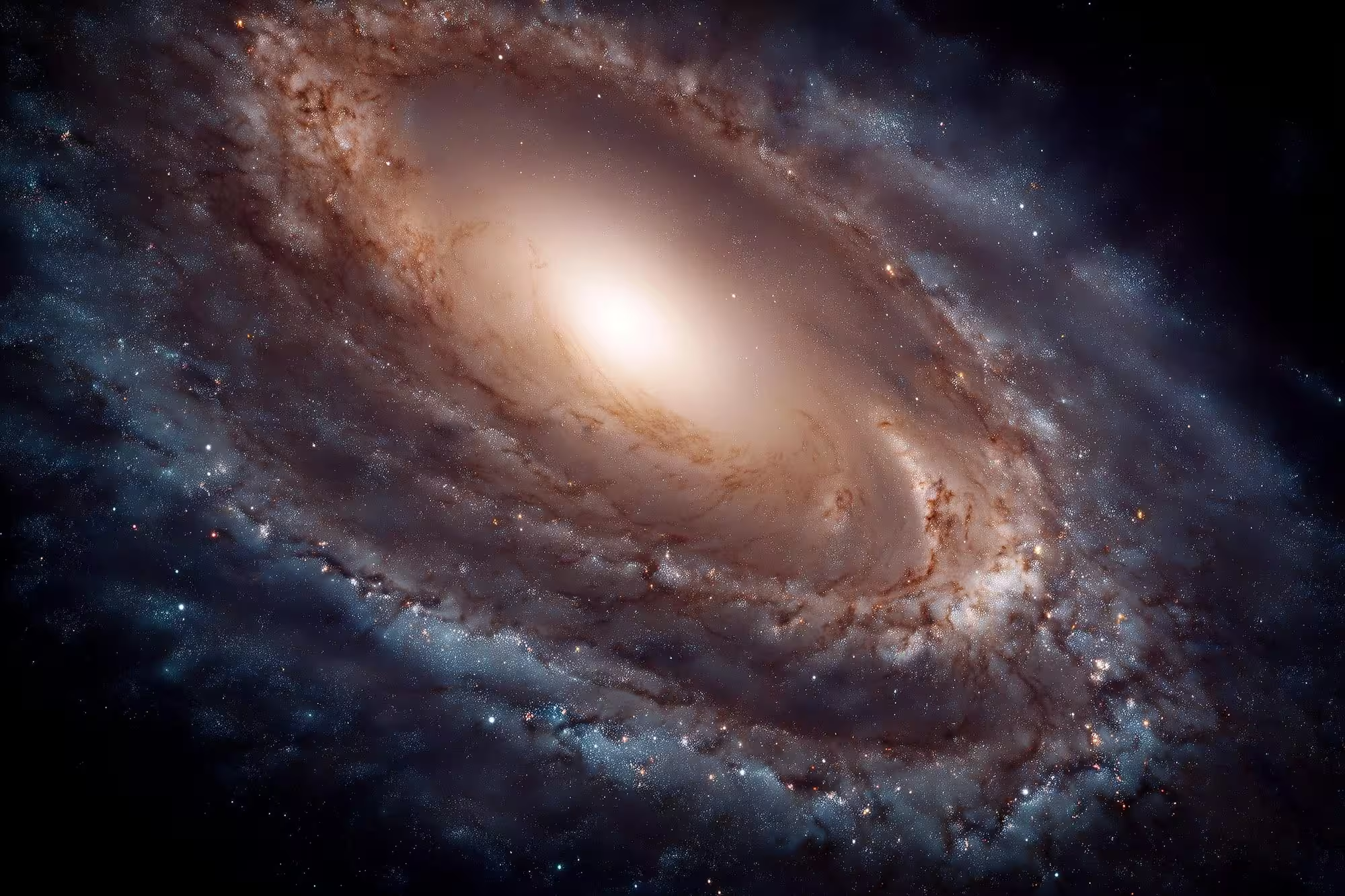
AI has made the first true star-by-star simulation of the Milky Way fast enough to complete in months instead of decades.
How the team overcame the simulation barrier
Modeling a galaxy like the Milky Way at single-star resolution is notoriously difficult. Typical galaxy simulations must balance competing demands: gravity acting over tens of thousands of light-years, gas dynamics and turbulence at tiny scales, and violent, short-lived events such as supernova explosions. Traditionally, researchers simplified the problem by grouping many stars into single computational particles. That shortcut loses the small-scale physics needed to study how stars, gas, and newly forged elements interact across cosmic time.
Researchers led by Keiya Hirashima at the RIKEN Center for Interdisciplinary Theoretical and Mathematical Sciences (iTHEMS), with collaborators at The University of Tokyo and Universitat de Barcelona, changed that approach. Instead of relying solely on brute-force numerical integration, they blended high-fidelity physics with a deep-learning surrogate model trained on high-resolution simulations of supernovae. The surrogate learned how gas expands and evolves for the roughly 100,000 years following an explosion, then replaced the most costly parts of the calculation inside the larger galactic run.
Speed without losing fidelity
The payoff is dramatic. Where a conventional physics-only simulation would require roughly 315 hours to compute one million years of Milky Way evolution at single-star resolution, the AI-accelerated approach reduced that interval to just 2.78 hours. Extrapolated, a billion-year simulation that once promised more than 36 years of runtime can now finish in about 115 days. That leap — more than two orders of magnitude faster — opens new possibilities for exploring galaxy assembly, stellar dynamics, and chemical enrichment at unprecedented scale.
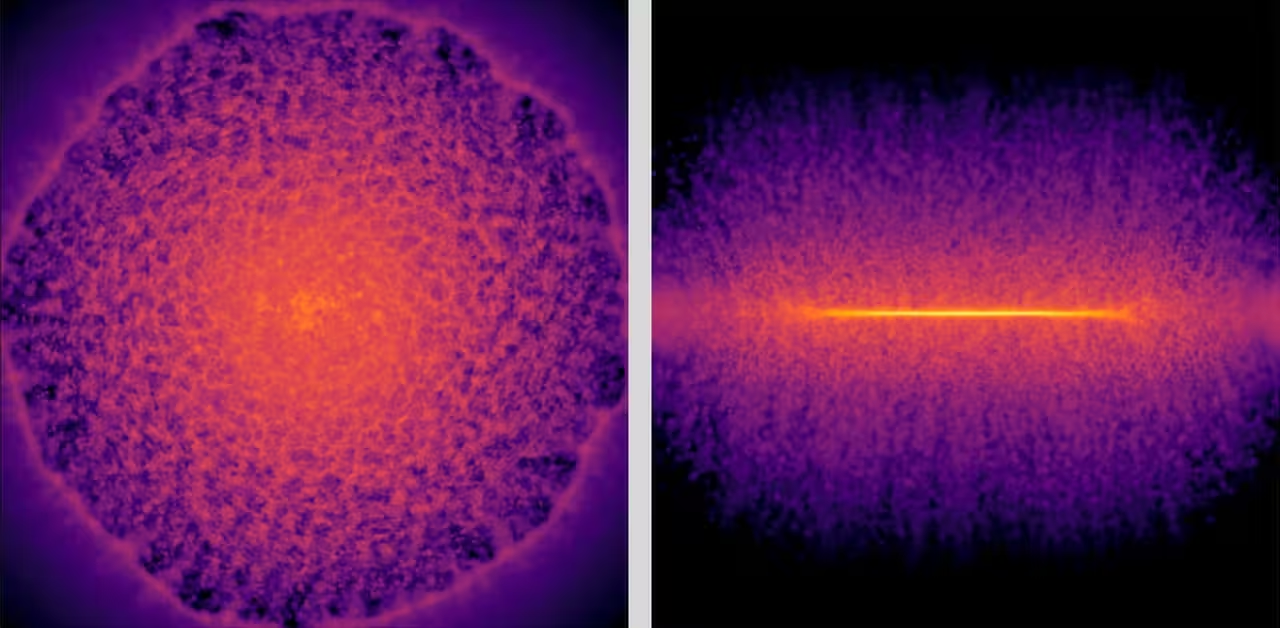
Head-on (left) and side-view (right) snapshots of a galactic disk of gas. These snapshots of gas distribution after a supernova explosion were generated by the deep learning surrogate model.
Why tracking individual stars matters
Following individual stars — rather than star clusters represented by single particles — preserves the small-scale processes that drive galaxy evolution. Supernovae inject energy and heavy elements into surrounding gas, triggering or quenching star formation and reshaping local dynamics. These processes unfold over short timescales and small volumes; only a model with fine-grained resolution can capture how they collectively sculpt galactic structure over millions to billions of years.
With single-star resolution, astrophysicists can compare simulated stellar orbits, age distributions, and chemical fingerprints directly against survey data from missions like Gaia and upcoming spectroscopic campaigns. That makes the new simulation not just a computational feat but a practical research tool for testing theories about the Milky Way’s formation and the origin of elements essential for life.
Technical validation and broader impact
The team validated their hybrid method against large-scale tests on RIKEN’s Fugaku supercomputer and The University of Tokyo’s Miyabi Supercomputer System, confirming that the surrogate model preserves key physical behaviors while dramatically lowering computational cost. Beyond galaxy modeling, this hybrid paradigm—where AI serves as a trusted surrogate for the most expensive microphysics—could transform multi-scale simulations in climate modeling, oceanography, and weather forecasting.
Hirashima noted the broader significance: "I believe that integrating AI with high-performance computing marks a fundamental shift in how we tackle multi-scale, multi-physics problems across the computational sciences," he said. "This achievement also shows that AI-accelerated simulations can move beyond pattern recognition to become a genuine tool for scientific discovery—helping us trace how the elements that formed life itself emerged within our galaxy."
Key scientific implications
- Galaxy evolution: Fast, high-resolution simulations allow more extensive parameter studies to test competing formation scenarios for the Milky Way.
- Stellar archaeology: Tracking individual stars improves comparisons with observational catalogs, aiding efforts to reconstruct the Galaxy’s merger history.
- Chemical enrichment: Detailed supernova feedback models let researchers trace the production and distribution of heavy elements across time.
- Cross-disciplinary potential: The AI-surrogate strategy can accelerate other computationally stiff problems in Earth and computational sciences.
What this doesn't do — yet
Despite the breakthrough, challenges remain. The current demonstration covers 10,000 years at single-star granularity within a galactic-scale framework and projects speed gains to million- and billion-year timescales. But incorporating additional physics — cosmic rays, magnetic fields at fine scales, or radiation transport in full detail — will require further development of both surrogate training data and coupling strategies. Energy efficiency and scaling on diverse supercomputing architectures are also active concerns for real-world, repeated production runs.
Expert Insight
Dr. Laura Méndez, an astrophysicist and computational scientist (fictional), commented: "This work is a milestone because it reframes the computational trade-off. Instead of asking how much hardware we can throw at a problem, we ask how smartly we can replace the most expensive physics with learned, reliable approximations. That has ripple effects: more experiments, more parameter sweeps, and ultimately faster scientific discovery."
Future prospects
Looking ahead, the hybrid AI-plus-HPC approach could be extended to simulate other galaxies, probe star formation histories across environments, and support observational missions by producing realistic mock surveys. As training datasets grow and surrogate models improve, the balance between accuracy and speed should continue to favor researchers, enabling deeper, more frequent explorations of the cosmic story written in the stars.

Leave a Comment
Comments (2)
Is this even true? 115 days for a billion-year sim sounds wild. But where are cosmic rays, magnetic fields, proper radiation? Seems like shortcuts to me...
Whoa, AI sim of every star in the Milky Way?? Mind blown. If it really runs in months not decades, this could rewrite galactic archaeology. wow