
2 Minutes
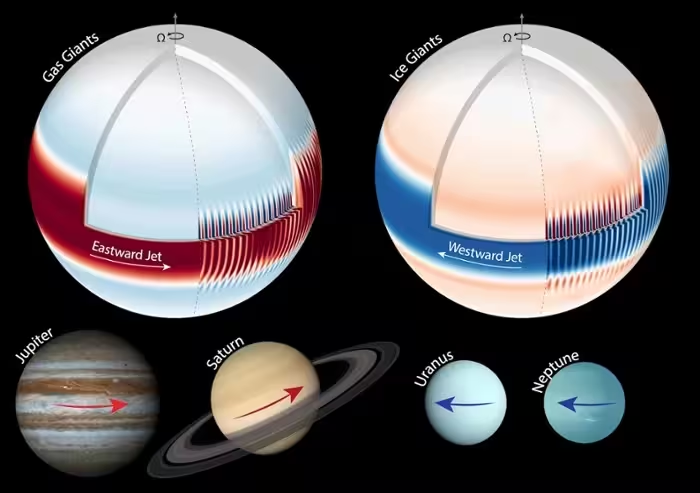
Giant exoplanets that hug their stars are stirring up winds far stronger than anything in our solar system. Observations and models now suggest jet streams on some Hot and Ultra-Hot Jupiters can reach speeds of at least 3,600 km/h (2,237 mph) — far exceeding the 500–2,000 km/h flows of Jupiter, Saturn, Uranus and Neptune.
How exoplanet winds dwarf Solar System giants
Imagine a gas giant so close to its star that one side bakes under permanent daylight while the other sits in perpetual night. Those extreme temperature contrasts, combined with very short orbital periods measured in hours or days, drive enormous atmospheric currents. While Jupiter completes an orbit in nearly 12 years, many Hot Jupiters orbit in less than a week — some in under a day — making them tidally locked and prone to intense, superheated weather.
What fuels supersonic jet streams?
Two factors dominate. First, the intense stellar heating of the dayside creates large pressure gradients; air races from the hot hemisphere toward the night side. Second, fast rotation and strong vertical mixing shape zonal jets that can exceed 3,600 km/h. On some worlds these flows form a dominant eastward jet; on others, models and sparse observations suggest more complex patterns, with multiple jets or shifting directions between day and night.
Strange chemistry, strange weather
Atmospheres of the hottest exoplanets can contain heavy metals like iron in vapor form. Spectra and circulation models show hotspots that do not always align with the substellar point, day–night jet contrasts, and even condensate clouds that cycle between liquid or solid states across the planet. In short, weather on Hot Jupiters can be violent, metallic and unlike anything seen in our neighborhood.
Why this matters for exoplanet science
Studying these extreme winds helps scientists test fundamental ideas about atmospheric dynamics under exotic conditions. Every new measurement — from phase curves to high-resolution spectra — refines models and reveals how simple physical processes can produce dramatic planetary phenomena. As telescopes and techniques improve, researchers expect to map wind fields more precisely and learn how common iron-rich or dayside-dominated atmospheres really are.
Expect surprises: the next decade of observations will likely overturn assumptions and reveal more of the strange, stormy lives of close-in gas giants.


Leave a Comment
Comments
No comments yet. Be the first.